Clear Sky Science · en
Ultralight microwave absorber with an enhanced absorption performance based on chitosan aerogel
Why blocking stray microwaves matters
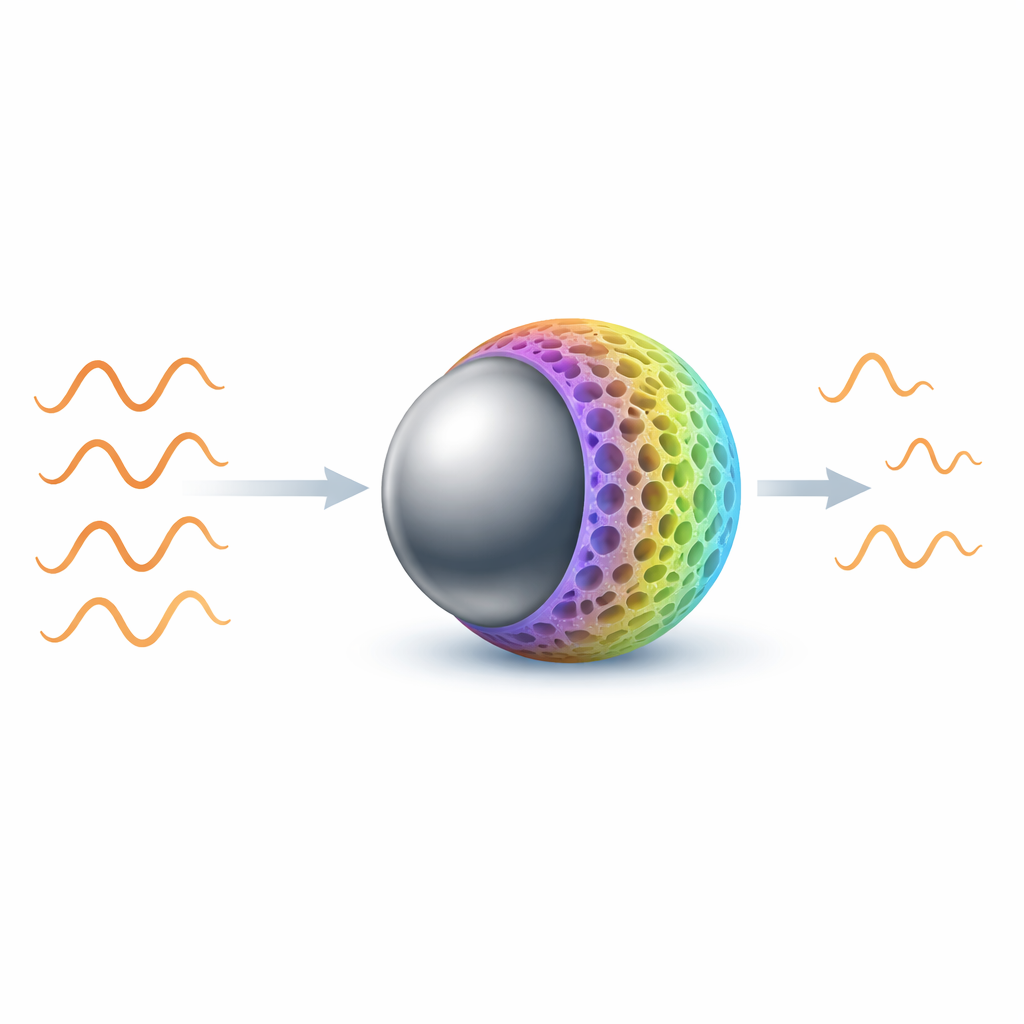
From smartphones and Wi‑Fi routers to airport radar and satellite links, our world hums with invisible microwave signals. While these waves enable modern communication, they can also create interference, reveal the presence of aircraft or equipment to radar, and in extreme cases pose risks to sensitive electronics and human health. Engineers therefore seek special coatings that can soak up unwanted microwaves instead of reflecting them. This study reports a new ultralight, sponge‑like material made from a blend of natural and inorganic ingredients that can strongly absorb microwaves over key communication and radar bands.
A featherweight sponge for invisible waves
The researchers set out to build a material that is both extremely light and highly effective at swallowing microwaves. Their starting point was chitosan, a biopolymer obtained from shellfish waste that can form a solid yet airy sponge called an aerogel. On its own, chitosan is too weak an absorber, but its porous structure is ideal for forcing microwaves to travel along tortuous paths, increasing the chances that their energy will be dissipated. To boost performance, the team filled this natural scaffold with a carefully tuned mixture of three components: a semiconducting compound (molybdenum diselenide, MoSe₂), a highly conductive carbon sheet material (reduced graphene oxide), and a layered mineral clay (montmorillonite). The result is a hybrid “polymer/carbon/mineral” aerogel with a density millions of times lower than water.
How the hybrid structure is built
To make the material, the scientists first synthesized MoSe₂ nanoparticles, then combined them with graphene sheets and clay layers in water so the tiny flakes spread out instead of clumping together. Separately, they dissolved chitosan in a mild acid to form a gel, then mixed in different amounts of the MoSe₂/graphene/clay blend. A small amount of a crosslinking agent helped lock everything together. Finally, they froze the mixture and removed the ice by vacuum, leaving behind a rigid, highly porous aerogel. Imaging under an electron microscope revealed a network of interconnected pores, with the inorganic sheets evenly dispersed through the chitosan skeleton—especially when the filler made up about half of the solid content.
Trapping and draining microwave energy
The key test is how well these aerogels absorb microwaves over the X and Ku bands (roughly 8–18 GHz), which are widely used in radar and high‑frequency communications. The team measured how much of an incoming signal was reflected when the material was backed by a metal surface—a strict condition that mimics a coating on real hardware. Pure chitosan showed only modest absorption. But when the MoSe₂/graphene/clay mixture was added, the performance improved dramatically. The best formulation, with about 50% filler by weight, reduced the reflected signal by up to 72 decibels at a thickness of just 2.7 mm—meaning the wave’s power dropped by more than ten million times. It also provided strong absorption over a 3.8 GHz span, while a slightly more heavily loaded version traded peak strength for extremely broad coverage of the entire X and Ku bands at only 2.3 mm thickness.
Why this sponge works so well
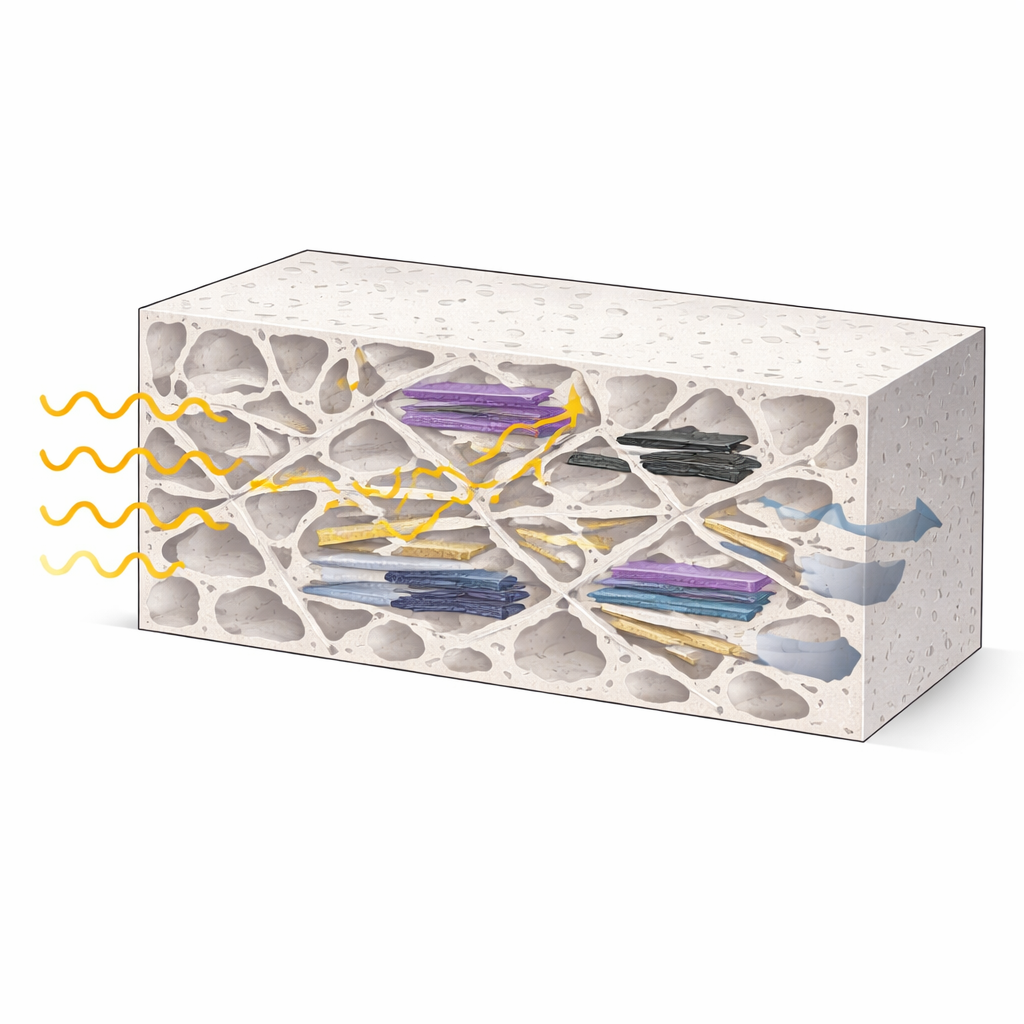
The aerogel’s success comes from several energy‑draining effects working together. First, its labyrinth of pores forces microwaves to bounce around inside, creating multiple reflections that extend the path length and increase the chances of loss. Second, the contrast between the polymer, the conductive graphene, the semiconducting MoSe₂, and the dielectric clay creates countless tiny interfaces where charges can shift back and forth when a wave passes, turning electromagnetic energy into heat. Third, the graphene and MoSe₂ provide pathways for moving charges, enhancing electrical losses without making the material so conductive that waves simply reflect from the surface. The clay’s layered structure helps keep the other sheets separated and well dispersed, maximizing the active surface area. Calculations and simulations confirm that these combined mechanisms give the aerogels excellent “impedance matching,” allowing microwaves to enter easily and then be attenuated deep inside.
Hiding metal objects from radar
To explore how this material might work in a real‑world setting, the researchers simulated a metal sphere—an idealized stand‑in for a radar target—coated with a 2.3 mm layer of their aerogel. They computed the radar cross section, a measure of how large the object appears to a radar system, and the strength of the scattered electric field around it. Compared with a bare metal sphere, the coated versions showed reductions in apparent size by 30 to 60 decibels across the X and Ku bands, along with a drop of more than 30 decibels in the scattered field in many directions. In simple terms, the coating makes the metal object seem much smaller and dimmer to radar while adding only a tiny amount of weight.
What this means for future devices
Overall, the study demonstrates that combining a renewable biopolymer with carefully chosen nanoscale fillers can yield an ultralight, thin coating that efficiently absorbs microwaves over technologically important frequency bands. The optimized MoSe₂/graphene/clay–chitosan aerogels outperform earlier versions based on similar ingredients and rival many heavier, more complex absorbers. Because chitosan is derived from abundant marine waste and the process uses relatively mild conditions, such materials could offer an environmentally friendlier route to shielding sensitive electronics, reducing electromagnetic pollution, and even stealth‑coating components in future communication and radar systems.
Citation: Dehghani-Dashtabi, M., Hekmatara, H. & Mohebbi, M. Ultralight microwave absorber with an enhanced absorption performance based on chitosan aerogel. Sci Rep 16, 9475 (2026). https://doi.org/10.1038/s41598-026-40116-2
Keywords: microwave absorber, aerogel, chitosan, electromagnetic shielding, radar stealth