Clear Sky Science · en
Geochemical characteristics and sources of potassium and bromine in Salt-Lake Brines of the Junggar Basin, China
Hidden riches beneath desert lakes
In the far northwest of China, a dry inland basin dotted with shallow salt lakes is quietly storing valuable ingredients for modern life, from crop fertilizer to high-tech materials. This study explores why a few of these lakes in the Junggar Basin hold unusually high amounts of potassium and bromine—two elements important for agriculture, chemicals, and industry—and traces how ancient seas, rising brines, and today’s harsh climate came together to create these hidden resources.
A dry land shaped by mountains and past seas
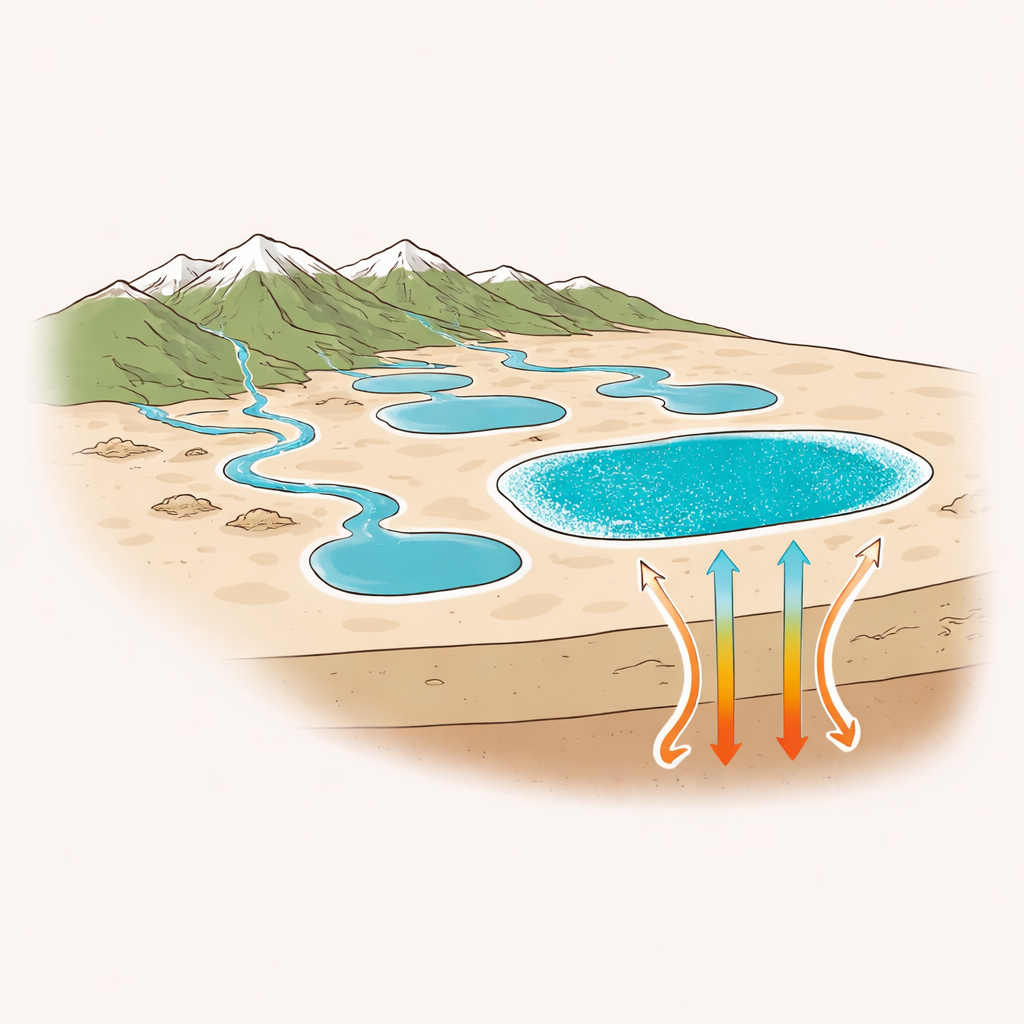
The Junggar Basin sits between two great mountain belts and is now covered largely by deserts. Streams flowing off the mountains carry dissolved minerals into low-lying areas, where water collects in closed salt lakes and then evaporates under a dry, windy climate. Over hundreds of millions of years, the region also experienced repeated invasions of the sea, followed by retreat and uplift. As a result, pockets of salty water from ancient oceans were trapped deep underground. Today’s landscape, with its scattered lakes and deep faults, provides a natural laboratory for seeing how modern surface water and buried ancient seawater interact.
Sampling the salty pools
To understand why some lakes are so rich in potassium and bromine, the researchers collected 29 samples of salty water, or brine, from seven representative lakes and springs across the basin. In the lab, they measured the main dissolved ingredients—such as sodium, chloride, sulfate, magnesium, calcium, and carbonate—along with smaller but economically important elements like potassium, lithium, boron, iodine, and bromine. By comparing the mix of ions from place to place, they could group the brines into several types that reflect how far each water body has traveled along an evaporation pathway, from relatively fresh to extremely concentrated.
Where the strongest concentrations occur
Most of the Junggar brines turned out to be dominated by sodium combined with either chloride or sulfate, a common pattern in salt lakes. But in three lakes—Dahong, Dabancheng, and Beishawo—the team found strikingly high levels of potassium and bromine, far above typical background values and even above industrial cutoffs used to judge whether extraction is worthwhile. In Dahong Salt Lake, for example, potassium reached more than twice the threshold used for potash production, and bromine reached levels often seen in commercial brine fields. Statistical comparisons showed that potassium and bromine rise and fall together, along with sodium, chloride, and several other ions, hinting that they share the same sources and history.
Clues from chemical fingerprints
To decode that history, the scientists used standard diagrams that plot how water chemistry changes as it is controlled by rainfall, rock weathering, or evaporation. The Junggar samples mostly fall in the “evaporation and crystallization” region, confirming that intense drying is concentrating the salts. Yet many points lie beyond the simple evaporation trend, implying an extra source of dissolved material. Ratios between bromine and chlorine, and between other ions, act like fingerprints: they show that the enriched lakes cannot be explained simply by dissolving local salt deposits or by washing potassium out of nearby rocks. Instead, the patterns closely resemble those of brines derived from seawater that has been partly evaporated and then stored underground, later mixing with younger lake waters.
Ancient oceans feeding modern lakes
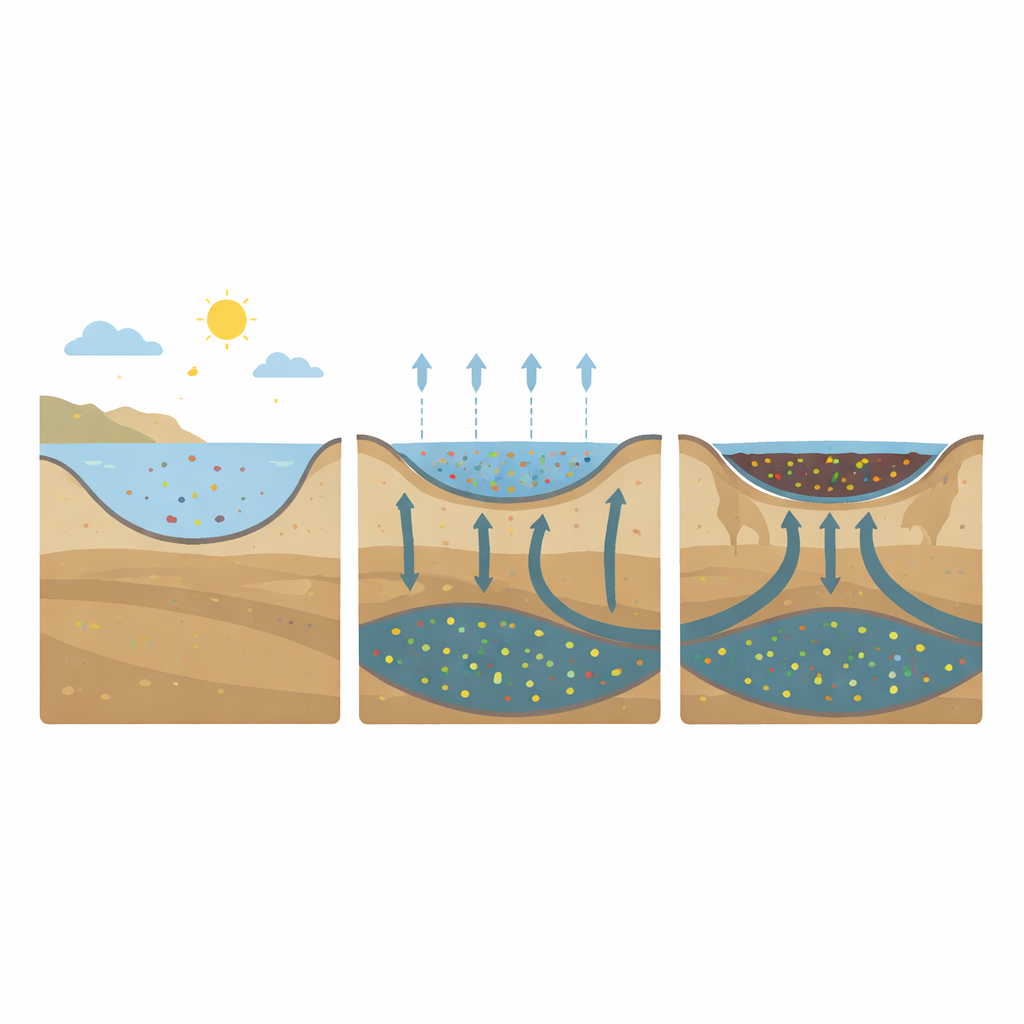
Bringing together the chemistry, the structure of the basin, and its known geological history, the authors propose that deep, seawater-derived brines are slowly rising along faults beneath certain lake basins. Once these hidden fluids reach shallow depths, they mix with mineral-rich waters coming off the surrounding mountains. In closed, shallow lakes exposed to intense sun and wind, this mixture is further concentrated by ongoing evaporation, leading to pockets of brine that are exceptionally rich in potassium and bromine. Lakes farther from fault zones, or outside the ancient marine centers, lack this deep contribution and therefore show more ordinary salt contents.
What this means for resources and research
For a non-specialist, the main takeaway is that a few desert lakes in the Junggar Basin owe their unusual wealth in useful elements to a long chain of events: ancient seas that once flooded the region, burial and preservation of their waters, later tectonic movements that reopened pathways to the surface, and today’s arid climate that concentrates salts in closed basins. Understanding this story not only points to promising sites for future potash and bromine production, but also shows how careful chemical detective work can reveal the deep history behind seemingly simple pools of salty water.
Citation: Zhou, C., Yang, Z., Chen, X. et al. Geochemical characteristics and sources of potassium and bromine in Salt-Lake Brines of the Junggar Basin, China. Sci Rep 16, 8566 (2026). https://doi.org/10.1038/s41598-026-40111-7
Keywords: salt lakes, brine resources, potash, bromine, Junggar Basin