Clear Sky Science · en
Deep probabilistic traversability with test-time adaptation for uncertainty-aware planetary rover navigation
Why safer rover driving matters
When we send wheeled robots to the Moon or Mars, they must drive across sand, rocks, and slopes without human help. A single bad guess about how soft the ground is can leave a billion‑dollar rover stuck forever, as happened when NASA’s Opportunity rover became trapped in rippled sand for weeks. This study introduces a new way for rovers to "feel" how risky the ground ahead is, make safer route choices, and even learn from their mistakes while they drive.
Soft ground as a hidden danger
On other worlds, the most dangerous obstacles are not always boulders or cliffs, which cameras can see easily, but deceptively smooth patches of loose soil. When rover wheels spin in this kind of terrain, the vehicle slips, crawls forward much more slowly than commanded, wastes energy, and may become permanently immobilized. Traditional navigation systems focus mainly on visible geometric hazards—what looks like an obstacle and what does not—without fully capturing how the ground will behave under the wheels. At the same time, machine‑learning methods that try to predict wheel slip from images and 3D maps can be wrong in unfamiliar conditions, such as new lighting or steeper slopes, and they usually do not say how uncertain their predictions are.
Teaching a rover to reason about risk
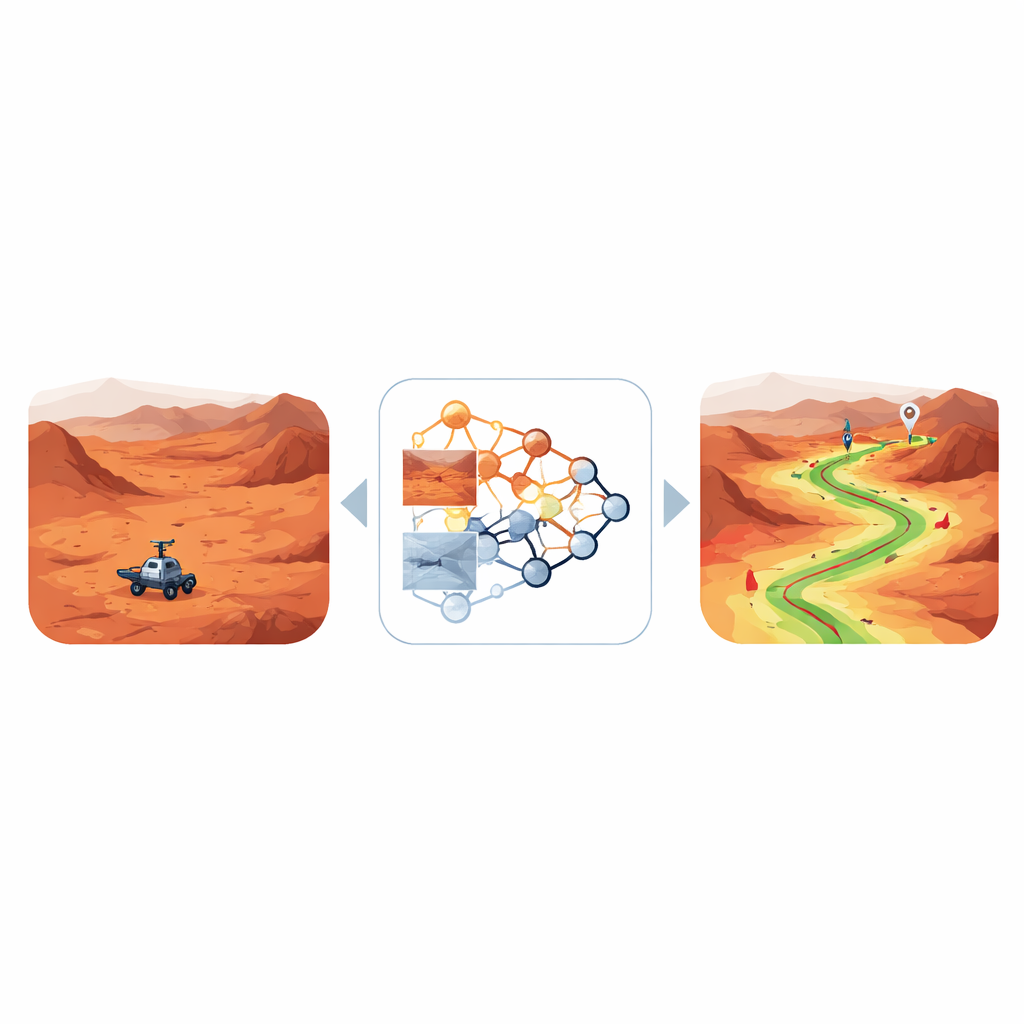
The authors propose an integrated learning and planning framework they call deep probabilistic traversability. Instead of producing a single "best guess" for how much the wheels will slip on each patch of terrain, their model predicts a full probability distribution of possible slips, based on color imagery and local slope. An ensemble of deep neural networks views the landscape from above and, for every possible move on a grid, outputs both an expected slip value and its uncertainty. From this distribution, the system translates slip into an effective driving speed and, ultimately, into a travel time cost for each step. Areas where the rover is likely to bog down receive very high costs; areas where the prediction is both favorable and confident receive low costs. A standard path‑search algorithm then finds a route that trades off short distance against low risk of immobilization.
Letting the rover learn as it goes
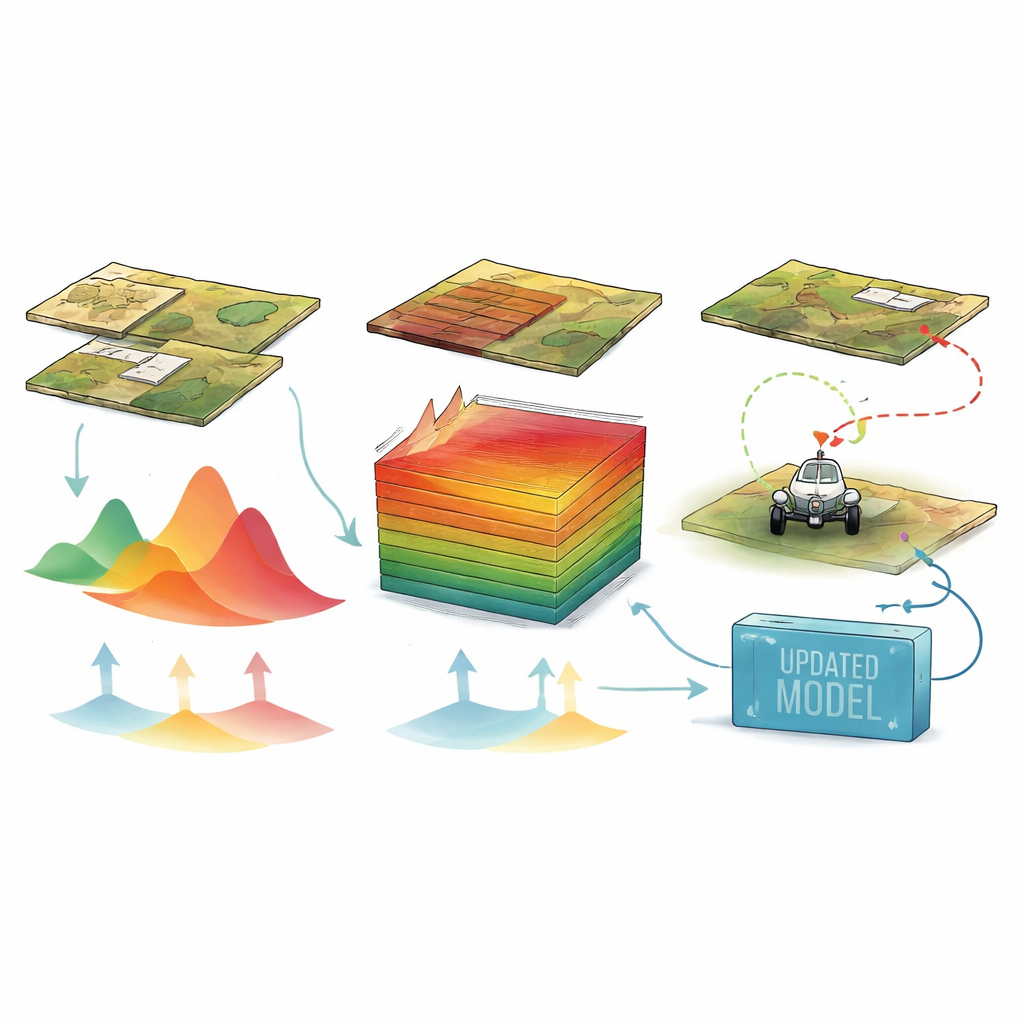
A major challenge in planetary exploration is that the conditions a rover sees on arrival can differ significantly from those in its training data: slopes may be steeper, soil properties unfamiliar, or lighting very different. To cope with this, the framework includes a test‑time adaptation mechanism. As the rover drives, it measures the actual slip it experiences. After each short movement, these fresh measurements are used to gently adjust added "scale and shift" layers in the neural networks while keeping the original weights fixed. This strategy allows the model to adapt quickly to new terrains using only a handful of observations, while preserving what it has already learned about previously seen conditions. Updated predictions then feed back into replanning, so the chosen path can improve on the fly.
Putting the system through tough tests
Because real rover data cover only limited types of terrain, the team built a large synthetic dataset of Martian‑like landscapes. They combined computer‑generated rough topography with ten hidden terrain classes, each with its own color and slip behavior, and varied both slope steepness and lighting direction to create familiar and unfamiliar scenarios. In thousands of simulated missions, the new method was compared against two state‑of‑the‑art planners that either ignore uncertainty or use it less directly. Under familiar conditions, all approaches performed similarly. But in the most challenging cases—dark lighting and steep crater‑like terrain—the deep probabilistic traversability approach achieved higher success rates and lower maximum slip, while maintaining competitive travel times. When on‑the‑fly adaptation was enabled, the system further reduced prediction errors and improved safety, especially in environments that differed strongly from training.
What this means for future missions
For a general reader, the key message is that this work gives planetary rovers a more cautious and self‑aware way to drive on treacherous ground. Instead of blindly trusting a single prediction about how their wheels will grip, rovers can now weigh both expected behavior and uncertainty, choosing routes that are fast yet unlikely to leave them stranded. By continuously learning from their own slip experience, they can adjust to novel sand, slopes, and lighting without human rescue. As space agencies plan longer and more ambitious surface missions, such uncertainty‑aware navigation could help ensure that valuable robots spend more time exploring new science targets and less time digging themselves out of trouble.
Citation: Endo, M., Taniai, T. & Ishigami, G. Deep probabilistic traversability with test-time adaptation for uncertainty-aware planetary rover navigation. Sci Rep 16, 9499 (2026). https://doi.org/10.1038/s41598-026-40109-1
Keywords: planetary rover navigation, terrain traversability, uncertainty-aware planning, machine learning robotics, autonomous exploration