Clear Sky Science · en
Predicting camouflage treatment outcomes in skeletal class III malocclusion using machine learning
Why this matters for everyday smiles
Many adults live with an underbite, where the lower teeth sit in front of the upper teeth. Fixing this can mean either jaw surgery or carefully planned braces that "camouflage" the jaw mismatch by moving the teeth. Choosing the wrong path can waste years of treatment and still leave the bite unsatisfactory. This study explores whether modern machine learning can help orthodontists predict, before treatment even starts, which patients are likely to do well with camouflage alone and which may really need surgery.
Understanding the underbite problem
Skeletal Class III malocclusion is the technical term for a strong or forward-positioned lower jaw relative to the upper jaw. It is especially common in many Asian populations and can affect both appearance and chewing function. Adults with this condition usually face two main choices: jaw surgery to reposition the bones, or camouflage treatment that relies on tooth movement alone. Traditionally, orthodontists have depended on experience and a handful of X-ray measurements to decide. However, even with guidelines, some camouflage cases fail to achieve a stable, comfortable bite.
Bringing smart prediction into the clinic
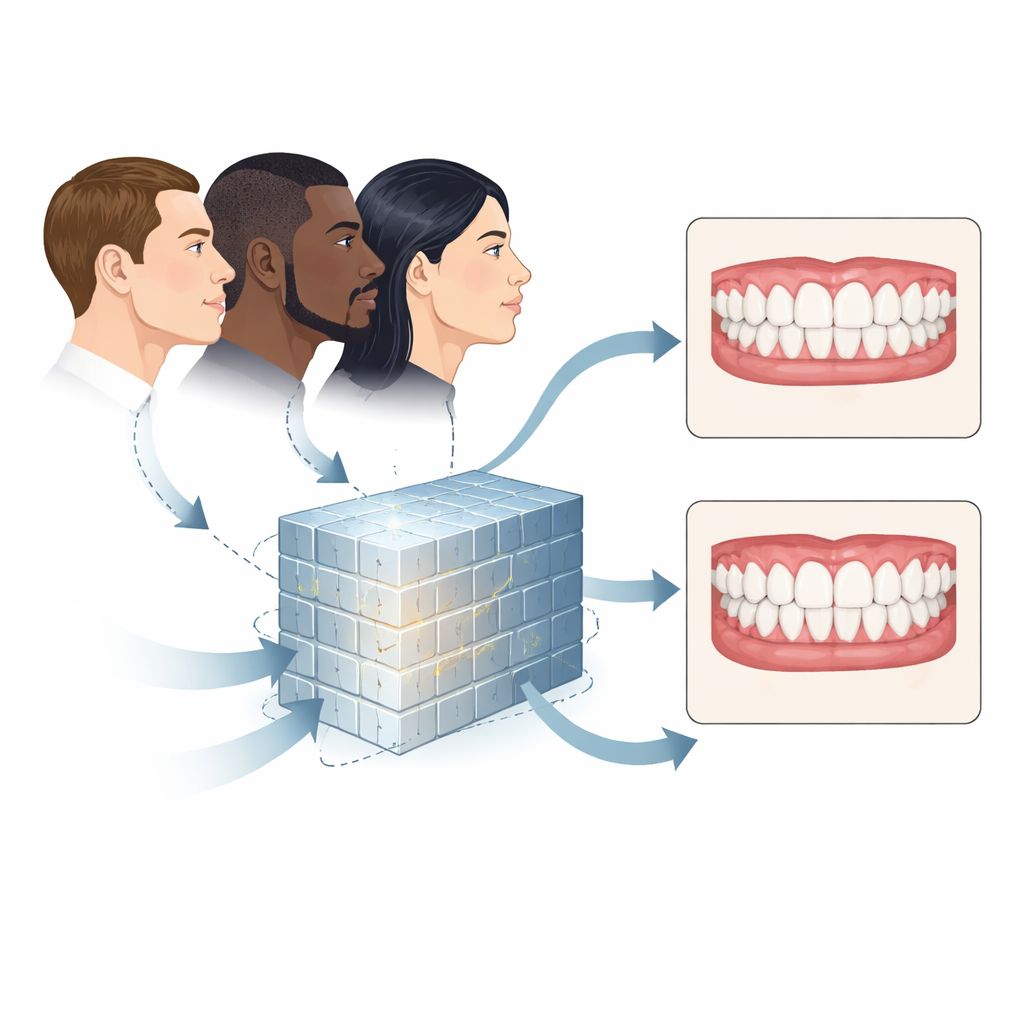
To tackle this challenge, the researchers examined records from 100 adults in South Korea who had underbites treated with camouflage orthodontics. Using detailed measurements from side-view head X-rays taken before and after treatment, they labeled each case as a success or failure according to bite criteria such as how the upper and lower front teeth overlapped and how the molars fit together. They then trained four different machine learning models—modern algorithms that learn patterns from data—to predict, using only pre-treatment measurements, whether a new patient would be likely to have a successful camouflage result.
What the algorithms discovered
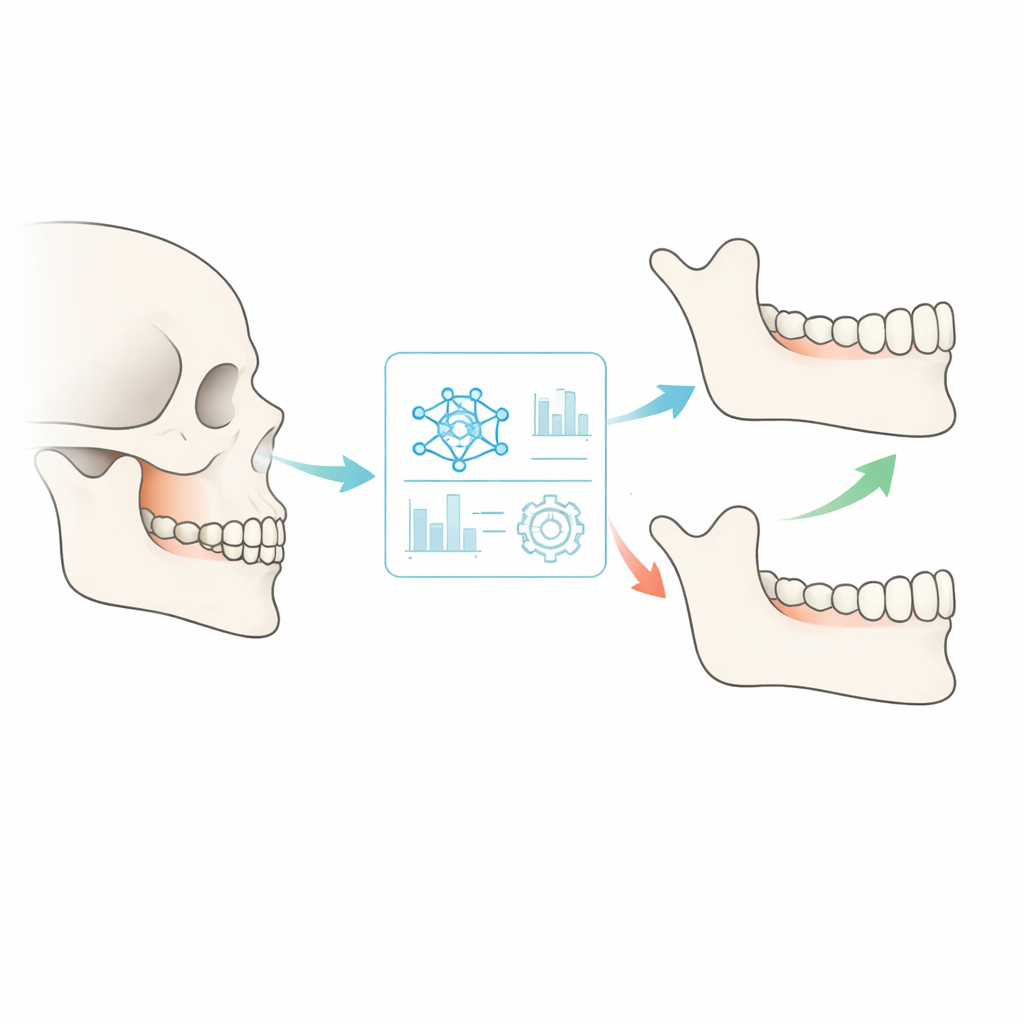
Among the four approaches tested, a method called XGBoost showed the most consistent and accurate predictions. While the study examined 87 different measurements, two stood out as especially important. The first was how far forward the lower front teeth sat in the jaw (a horizontal distance called L1_x). The second was the length of the upper jaw along the palate (Palatal L), which reflects how much bone is available to house the upper teeth. In simple terms, camouflage worked best when the lower front teeth were not already pushed too far forward and when the upper jaw was not too short front-to-back.
A simple decision tree for real-world use
To turn these insights into something a clinician could use at the chairside, the team built a decision tree—a flowchart-like model. It showed that if the lower front teeth were beyond a certain forward limit, camouflage treatment almost always failed, suggesting that surgery or another approach would be safer. If the lower teeth were within that limit, the model next checked upper jaw length. When the upper jaw was long enough, camouflage was predicted to succeed almost all the time. But if it was shorter, success dropped sharply, especially when the lower teeth were also near their forward boundary. The researchers illustrated this by applying the tree to two patients who looked similar at first glance; the model correctly anticipated that one would finish with a good bite and the other would not.
What this means for patients and practitioners
This work suggests that machine learning can turn complex X-ray measurements into clear, practical guidance for orthodontic decisions. For patients, that could mean a more honest discussion early on about whether braces alone are likely to deliver the desired result, reducing the risk of years of treatment ending in disappointment. For clinicians, the study highlights two easily checked features—the forward position of the lower front teeth and the effective length of the upper jaw—as crucial warning signs when considering camouflage for an underbite. While the model was developed from a single clinician’s cases and still needs broader testing, it points toward a future in which personalized, data-driven tools help match each patient with the treatment that truly fits their anatomy and goals.
Citation: Koh, J., Kim, Y.H., Kim, N. et al. Predicting camouflage treatment outcomes in skeletal class III malocclusion using machine learning. Sci Rep 16, 9297 (2026). https://doi.org/10.1038/s41598-026-40107-3
Keywords: underbite, orthodontic camouflage, machine learning, treatment planning, jaw alignment