Clear Sky Science · en
Enhanced power management in PV-Integrated hybrid energy storage systems using fuzzy 2DOF-PI control optimized by hippopotamus algorithm
Smarter Solar Power for Everyday Use
As more homes, villages, and devices run on solar power, one stubborn problem remains: the sun does not shine steadily, while our lights, refrigerators, and electronics expect smooth, reliable electricity. This paper explores a smarter way to juggle solar energy and storage so that power stays steady, batteries last longer, and clean electricity becomes more practical for off-grid homes and small direct-current (DC) networks.
Why Solar Needs a Backup Team
Solar panels are clean and increasingly affordable, but their output constantly changes with clouds, time of day, and weather. Traditionally, batteries alone have been used to bridge the gap between irregular sunshine and steady demand. However, asking a battery to handle both long-term energy needs and every tiny, rapid fluctuation in power is like using a freight train to do a race car’s job: it works, but it wears out the battery faster and wastes energy. To fix this, engineers pair batteries with supercapacitors—devices that can charge and discharge almost instantly but store less energy overall. The battery then acts as the slow, deep reservoir, while the supercapacitor absorbs fast jolts in demand, creating a more durable and efficient storage team.
How the Hybrid Solar System Is Built
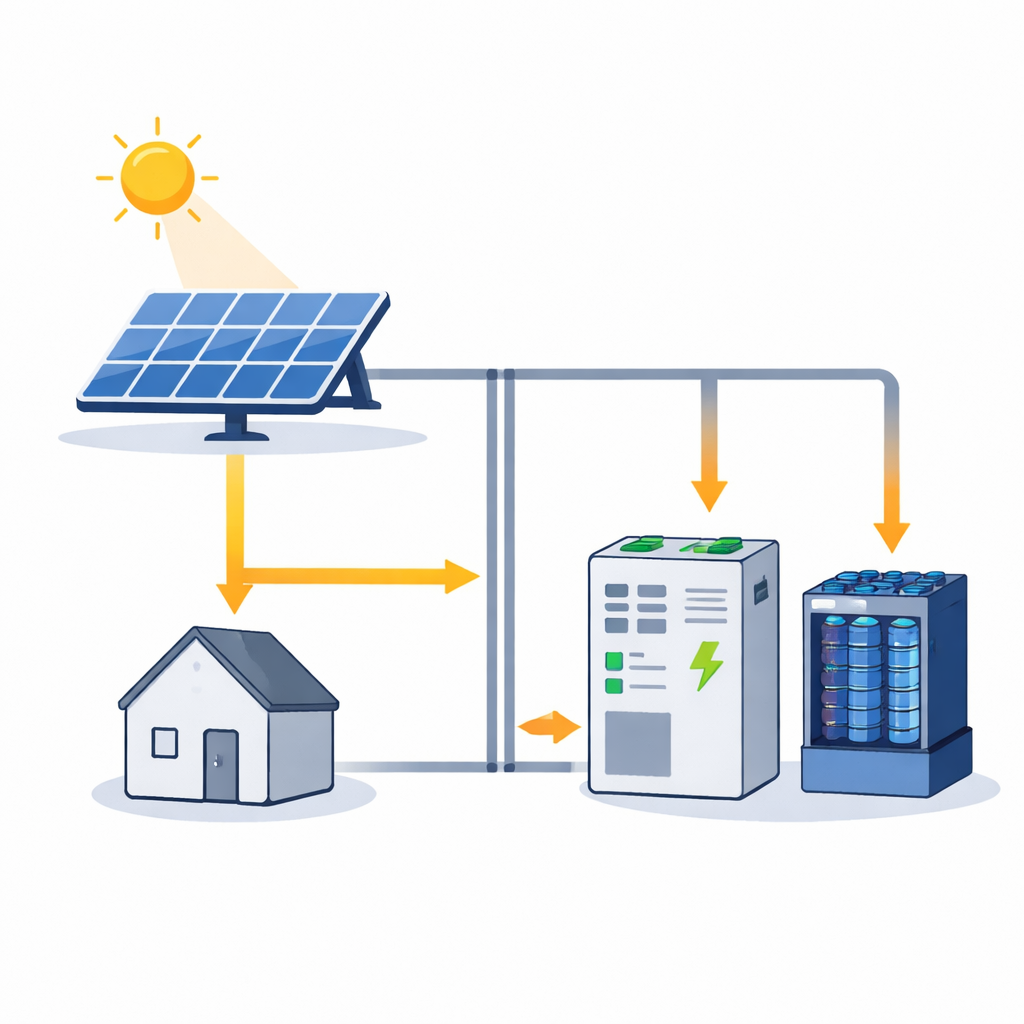
The study focuses on a standalone DC microgrid powered by solar panels and supported by a hybrid energy storage system that combines a battery bank with a bank of supercapacitors. All of these elements connect to a central DC bus, which feeds a DC load such as a house or small building. Each storage device has its own bidirectional electronic converter, allowing it to both take in energy when there is surplus solar power and release energy when sunlight drops or demand spikes. This "active" arrangement means the battery and supercapacitor can be controlled independently, rather than being passively tied together, giving the control system fine-grained authority over who does what and when.
A Brain Inspired by Rules and Animal Behavior
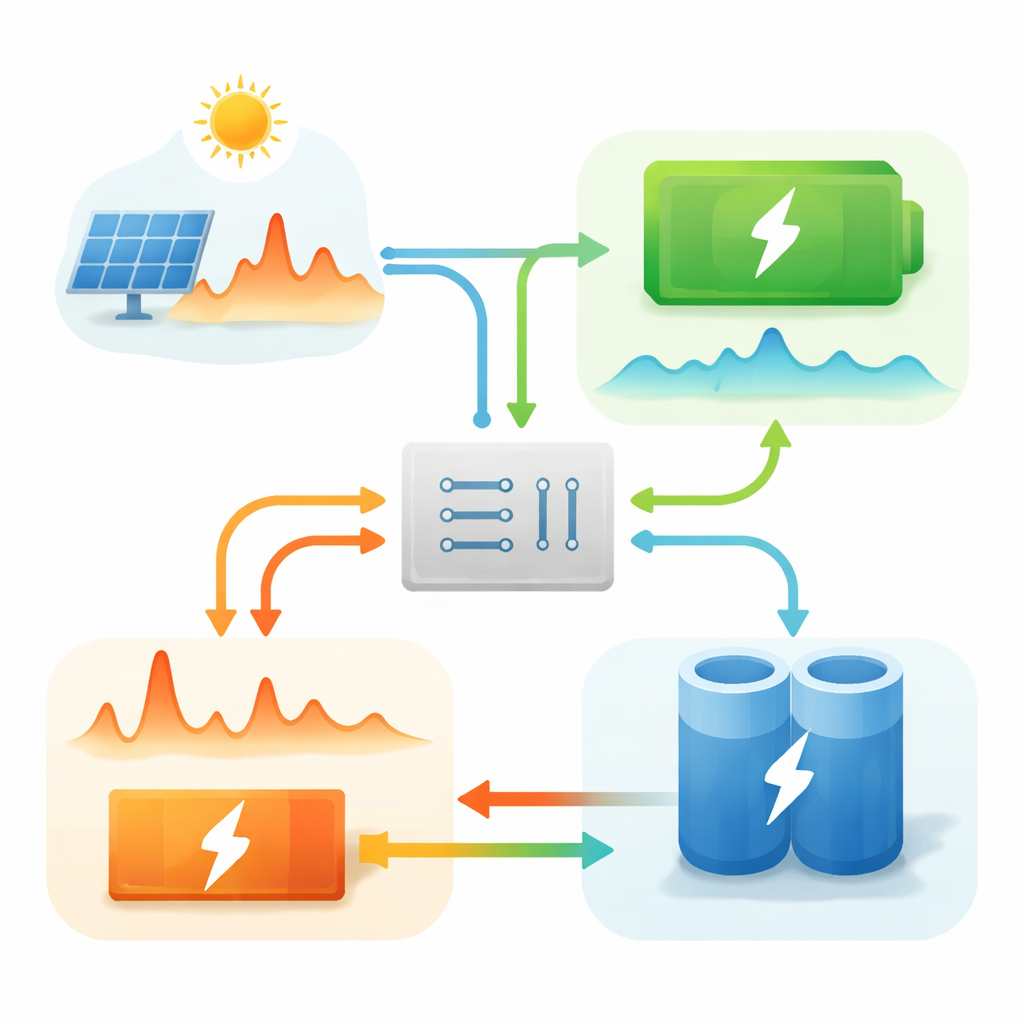
At the heart of the system is an intelligent controller that decides how to split the workload between battery and supercapacitor while keeping the DC bus voltage steady. The authors combine two ideas. First, they use fuzzy logic—a rule-based approach that mimics human reasoning with statements like "if the voltage error is small but changing quickly, adjust gently." Second, they employ a two-degree-of-freedom proportional–integral (2DOF-PI) structure, which allows the controller to tune how it follows a desired voltage level separately from how it rejects disturbances such as sudden load changes. To fine-tune all these settings, they rely on a modern search method called the Hippopotamus Optimization algorithm, inspired by how hippos move, defend, and retreat in groups. This optimizer sifts through many possible controller settings to find those that best balance accuracy, speed, and stability.
Putting the New Control to the Test
The researchers test their approach in detailed computer simulations using MATLAB/Simulink. They expose the system to four demanding situations: rapidly changing sunlight, sudden increases in load, sudden decreases in load, and a combination of changing sun and changing demand. They compare their fuzzy 2DOF-PI controller with three alternatives: a conventional PI controller and two fuzzy-PI designs tuned by older optimization methods. Across all cases, the new controller keeps the DC bus voltage closer to its target, reduces the size of temporary power spikes by at least 15 percent, and shortens the time it takes for the system to settle by at least 10 percent. The battery is shielded from sharp surges, because swift changes are redirected to the supercapacitor, which is better suited to handle them. This means less stress on the battery and, in real-world use, the potential for a longer service life.
What This Means for Clean Energy Users
In everyday terms, the proposed control strategy makes a small solar-based power system behave more like a stable, dependable power source, even when the sun and the load are misbehaving. By coordinating a battery and a supercapacitor with a smart control “brain,” the system delivers smoother power, uses the stored energy more efficiently, and reduces wear on expensive battery packs. While the results are based on simulations and still need to be confirmed in hardware tests, the work points toward more robust, longer-lasting solar microgrids for homes, remote communities, electric-vehicle charging, and other off-grid uses, helping turn fluctuating sunshine into truly dependable electricity.
Citation: Kotb, H., Khairalla, A.G., ElRefaie, H.B. et al. Enhanced power management in PV-Integrated hybrid energy storage systems using fuzzy 2DOF-PI control optimized by hippopotamus algorithm. Sci Rep 16, 9200 (2026). https://doi.org/10.1038/s41598-026-40106-4
Keywords: solar microgrid, hybrid energy storage, battery supercapacitor, fuzzy control, renewable power management