Clear Sky Science · en
Differential geometry-based harmonic analysis of three-phase systems
Why the shape of electricity matters
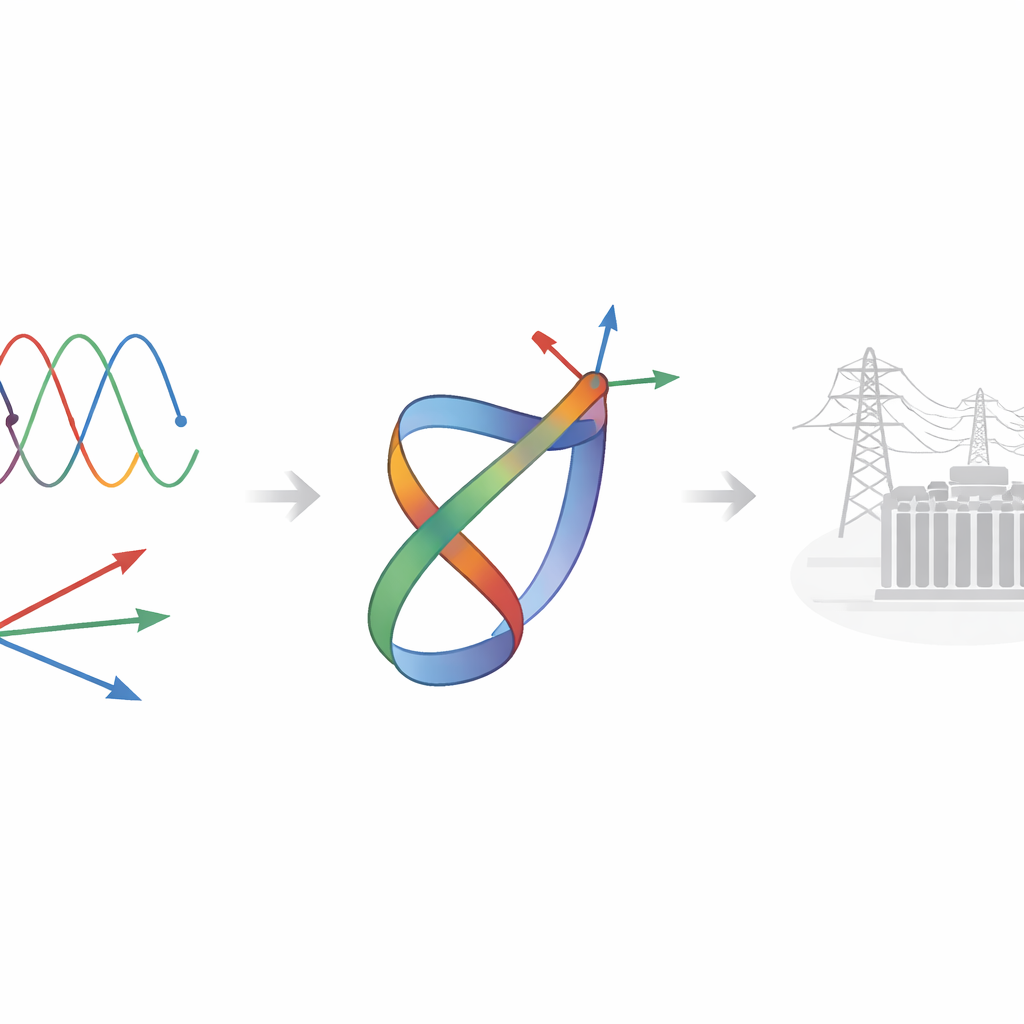
Modern homes, factories, and data centers all depend on three-phase electricity, the workhorse of the power grid. But when this power becomes distorted or unbalanced, lights flicker, motors overheat, and sensitive electronics can fail. This paper explores a fresh way to look at these problems: instead of seeing voltages and currents only as wavy lines in time, it treats them as three-dimensional curves in space. By studying the geometry of these curves, the authors show how to spot hidden distortions and calculate power more reliably in messy, real-world conditions.
Turning electric waves into space curves
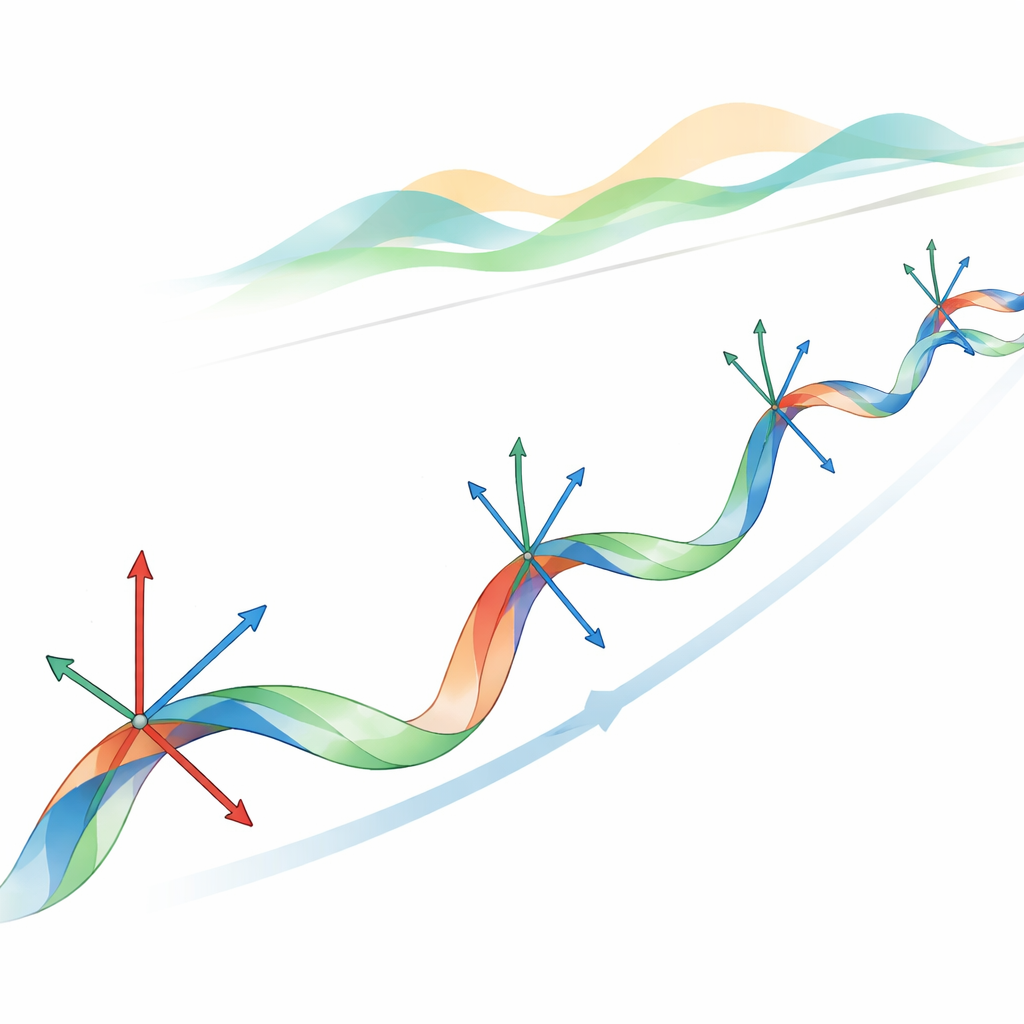
In a three-phase system, there are three coordinated voltages that normally rise and fall like evenly spaced sine waves. The authors reinterpret these three signals as the coordinates of a single moving point in three-dimensional space. As time passes, this point traces out a smooth path, or space curve. To describe what happens along that path, they use a classic tool from geometry called the Frenet frame, built from three directions: the tangent (which way the curve is heading), the normal (how it is bending), and the binormal (how it is twisting out of its plane). This moving trio of directions provides a local "compass" that is tied directly to the actual waveform, rather than to an externally imposed rotating reference.
New geometric fingerprints of distortion
Once the three-phase signals are turned into a curve, two simple geometric quantities become powerful diagnostics. Curvature measures how sharply the curve bends; torsion measures how much it twists out of a flat plane. For a perfectly balanced, undistorted three-phase supply, the path forms a neat circle or ellipse in a plane: the curvature is constant and small, and the torsion is essentially zero. As soon as harmonics, noise, or unbalanced conditions appear, the curve begins to wobble and lift out of the plane. Curvature jumps where strong harmonic content is present, and torsion grows when the three phases no longer behave symmetrically. In this way, the time-varying curvature and torsion become geometric fingerprints of power-quality problems.
Measuring power directly from shape
Beyond diagnosis, the geometric framework also provides a new way to compute how much power is actually flowing. Traditional tools such as the Clarke and Park transforms project three-phase signals onto two axes and assume nicely balanced, sinusoidal conditions. Under real conditions with harmonics and imbalance, these methods can misjudge the so-called reactive power, which is crucial for sizing equipment and designing control systems. In the new approach, voltage and current are treated as full three-dimensional vectors, and power is obtained using geometric products that naturally split into an "in-phase" part (active power) and a "cross" part (reactive power). Because this calculation is performed directly in the original three-dimensional space, no information is lost in projection.
Putting the method to the test
To check that this geometric view is more than a mathematical curiosity, the authors run a series of case studies. They analyze ideal balanced supplies, deliberately distorted and unbalanced waveforms, and circuits with purely resistive and inductive loads. In each case, the space-curve description behaves as expected: balanced cases produce nearly flat torsion, while distorted ones show sharp variations in curvature and twisting. When they compare power calculations, the new method matches theoretical values even in the presence of harmonics, while the standard Park transform shows noticeable errors in reactive power. Finally, the authors apply their technique to real disturbance data from an industry test library, showing that simple curvature indices can distinguish between a sag on a single phase and a sag affecting all three phases together.
Promise and practical hurdles
Like any powerful lens, this geometric viewpoint comes with trade-offs. It relies on taking several derivatives of the measured signals, which makes it sensitive to noise and demands relatively high sampling rates and more computation than traditional methods. The authors argue that these challenges can be addressed with careful digital filtering and dedicated hardware, and that the payoff is a clearer, more unified picture of power quality events. In everyday terms, their conclusion is that by watching not just how electric waves rise and fall, but how their combined path bends and twists in space, engineers can more accurately diagnose problems and manage complex, converter-heavy power systems.
Citation: Sundriyal, N., Thakur, P., Dixit, A. et al. Differential geometry-based harmonic analysis of three-phase systems. Sci Rep 16, 9372 (2026). https://doi.org/10.1038/s41598-026-40101-9
Keywords: three-phase power, power quality, harmonic distortion, geometric analysis, reactive power