Clear Sky Science · en
Current sensorless MPPT method with battery management for PV based single phase standalone system
Smarter Solar Power for Off‑Grid Living
As more homes, farms, and remote facilities turn to solar power, one big question looms: how do you squeeze the most electricity out of panels while keeping batteries healthy and costs low? This paper presents a new way to run standalone solar systems that avoids some of the usual hardware and measurement complexity, yet still captures nearly all available sun power and manages battery charging safely.
How Standalone Solar Systems Work Today
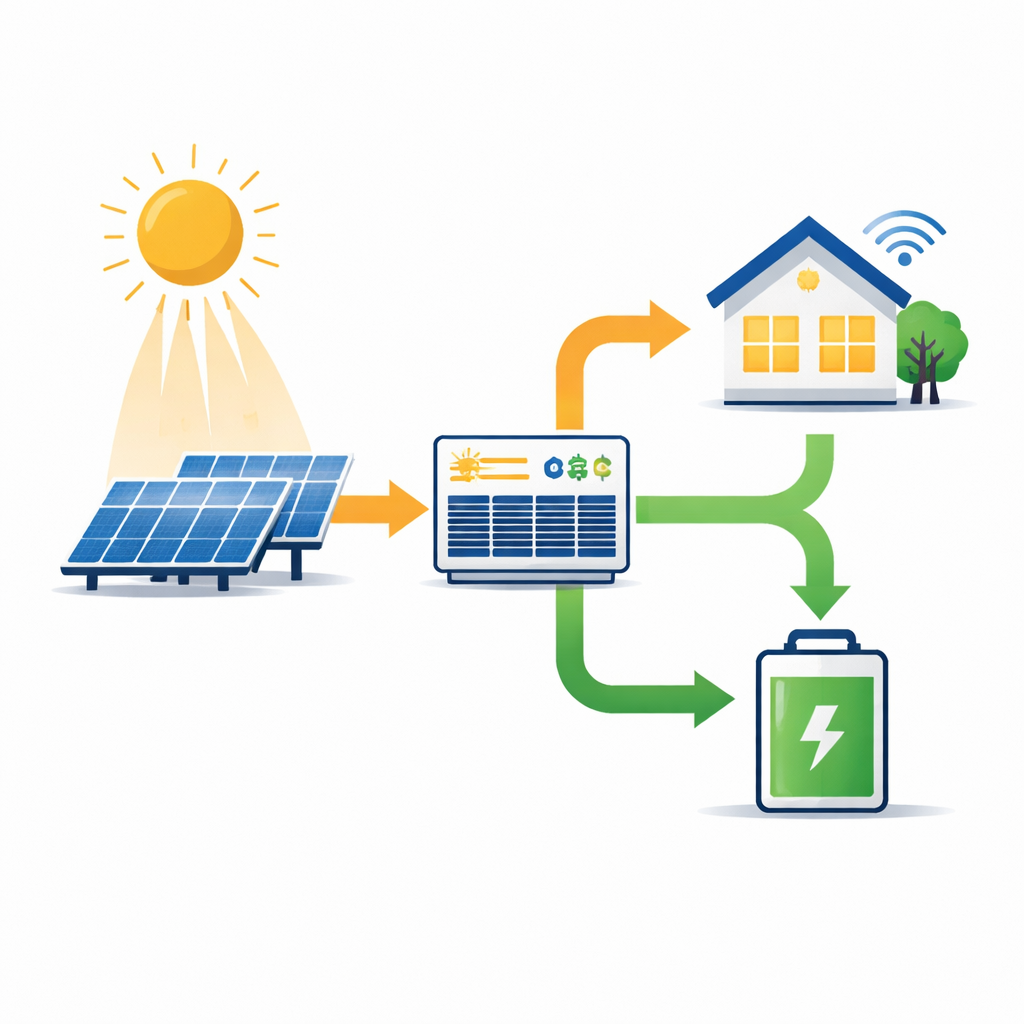
A typical small solar setup includes a panel array, electronics that boost and regulate the panel voltage, a battery bank for night and cloudy periods, and an inverter that turns direct current into the familiar household alternating current. To get the most from the panels, a control routine continuously nudges their operating point to the so‑called "sweet spot" where power output is highest. This task, known as maximum power point tracking, usually relies on measuring both voltage and current from the panels in real time. Extra sensors and their wiring, however, add cost, introduce electrical noise, and complicate the design, especially in small off‑grid systems where budgets and space are tight.
Finding the Sweet Spot Without Measuring Current
The authors propose a twist on a popular tracking routine called "perturb and observe." Instead of measuring both voltage and current, the new method directly measures only panel voltage and then calculates the panel current indirectly, using known properties of the electronic converter that sits between the panels and the rest of the system. By watching how voltage across an inductor inside this converter rises and falls during switching, the controller can infer the average panel current with good accuracy. With this estimated current paired to the measured voltage, the algorithm can still hunt for the maximum power point, but without a dedicated current sensor and its supporting circuitry. Simulations and experiments show that the estimated current stays within about one to three percent of the true value, which is sufficient for precise control.
Boosting Voltage and Taming Ripples
To make the most of this sensorless approach, the system uses a special "interleaved" boost converter that combines two switching stages working out of phase. Together they step the often low and variable panel voltage up to a much higher, nearly constant level suitable as a shared direct‑current bus. This design roughly doubles the usable voltage gain compared with a simple single‑stage booster and smooths out current fluctuations by overlapping the waveforms from each leg. In practice, that means less electrical stress, smaller filters, and more stable operation, all of which help the tracking algorithm respond quickly when sunlight changes without shaking the rest of the system.
Keeping the Battery in Its Comfort Zone
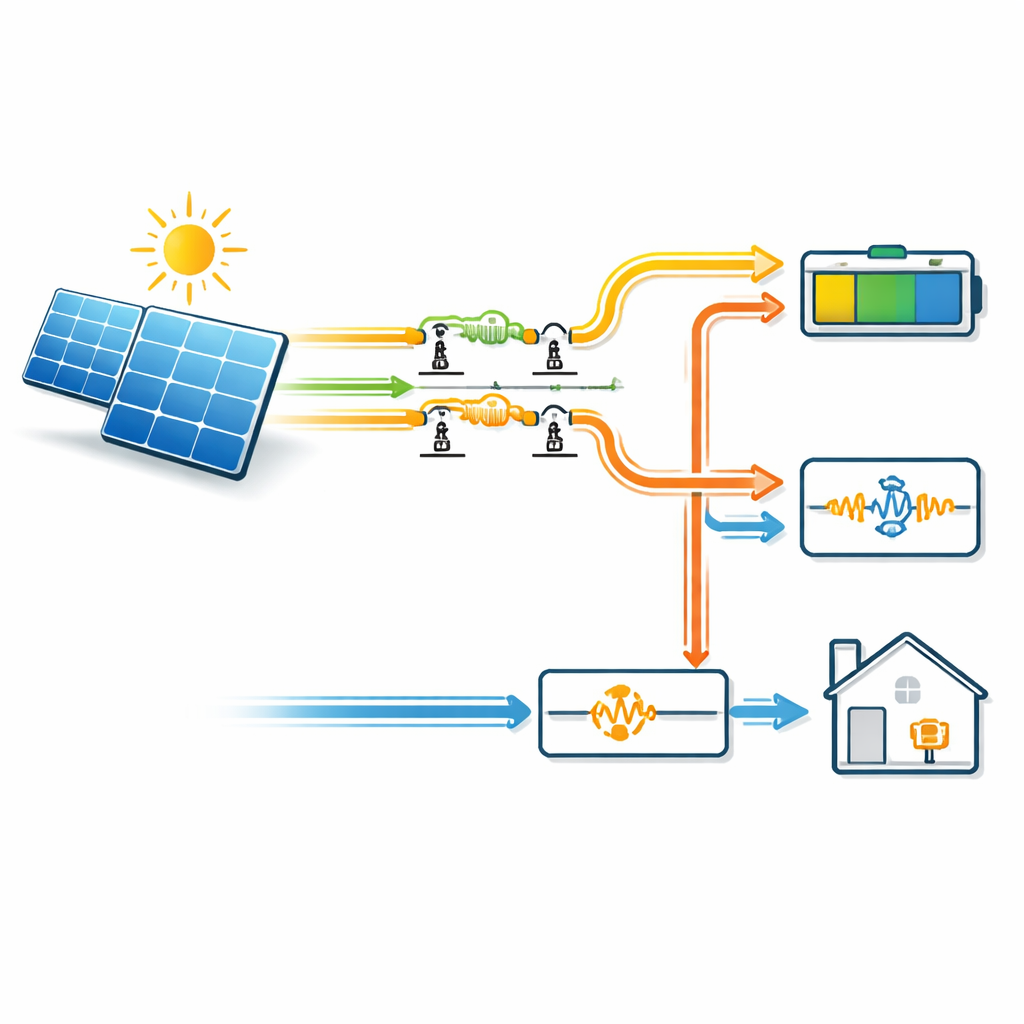
Beyond panel control, the work also integrates a battery management strategy so the same system can automatically decide when to charge, discharge, or rest the battery bank. A separate bidirectional converter provides electrical isolation and can move power in either direction between the high‑voltage bus and a lower‑voltage battery stack. The controller constantly compares how much power the panels could deliver at their sweet spot with how much the loads currently need. When solar power exceeds demand and the battery is not full, the surplus is routed into charging mode; when demand outstrips what the sun can provide, the converter flips into boost mode and the battery helps carry the load. Six operating scenarios cover everything from bright sunny charging to night‑time supply and even safe shutdown when neither panels nor battery can support the load.
Real‑World Performance and Why It Matters
Computer models and laboratory tests with a few hundred watts of panels and batteries show that the new control scheme keeps the main direct‑current bus almost constant while following rapid shifts in sunlight. After a step change in light level, the system settles into the new maximum power point in roughly 50 to 100 milliseconds, faster than many standard approaches, yet with only tiny power ripples around the optimum. Measured efficiencies reach about 96 percent for the voltage‑boosting stage and 94 percent for the inverter, while overall tracking efficiency is estimated near 99.4 percent. For a lay reader, the takeaway is that this design can deliver nearly every usable watt the panels can produce, with clean power quality and well‑behaved batteries, but with simpler and cheaper hardware. That combination makes it an attractive option for cost‑sensitive, off‑grid solar installations where reliability and efficiency are both at a premium.
Citation: Genc, N., Uzmus, H., Kalimbetova, Z. et al. Current sensorless MPPT method with battery management for PV based single phase standalone system. Sci Rep 16, 9107 (2026). https://doi.org/10.1038/s41598-026-40097-2
Keywords: solar energy, off-grid power, battery storage, power electronics, maximum power point tracking