Clear Sky Science · en
Analysis on the thermal performance and economic efficiency of XLPE submarine cable based on electric–thermal–hydraulic coupling simulation
Keeping Undersea Power Lines Safe
As offshore wind farms grow, more electricity must travel to shore through thick power cables buried in the seabed. If these submarine cables run too hot, the plastic insulation that keeps electricity safely contained can age quickly, shortening cable life and driving up costs. This study asks a deceptively simple question with big practical consequences: how do the seabed’s properties and the way a cable is buried change its temperature and, in turn, the economics of getting clean power to land? 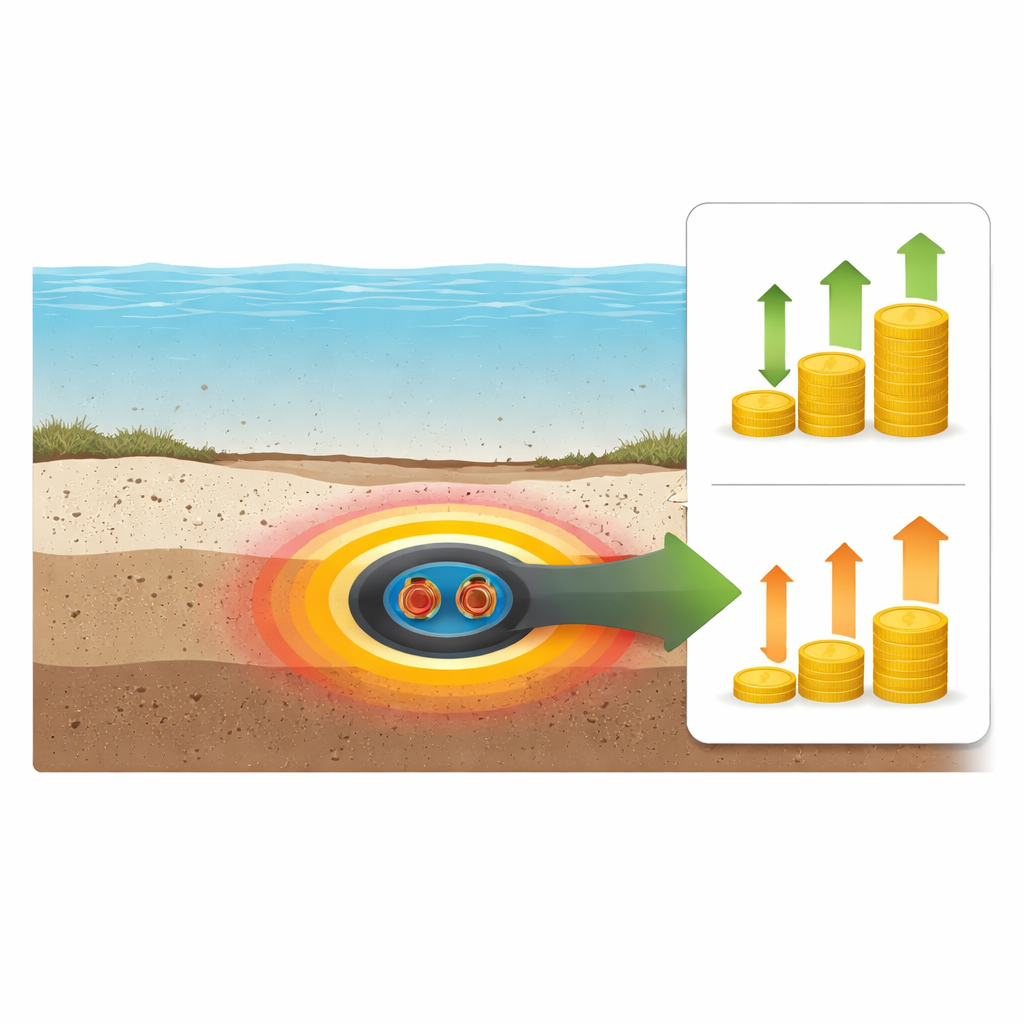
Why the Seabed Matters
Submarine cables for offshore wind projects typically use a tough plastic called cross-linked polyethylene as insulation and are designed so their metal cores stay below about 90 degrees Celsius. The heat they generate must escape into the surrounding seabed and seawater. But seabed soils are not all the same. Some are sandy and conduct heat well; others are clay-rich and more insulating. In addition, water trapped in the pores between grains can move when heated, carrying heat with it. These local conditions decide how easily a cable can shed heat, which in turn determines how much current it can safely carry and how cost-effective the whole project will be over decades of service.
Simulating a Complex Heat Problem
The authors focused on a common three-core, 220-kilovolt AC cable type and built a detailed computer model of a slice through the seabed where such a cable is buried. Instead of treating the cable as a simple heater, they explicitly modeled the electromagnetic fields that generate heat inside the metal conductors and other layers. That heat then spreads into the surrounding soil, where it can move both by simple conduction and by the motion of the pore water driven by buoyancy, like a very slow natural convection current. By coupling the electric, thermal, and fluid-flow behavior in one framework, they could see how changes in burial depth, background temperature, soil thermal conductivity, and soil permeability interact to set the cable’s steady operating temperature and its allowable current. They also checked that the model agreed well with an established engineering standard, finding only a small difference in predicted current capacity.
What Controls Cable Temperature
The simulations show clear and sometimes surprising trends. Burying the cable deeper consistently raises the conductor temperature, and the effect becomes stronger as depth increases, because the heat has farther to travel before reaching the cooling influence of seawater above. Warmer ambient seabed temperatures simply shift the entire system upward: for the same electrical load, a few degrees of extra background warmth can push the cable over its safe limit. Soil thermal conductivity—how easily heat passes through the sediment—plays a powerful role. In soils that conduct heat poorly, temperature falls off sharply with distance and the cable runs hotter, sharply limiting the current it can carry. In more conductive soils, heat spreads out quickly, allowing higher current without exceeding the temperature limit.
Hidden Help from Moving Pore Water
Another key factor is permeability, which describes how easily water can move through the soil’s pores. In very tight soils, typical of clays, the model shows that changing permeability over several orders of magnitude barely affects cable temperature, because pore water hardly moves and conduction dominates. Once permeability exceeds a threshold of about 10⁻¹¹ square meters—more like coarse silt or sand—buoyancy-driven flow becomes important. Warmer, lighter pore water rises and cooler water sinks, creating looping flow paths that enhance heat removal. In this regime, higher permeability leads to noticeably lower cable temperatures, with heat spreading in elongated patterns that reflect these internal currents. 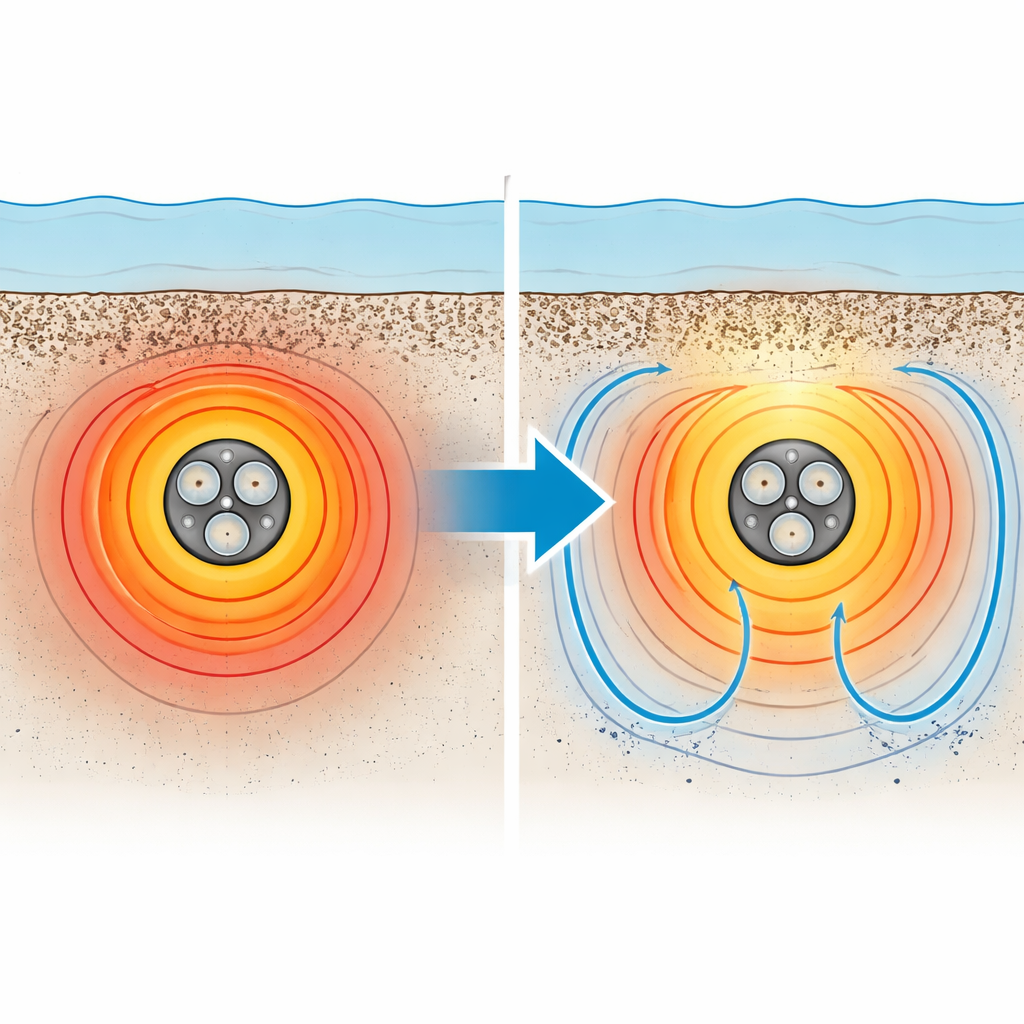
What It Means for Project Costs
Because cable cost is not just about buying and installing hardware, the authors linked their thermal results to a simple economic model. They combined equipment and installation expenses with the value of energy lost as heat over a 30-year lifetime, and routine maintenance, to calculate an investment index: the total cost divided by the cable’s current-carrying capacity. A lower index means more watts delivered per dollar invested. The analysis shows that shallower burial, higher soil thermal conductivity, and sufficiently high permeability all reduce this index, making projects more cost-effective. However, very shallow burial can expose cables to anchors, fishing gear, and waves, so engineers must balance thermal and economic advantages against mechanical risk and regulatory requirements.
Takeaway for Offshore Energy
For readers interested in the future of offshore wind, the study’s message is straightforward: the seabed is not just a passive backdrop. Its temperature, grain size, and water pathways strongly influence how hard we can safely push the cables that connect offshore turbines to the grid, and how much that connection costs over its lifetime. By using a coupled electric–heat–flow model, the authors show that choosing cooler, more heat-conductive, and sufficiently permeable sediment layers—and avoiding unnecessarily deep burial—can allow higher power transfer and better returns on investment, provided that protection against physical damage is maintained.
Citation: Ye, M., Zhang, Y., Wu, H. et al. Analysis on the thermal performance and economic efficiency of XLPE submarine cable based on electric–thermal–hydraulic coupling simulation. Sci Rep 16, 9467 (2026). https://doi.org/10.1038/s41598-026-40092-7
Keywords: submarine power cables, offshore wind, seabed sediments, heat transfer, cable reliability