Clear Sky Science · en
Regional variability in the Acheulian to Middle Stone Age transition in southern Africa
Why ancient stone tools still matter today
Long before cities, farming, or even our own species fully emerged, early humans were already shaping stone into tools. By studying how those tools changed, scientists can trace when and how our ancestors began thinking and living in ways that resemble us. This paper looks at a key turning point in that story on South Africa’s southern coast, revealing that human groups in different regions did not all modernize at the same pace or in the same way.
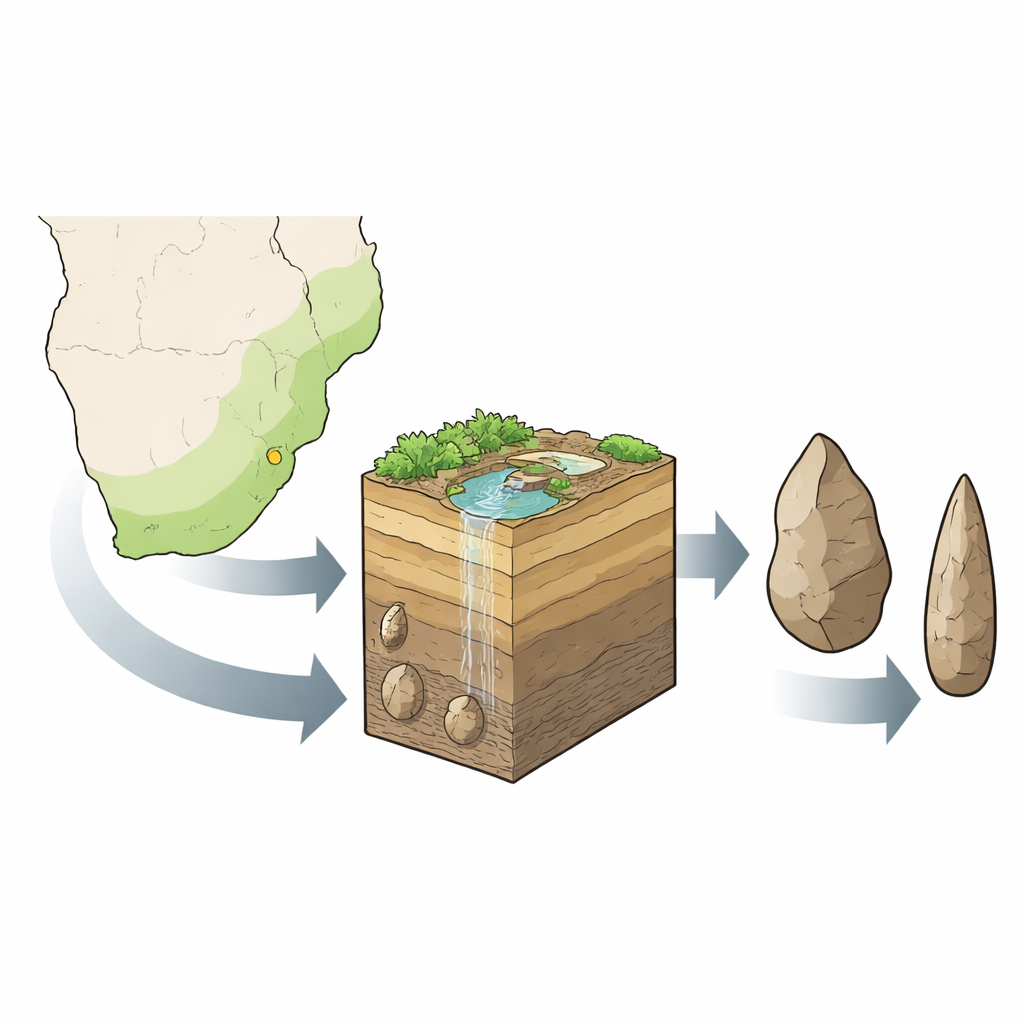
A spring that remembers hundreds of thousands of years
The research focuses on Amanzi Springs, an open-air site about 20 kilometers inland from Algoa Bay in South Africa’s Eastern Cape. Here, natural springs gradually filled a basin with layers of mud, sand, and plant remains over hundreds of thousands of years. Each layer trapped stone tools and traces of past environments, creating a stacked record from roughly 379,000 to 95,000 years ago. Because the deposits are not inside a cave, they offer a rare window into how people used the wider landscape. Using advanced forms of luminescence dating—which measure when grains of sand were last exposed to sunlight—the team built a detailed timeline for five main sediment horizons, from the oldest peat-rich layers at the base to younger silts near the surface.
From heavy handaxes to lighter, sharper tools
In the oldest horizons, the stone tool kit is clearly Acheulian, a long-lasting tradition marked by large cutting tools such as handaxes and cleavers. These implements, made mostly from locally available quartzite cobbles, were shaped by relatively simple flaking methods. The cores from which flakes were struck show short reduction sequences and little fine preparation. As the sequence moves upward in time, these heavy-duty tools remain common until at least about 311,000 years ago, showing that this earlier way of making and using stone tools persisted along the southern coast even as other African regions were already experimenting with new techniques.
Arrival of a new way of making tools
Around 230,000 years ago, the picture shifts. In the overlying layers, archaeologists see the first clear signs of the Middle Stone Age on this coastline. New core-working methods appear, including more carefully prepared cores that allowed knappers to strike off flakes of predictable size and shape. These techniques, often called prepared core methods, generate smaller, thinner flakes and occasional blades, which provide more cutting edge for less raw material. Stoneworkers also begin to use a wider range of rock types, including silcrete and fine-grained stones brought in from outside the immediate spring area. Retouched pieces—such as notched flakes, denticulated (tooth-like) edges, and scrapers—become more common, hinting at a broader range of tasks and more flexible toolkits.
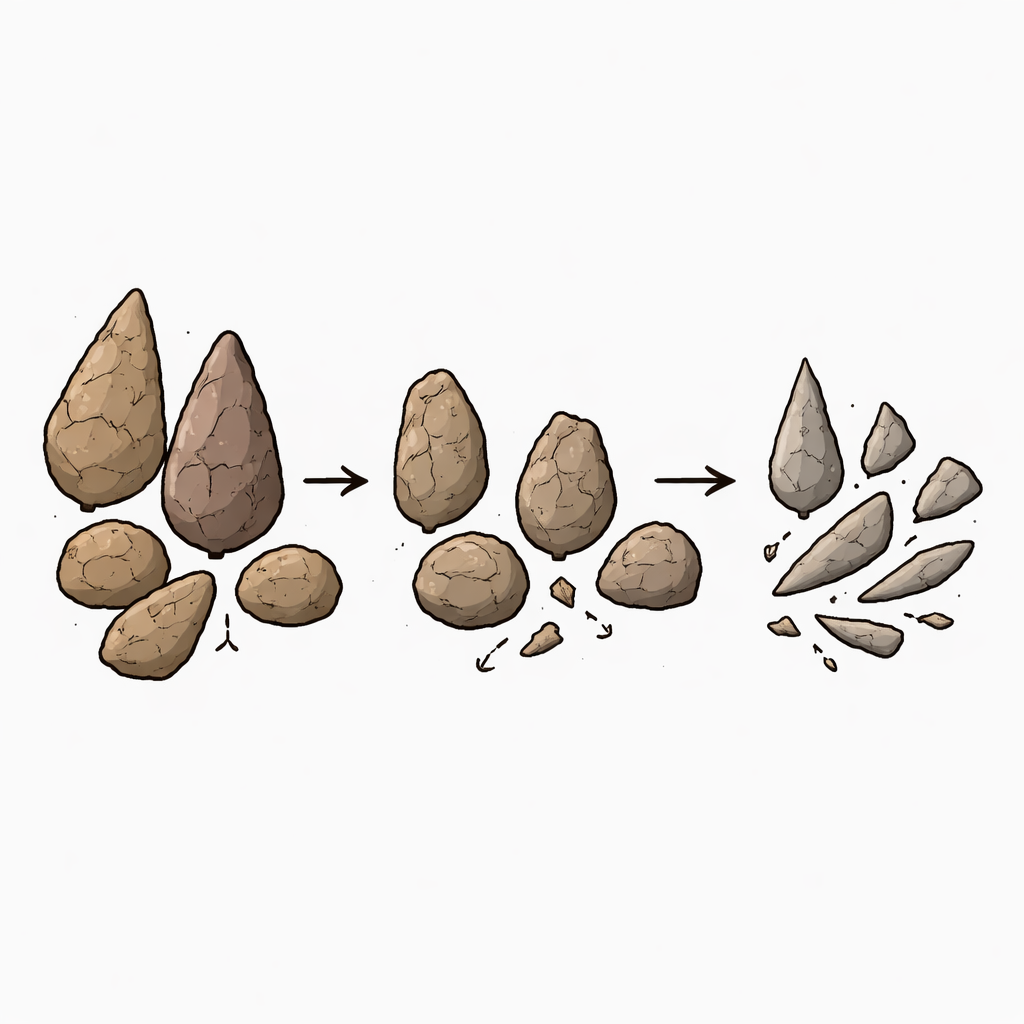
Change with continuity, not a sudden revolution
Despite these innovations, the shift at Amanzi Springs is not a sharp break. Many of the same core types and flaking strategies used in the Acheulian continue into the early Middle Stone Age layers, and a few large tools still occur, although there is no sign they were being made on site anymore. This mix suggests that local groups gradually added new methods rather than suddenly replacing older ones or being replaced themselves. At the same time, the southern coastal plain seems to have followed its own timetable: the Middle Stone Age arrives here tens of thousands of years later than in the interior plateau of southern Africa and in parts of eastern Africa, where blades and highly prepared cores appear earlier.
Many paths on the road to being human
For a non-specialist, the key message is that the road toward modern human behavior was not a single, synchronized march across Africa. Instead, different regions explored new technologies and ways of living at different times, shaped by local landscapes, climates, and possible barriers such as mountain ranges and shifting coastlines. Amanzi Springs shows that along South Africa’s southern coast, older tool traditions endured for a long time before new, more efficient Middle Stone Age methods took root. This regional variability fits with genetic and fossil evidence that our species emerged from a web of interacting populations across the continent, each contributing its own chapter to the story of how we became human.
Citation: Blackwood, A.F., Wilkins, J., Arnold, L.J. et al. Regional variability in the Acheulian to Middle Stone Age transition in southern Africa. Sci Rep 16, 9529 (2026). https://doi.org/10.1038/s41598-026-40075-8
Keywords: Middle Stone Age, Acheulian, southern Africa, stone tools, human evolution