Clear Sky Science · en
Parametric study on the behavior of CFRP-strengthened reinforced concrete deep beams with cut circular web openings in shear spans
Why cutting holes in big concrete beams matters
Modern buildings and bridges hide a jungle of pipes, cables, and ducts. To make room for them, engineers often drill holes through thick concrete beams after construction. This study asks a simple but crucial question: what really happens to those beams when sizeable round holes are cut through them, and can thin carbon-fiber sheets glued to the concrete safely make up for the lost strength? The answers affect how safely we can upgrade or retrofit existing structures without expensive rebuilding.
How deep beams carry loads in the first place
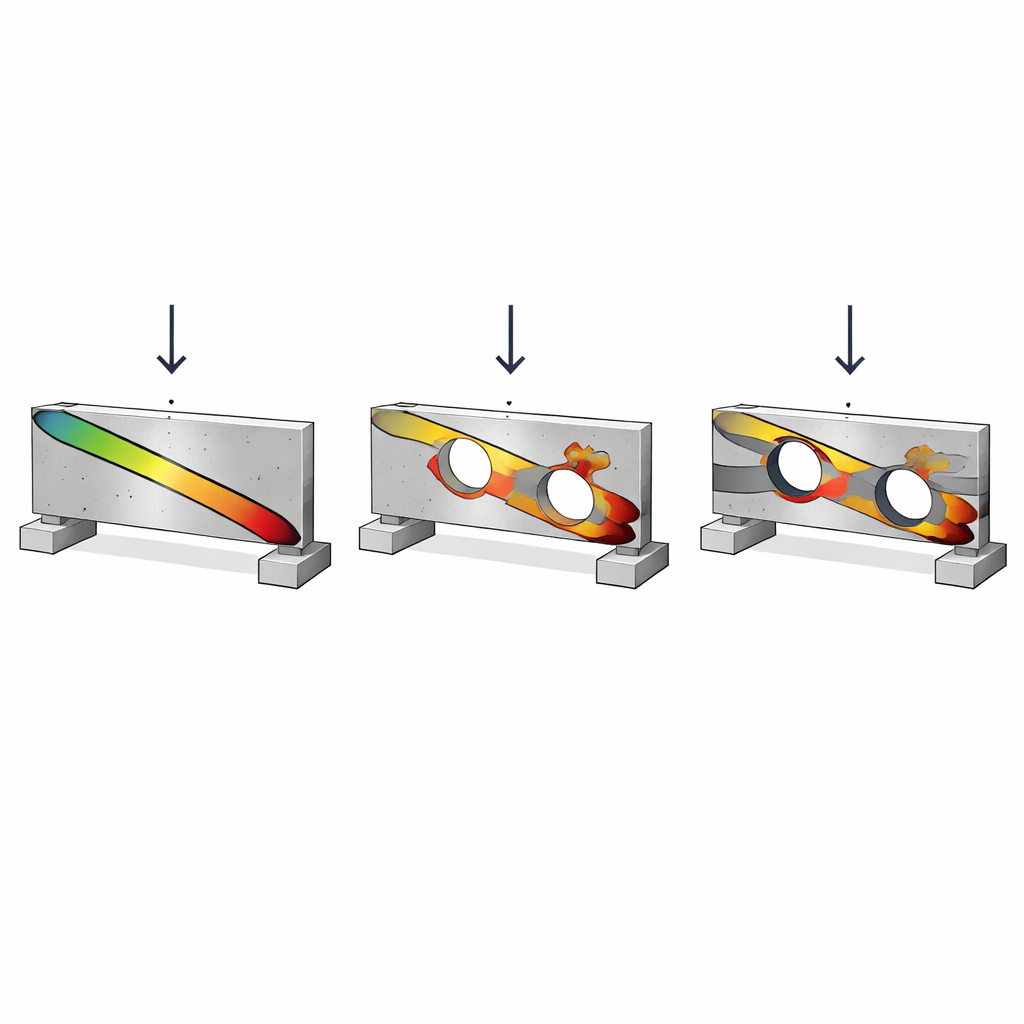
Deep concrete beams behave differently from the familiar slender beams in floors. Instead of bending gently, they push forces along short, steep compression paths that run diagonally from where the load is applied down to the supports. Steel bars and stirrups inside the beam help hold everything together, especially against diagonal cracking. When the internal layout is intact, these hidden paths allow deep beams to carry very large loads with relatively compact dimensions.
What happens when round holes are drilled later
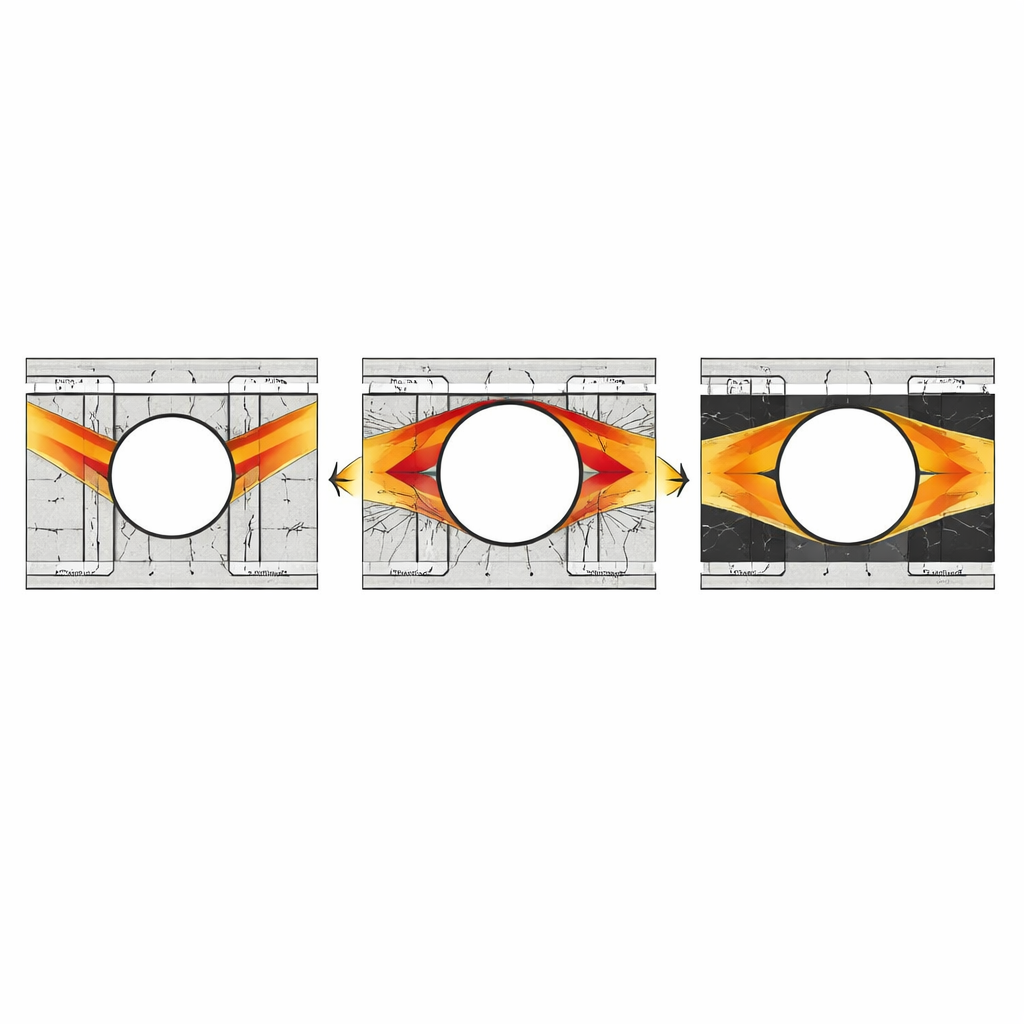
In real projects, many openings are not planned in advance. Contractors often drill circular holes straight through the existing concrete, cutting not only the concrete but also the steel stirrups that were meant to carry shear forces. This study focused on such “post-installed” openings in the most sensitive zone of the beam, the shear span, and on cases where the holes are placed symmetrically. Computer models calibrated against real laboratory tests showed that even modest openings in this region sharply reduce how much load the beam can carry and how much deformation energy it can absorb before failing. As the hole diameter grows from 150 to 300 mm in a 500 mm deep beam, the failure pattern shifts from mainly diagonal cracking to sudden crushing of concrete above and below the opening.
Testing the help from carbon fiber wraps
To see how much of this damage can be undone, the researcher simulated wrapping the region around the openings with thin laminates made of carbon fiber–reinforced polymer, or CFRP. These strips, bonded to the beam surface, act like external reinforcement straps that can catch and redistribute forces after cracks form. The study varied both the size of the openings and the thickness of the CFRP layers. For each combination, the model tracked load–deflection curves, crack patterns, and the amount of energy the beam could absorb before failure, allowing a careful comparison with an identical solid beam without openings.
How much strength is really lost and regained
The numbers tell a clear story. Without any strengthening, a 300 mm circular opening in a 500 mm deep beam reduced the maximum load capacity by more than half and the energy absorption by almost ninety percent compared with the solid reference beam. Even smaller openings inside the shear span caused substantial drops in performance. Adding CFRP laminates helped, improving both strength and toughness, and thicker laminates generally worked better. Yet the gains were limited: beams with large openings and even the thickest CFRP never fully recovered the strength of the solid beam. The benefit of extra carbon fiber also diminished as the opening grew, because the underlying load path inside the concrete had been too badly disrupted.
What this means for real buildings
For non-specialists, the central message is straightforward: drilling big round holes through thick concrete beams in critical zones is much more harmful than it might look, especially when it severs internal steel ties. Carbon fiber wraps can make such damaged beams safer and more resilient, but they cannot completely restore the original capacity when openings are large or cut through key reinforcement. The study’s detailed computer analysis provides a guide for engineers on how opening size and strengthening thickness interact, reinforcing the idea that careful planning of service holes during design is far safer than cutting them later and trying to repair the damage.
Citation: Yagmur, E. Parametric study on the behavior of CFRP-strengthened reinforced concrete deep beams with cut circular web openings in shear spans. Sci Rep 16, 9414 (2026). https://doi.org/10.1038/s41598-026-40071-y
Keywords: concrete beams, web openings, CFRP strengthening, structural retrofitting, shear behavior