Clear Sky Science · en
Enhanced stability and reusability of metagenomic laccase via immobilization on functionalized mesoporous silica for antibiotic contaminant removal
Why leftover medicines in water matter
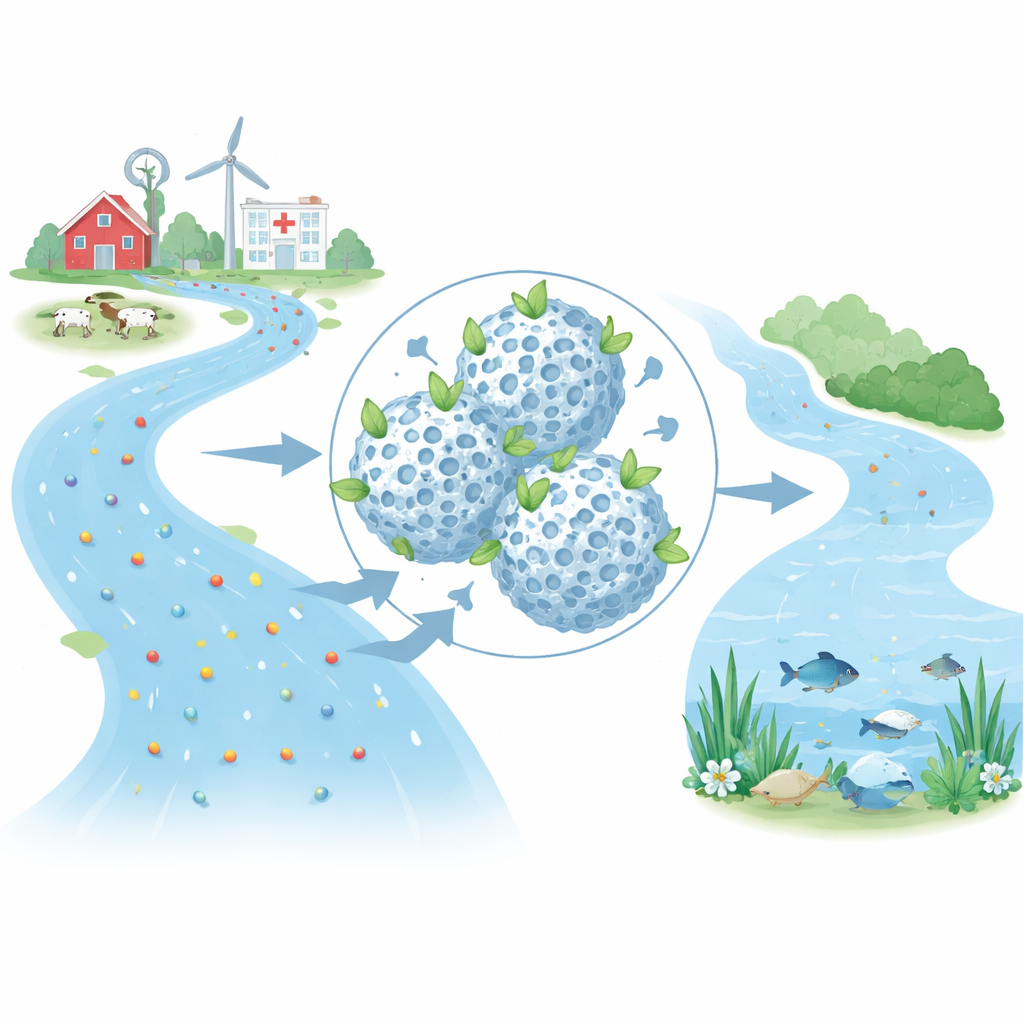
Antibiotics such as tetracycline and doxycycline are used widely in hospitals, clinics, and livestock farms. Much of each dose leaves the body unchanged and ends up in wastewater, rivers, and soil, where it can harm helpful microbes and encourage drug‑resistant bacteria. This study explores a new enzyme‑based material designed to strip these stubborn antibiotics from water more efficiently and in a way that can be reused many times, pointing toward cleaner and more sustainable treatment systems.
A natural cleaner gets a helping hand
Laccases are enzymes made by microbes and fungi that act like tiny oxidation machines, able to break down many complex chemicals. On their own in water, however, laccase molecules are fragile: they lose activity at high temperatures, are hard to recover after use, and can simply wash away. The researchers worked with a particularly tough laccase, named PersiLac1, discovered from environmental DNA (metagenomic) surveys rather than from a single cultured microbe. Their goal was to attach this enzyme firmly onto a solid support so it would become easier to handle, longer‑lasting, and better suited for cleaning up antibiotic pollution.
Building a porous scaffold for the enzyme
To house the laccase, the team chose SBA‑15, a type of silica with an orderly network of tiny channels and a very large internal surface area, resembling a sponge at the nanoscale. They first decorated the surface of this material with imidazole groups—small organic “hooks” that help form strong bonds with proteins—creating a functionalized carrier called Im@SBA‑15. When PersiLac1 was mixed with this modified silica, the enzyme became covalently attached, producing a new hybrid material referred to as LAC@Im@SBA‑15. Microscopy and spectroscopic tests confirmed that the basic pore structure of SBA‑15 was preserved while the organic groups and enzyme were successfully introduced.
Stronger performance under tough conditions
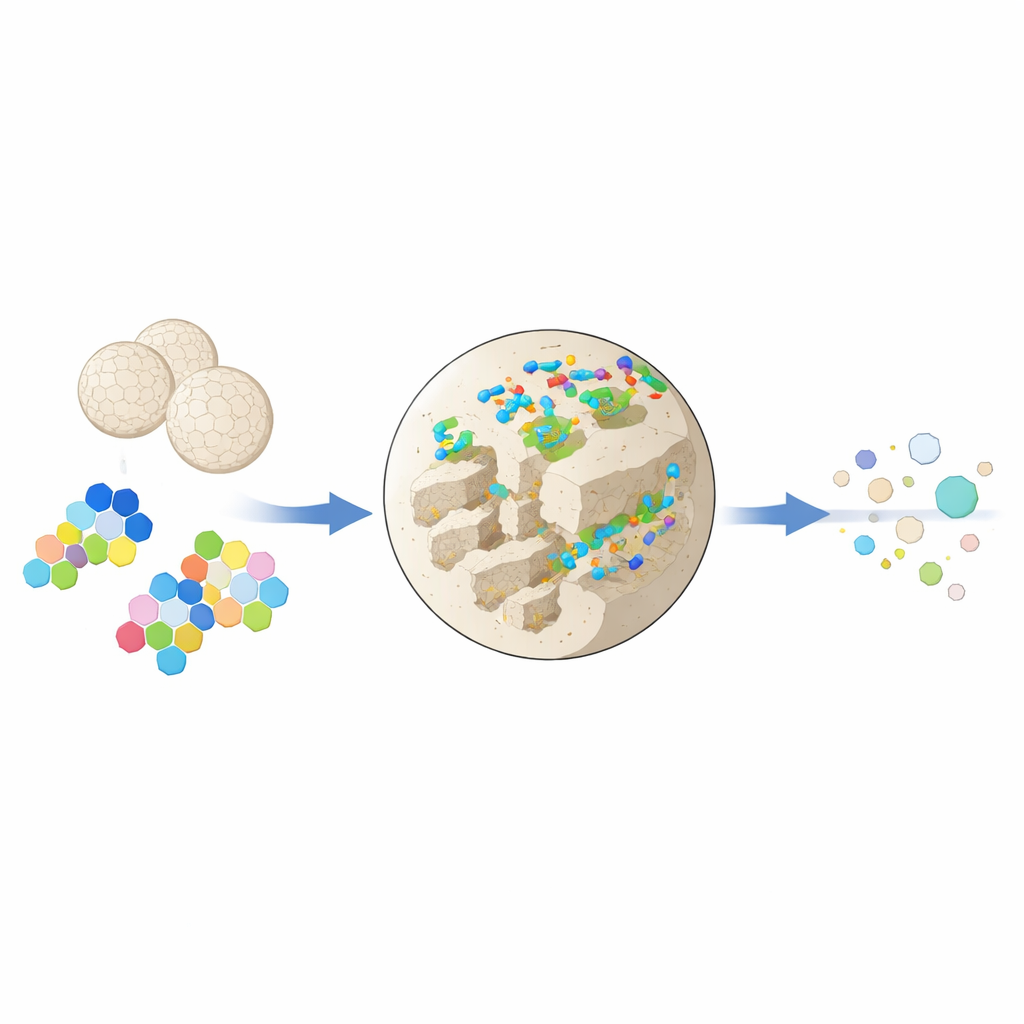
The immobilized laccase behaved differently from the free enzyme in solution. Both worked best around 50 °C and pH 6, but the attached enzyme kept more of its activity at higher temperatures and across a broader pH range. Tests of enzyme loss, known as leaching, showed that only about 10% of PersiLac1 washed out after several hours at room temperature, and roughly 22% after heating to 80 °C, indicating tight binding to the support. When challenged with tetracycline and doxycycline, the immobilized form removed substantially more antibiotic over 24 hours than the free enzyme—about 54% of tetracycline and 77% of doxycycline at 350 mg/L, levels typical of highly polluted waste streams.
Handling higher pollution and being reused
Real‑world wastewater may contain much higher antibiotic levels than standard lab tests. The team therefore increased the starting concentration up to 200–300 mg/L. While free laccase struggled as concentrations rose, the immobilized enzyme maintained or even improved its removal efficiency, reaching around 44% for both antibiotics at 200 mg/L and showing better performance than the free form at the highest levels tested. Just as important, the hybrid material could be collected, washed, and used again. Over ten treatment cycles with lower antibiotic levels (25 mg/L), it retained more than 83% of its initial activity for doxycycline and 73% for tetracycline, suggesting that such a system could operate repeatedly without constant enzyme replacement.
Promise and next steps for cleaner water
In plain terms, the researchers have built a reusable "enzyme filter" that is more stable and effective than the same enzyme floating freely in water. By anchoring a robust, metagenome‑derived laccase onto a carefully designed porous mineral support, they achieved strong removal of two widely used antibiotics, even at high concentrations and over many cycles of use. The work was carried out in simplified test solutions, so the next challenge is to see how well this material performs in real wastewater, where many other substances are present and breakdown by‑products must also be checked for safety. Still, this hybrid enzyme–silica platform represents a promising step toward greener technologies for keeping our water systems free from lingering medicinal pollutants.
Citation: Ariaeenejad, S., Abedanzadeh, S. Enhanced stability and reusability of metagenomic laccase via immobilization on functionalized mesoporous silica for antibiotic contaminant removal. Sci Rep 16, 9933 (2026). https://doi.org/10.1038/s41598-026-40065-w
Keywords: antibiotic pollution, enzyme immobilization, laccase, wastewater treatment, mesoporous silica