Clear Sky Science · en
Local heating induces an increase in the pulse wave velocity in peripheral vessels
Warming the Skin and Watching the Pulse
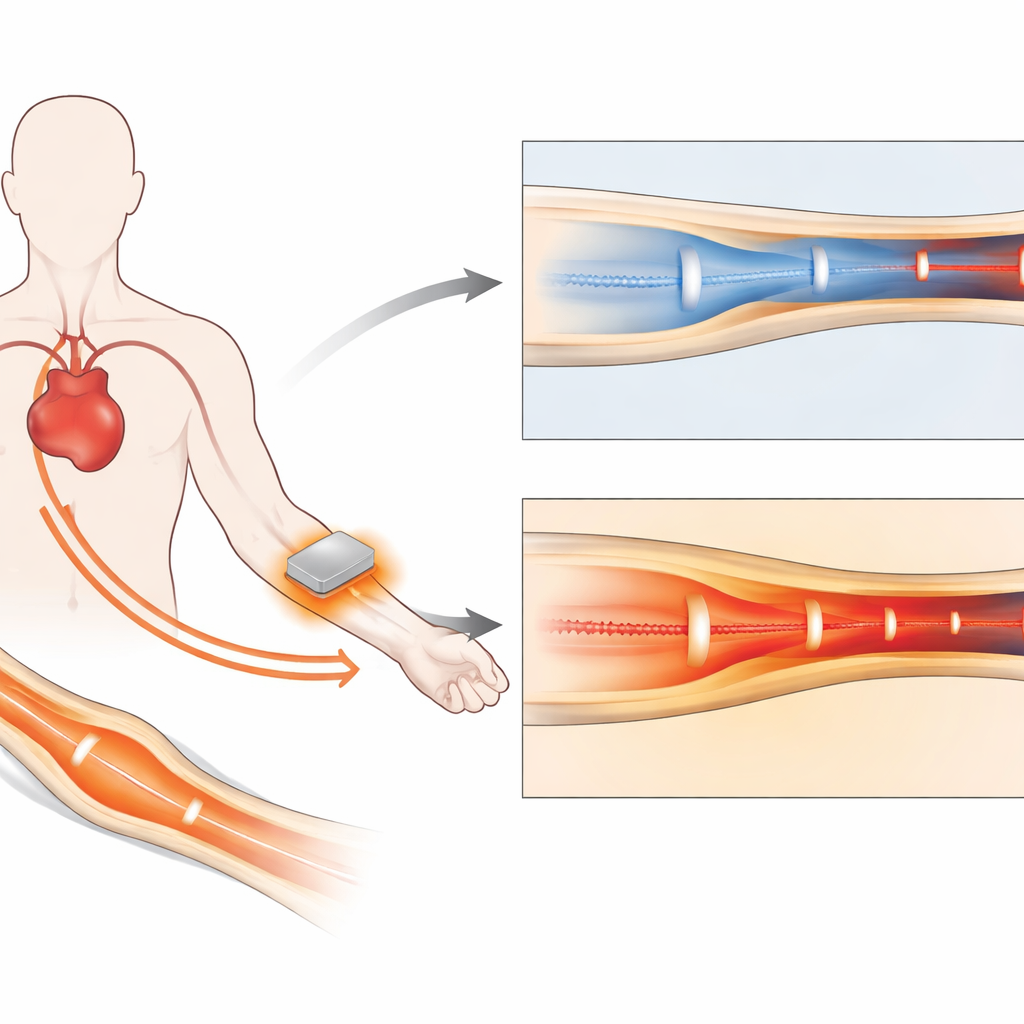
When you put a warm pack on your arm, your skin flushes and feels different almost at once. But under the surface, your heartbeat’s pressure wave is also changing how it travels through tiny vessels. This study shows that gently heating a small patch of forearm skin not only makes local blood flow stronger, it also makes the pulse wave race through that area faster. Understanding this hidden response could help doctors evaluate blood vessel health without needles or cuffs, using nothing more than light and a heart monitor.
Why Tiny Vessels Matter for Everyday Health
The body’s smallest blood vessels, especially those in the skin, are key players in both temperature control and overall circulation. Their behavior can reveal early signs of heart and blood vessel disease, problems with nerves, or complications of conditions like diabetes and obesity. Many tools already exist to study skin blood flow, but they often look only at limited areas or require direct contact with the skin. The team behind this work uses a contactless optical method that can watch blood pulsations over a wide area, opening the door to new, painless tests of microcirculation in clinics and operating rooms.
A Camera That Sees Your Pulse
The researchers combined a video-based technique called imaging photoplethysmography with a standard electrocardiogram of the heartbeat. Green light was shone on the forearm while a camera recorded subtle changes in reflected light, which track the rhythmic filling and emptying of vessels with each heartbeat. At the same time, electrical signals from the heart were captured. By carefully stabilizing the images to reduce motion noise and processing each heartbeat separately, the team could measure two key features at thousands of tiny spots on the skin: how strong the pulse wave is, and how long it takes to arrive after each heartbeat. From this delay, they inferred how fast the pulse wave travels through the local vascular network.
Heating a Small Patch of Skin
Forty-seven healthy volunteers had a glass heater gently placed on the distal part of the forearm. After a short baseline period, the skin under the glass was warmed to about 41 degrees Celsius and held there for 15–20 minutes, while the rest of the arm stayed at room temperature. The camera and heart monitor recorded continuously. Across 67 sessions, the same pattern appeared: in the warmed zone, the size of the pulse wave, reflecting how much blood volume oscillates with each beat, rose sharply—often more than sevenfold and up to about twentyfold in some people. Meanwhile, the time it took the pulse wave to reach that area shrank by roughly a third, typically by around 50 milliseconds. Outside the heated patch, these changes were small or absent, and overall heart rate did not shift, underscoring that the effect was local rather than a whole-body reaction.
What Happens Inside the Microvascular Maze
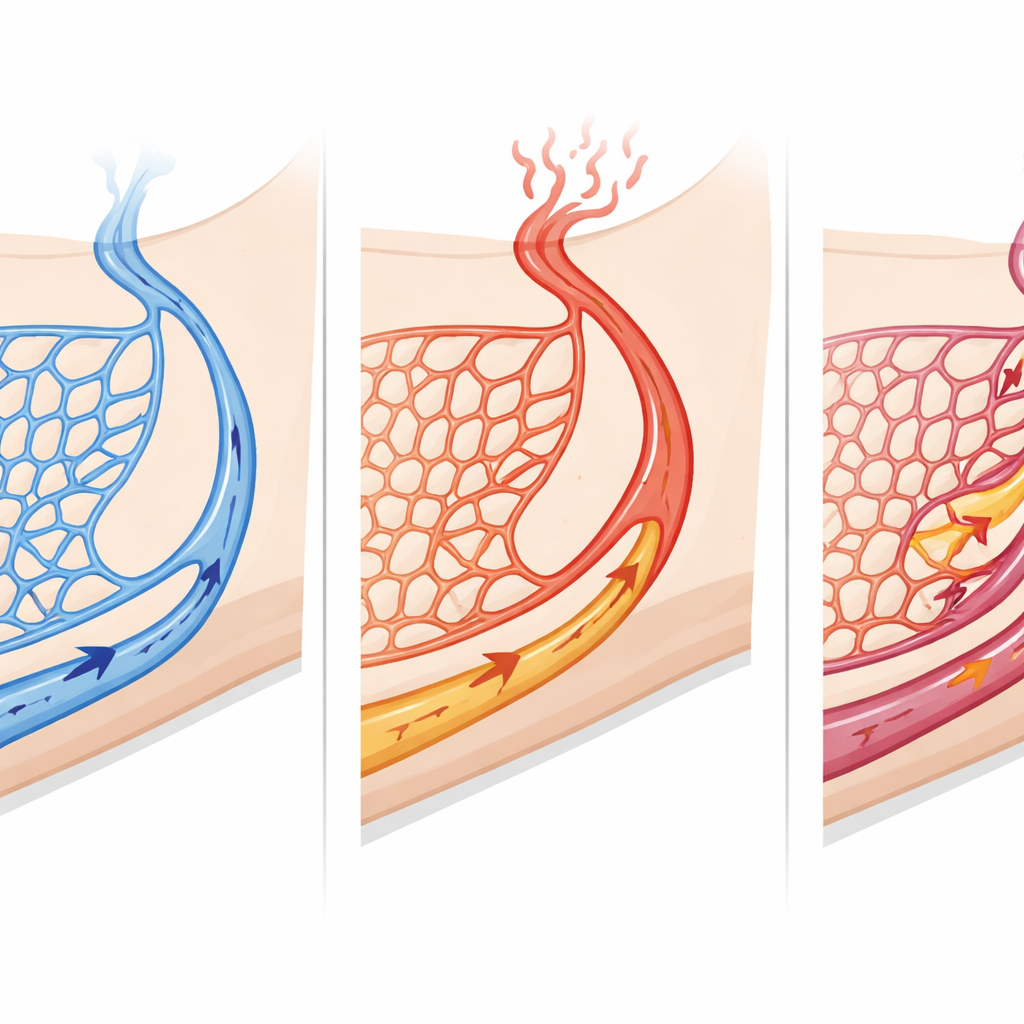
How can warming a few square centimeters of skin make the pulse wave move faster there? The authors argue that the answer lies in special shortcuts within the microcirculation known as arteriovenous connections, which can divert blood directly from small arteries to veins, bypassing dense capillary networks. Heat causes the feeding small arteries and these shortcuts to widen and become more flexible, greatly boosting the motion of their walls with each heartbeat and reducing resistance along certain paths. At the same time, the overall amount of non-pulsating blood in the upper layers of skin changes only modestly, suggesting that the number of active capillaries does not explode. Instead, blood is being redistributed through deeper, more pulsatile routes that favor faster wave transmission.
Implications for Vascular Health
For a layperson, the core message is that the speed of your pulse wave depends not just on the stiffness of major arteries but also on how blood is routed through the finest vessels near the surface. By watching both the strength and timing of the pulse in a small heated region, this non-contact camera-and-ECG system can detect how these hidden pathways respond. The work suggests a new way to probe microvascular function and temperature control in real time, which could one day help doctors spot early vessel problems, track treatment effects, or study how conditions like obesity or cardiovascular risk factors alter the body’s ability to redirect blood where it is needed most.
Citation: Kamshilin, A.A., Podolyan, N.P., Mizeva, I.A. et al. Local heating induces an increase in the pulse wave velocity in peripheral vessels. Sci Rep 16, 9002 (2026). https://doi.org/10.1038/s41598-026-40041-4
Keywords: microcirculation, pulse wave velocity, skin blood flow, local heating, photoplethysmography