Clear Sky Science · en
Comparative effectiveness of minimally invasive therapies for plantar fasciitis: a systematic review and network meta-analysis
Why Heel Pain Matters
Persistent heel pain can turn everyday activities—like getting out of bed or going for a walk—into a real struggle. Plantar fasciitis, one of the most common causes of heel pain, affects millions of adults and many runners each year. Because so many different treatments are offered in clinics—from injections to sound wave devices—it can be hard for patients and doctors to know what actually works best, and when. This study pulls together results from dozens of trials to compare popular minimally invasive options head-to-head and map out which ones help most over time.
Many Ways to Calm an Angry Heel
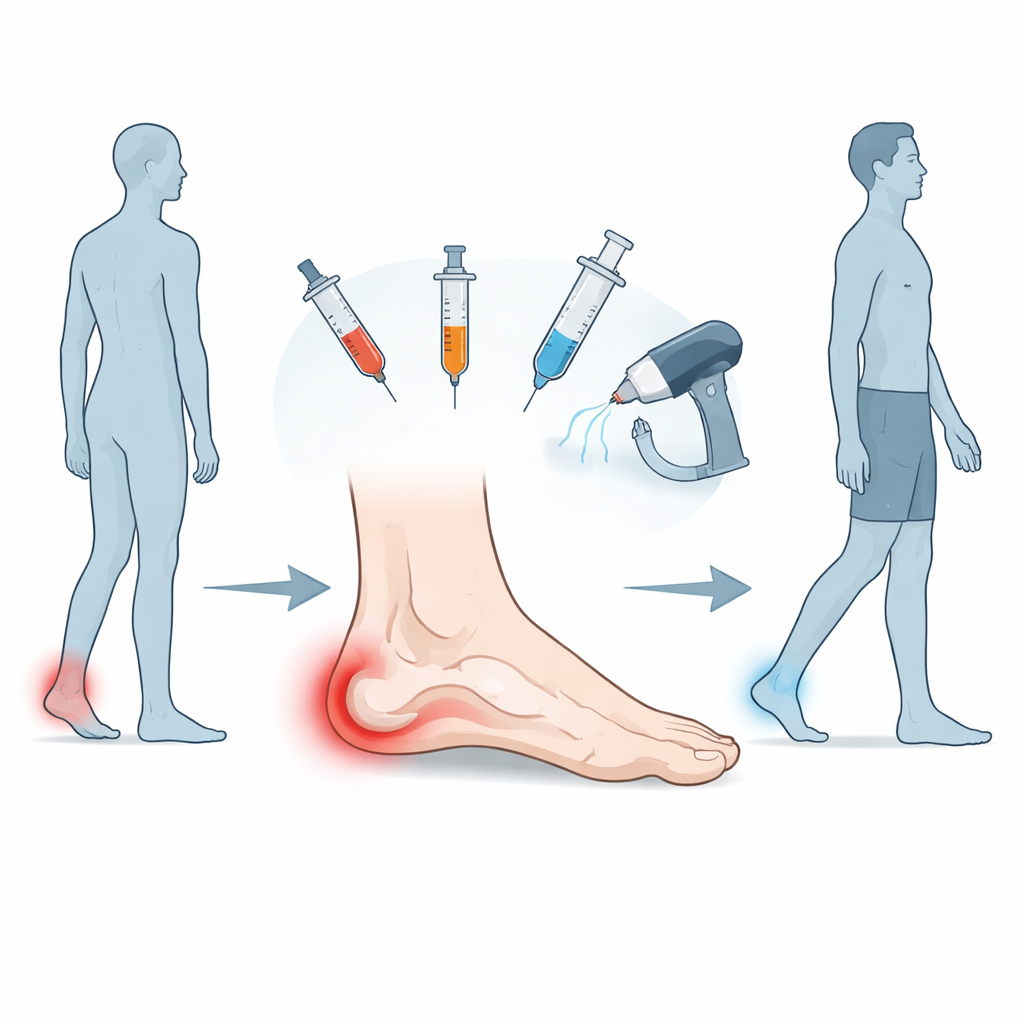
The authors focused on people with plantar fasciitis who had already tried basic measures such as rest, stretching, pain tablets, and shoe inserts. They examined more than sixty randomized clinical trials involving over four thousand participants. The treatments they compared included several kinds of injections (corticosteroids, platelet-rich plasma taken from a person’s own blood, dextrose “prolotherapy,” botulinum toxin A, local anesthetic, and whole blood) as well as extracorporeal shock wave therapy, a device that sends pressure waves through the heel. By using a method called network meta-analysis, the team could compare all of these choices at once, even if some had never been tested directly against each other in a single trial.
Looking at Pain, Movement, and Tissue Change
To make sense of the many studies, the researchers sorted outcomes into three practical questions: How much did the treatment reduce pain? How well could people use their feet in daily life? And did the thickened band of tissue under the heel—the plantar fascia—actually shrink on scans? They also divided results by time. Short-term meant up to six weeks after treatment, mid-term covered six to twelve weeks, and long-term meant beyond three months. This timeline is important because some treatments may offer quick relief that fades, while others work more slowly but last longer.
Quick Fixes Versus Lasting Relief
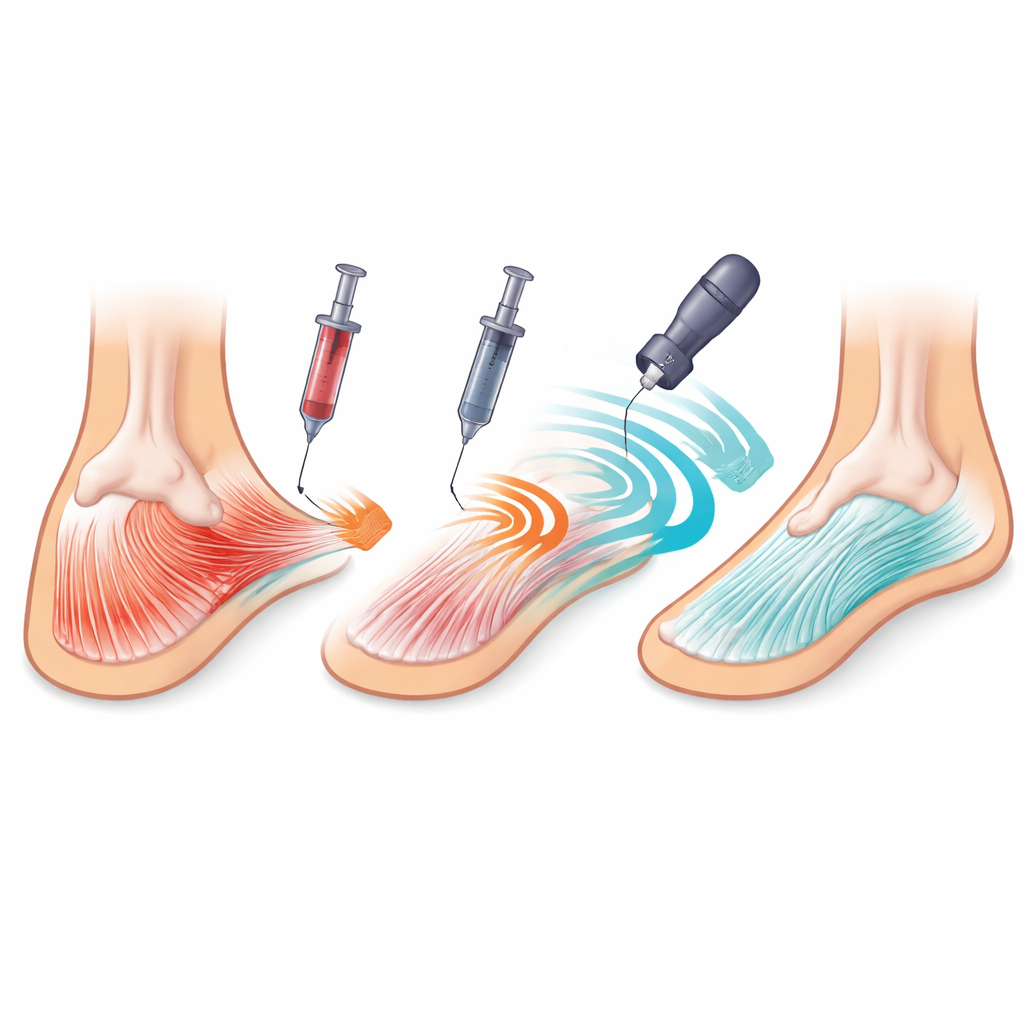
The analysis showed that no single therapy was best at everything. In the first few weeks, botulinum toxin A injections stood out for easing pain and slightly thinning the plantar fascia, while corticosteroid injections gave the biggest improvements in foot function. Shock wave therapy and platelet-rich plasma also beat placebo in the short term. As time went on, however, the ranking shifted. In the mid-term and long-term, dextrose prolotherapy provided the most reliable and durable pain relief, outperforming both steroids and some other injections. Platelet-rich plasma rose to the top for improving function and reducing fascia thickness in the medium and longer ranges, suggesting it helps the tissue remodel rather than just masking symptoms. Shock wave therapy showed steady benefits across time points, offering a non-surgical option with broad, if not always top-ranked, effects.
What the Findings Mean in Practice
These patterns suggest that treatments for plantar fasciitis should be matched to a person’s goals and how long they have been in pain. Someone desperate for immediate relief may benefit from a short-acting option such as botulinum toxin A or a carefully used steroid shot, understanding that these are unlikely to solve the problem for good and that repeated steroid injections can carry risks. For people with symptoms that drag on for months, prolotherapy with dextrose and platelet-rich plasma appear to offer more lasting benefit by nudging the tissue toward healing. Shock wave therapy provides another route for those who prefer to avoid needles. At the same time, the authors stress that all of these approaches mainly target the sore tissue itself and do not correct underlying foot mechanics, such as arch collapse or ankle alignment, which can keep strain on the fascia.
Take-Home Message for Patients
For those living with stubborn heel pain, this study’s bottom line is reassuring: several minimally invasive therapies do work, but they work in different ways and on different timelines. Rather than relying on one “magic shot,” the evidence supports a tailored plan. Short-term pain control can be combined with longer-acting, tissue-focused treatments like dextrose prolotherapy, platelet-rich plasma, or shock wave therapy, plus attention to shoes, insoles, and strengthening to correct how the foot loads with each step. In plain terms, the most effective path out of plantar fasciitis is not a single procedure, but a smart mix of tools chosen to match the stage of the condition and the patient’s everyday needs.
Citation: Tien, C.H., Chiu, M.C., Shen, Y.L. et al. Comparative effectiveness of minimally invasive therapies for plantar fasciitis: a systematic review and network meta-analysis. Sci Rep 16, 9074 (2026). https://doi.org/10.1038/s41598-026-40038-z
Keywords: plantar fasciitis, heel pain, injection therapy, shock wave treatment, platelet rich plasma