Clear Sky Science · en
Investigating perceptual discrimination thresholds for attributes of whole-body vibration
Why tiny vibrations matter to everyday technology
From the hum of a car seat to the buzz of a game controller, subtle vibrations quietly shape how we experience machines and digital worlds. Yet designers still have only rough guesses about how small a change in vibration people can actually feel, and how those changes map onto everyday descriptions like “weak,” “tingling,” or “fading.” This study set out to measure those limits precisely for whole-body vibrations, building a foundation for more natural, informative haptic feedback in cars, virtual reality, medical devices, and assistive technologies.
Turning everyday feelings into measurable signals
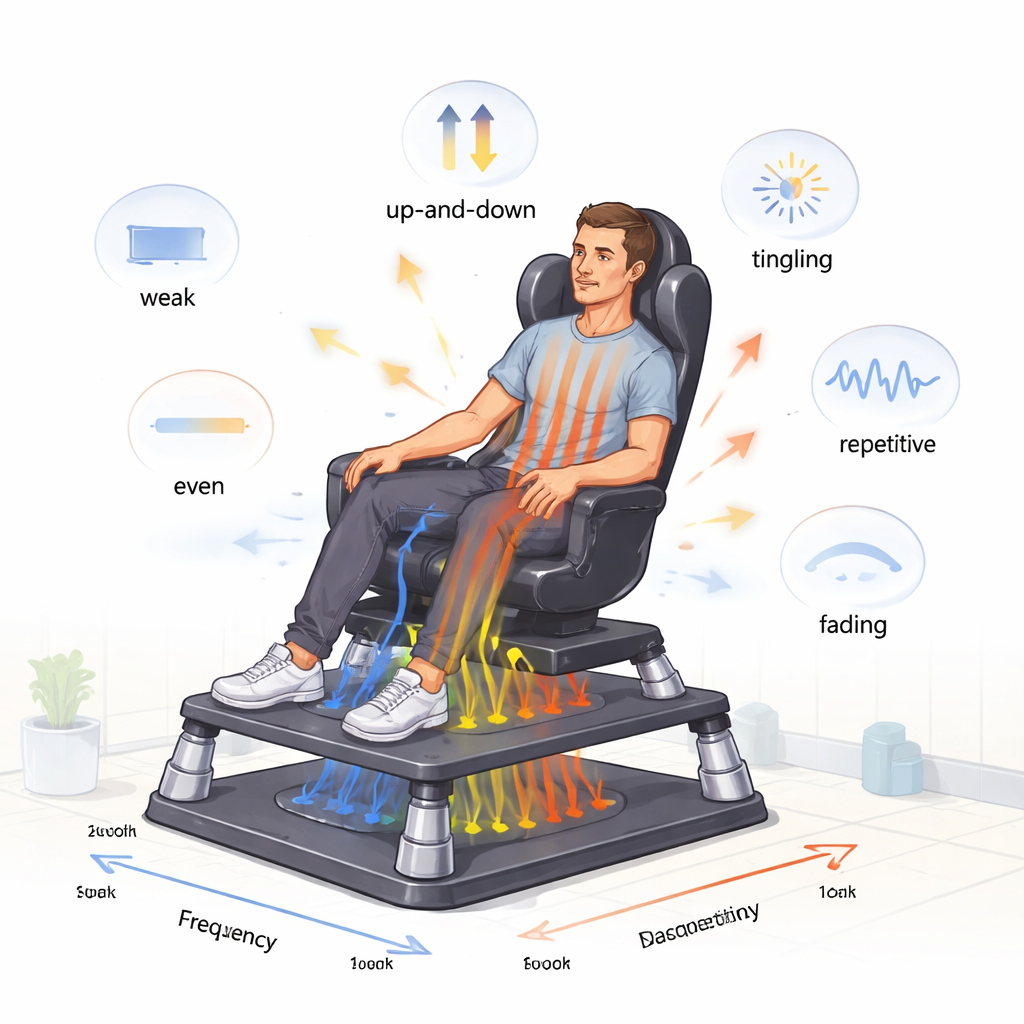
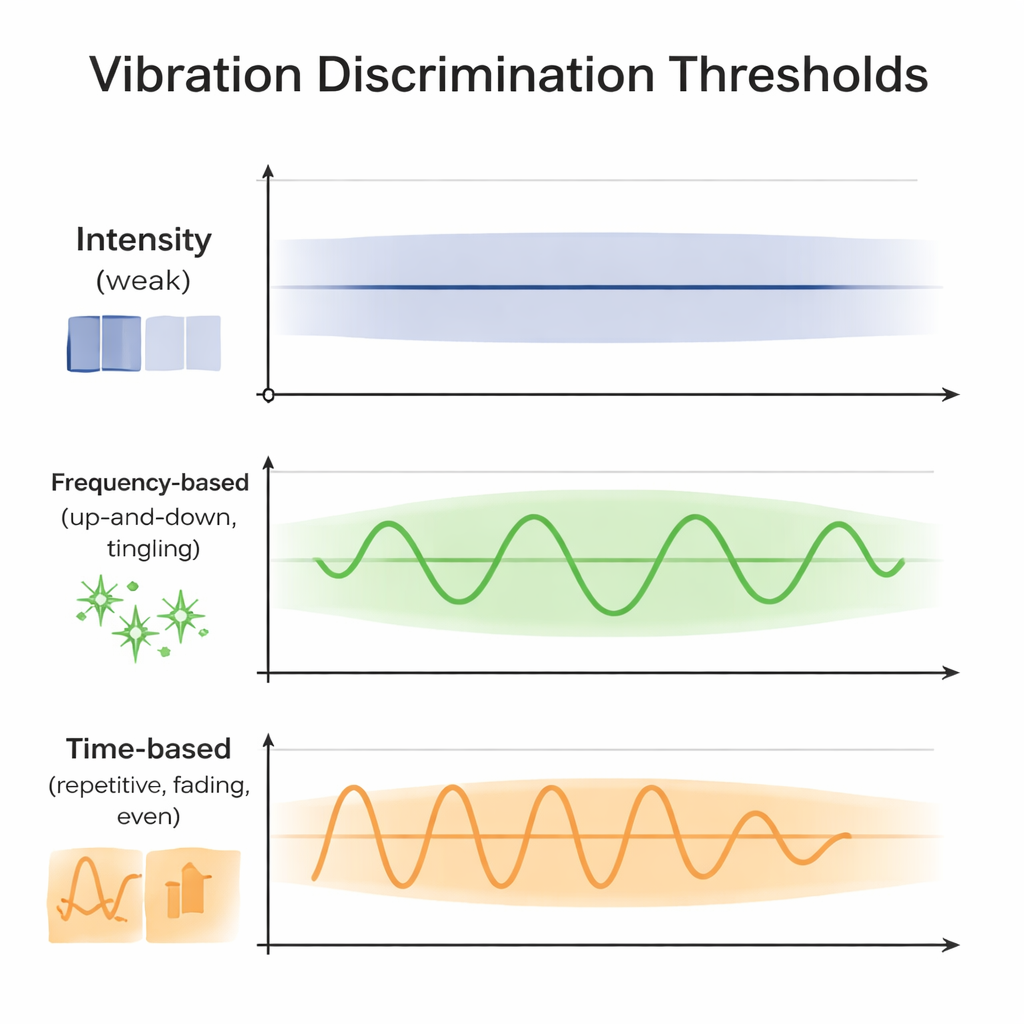
The researchers focused on six intuitive ways people describe vibrations: “weak,” “up-and-down,” “tingling,” “repetitive,” “even,” and “fading.” Each word was tied to a specific property of the vibration signal. “Weak” referred to how strong the vibration felt; “up-and-down” and “tingling” were linked to vibration frequency—how fast it shook. “Repetitive” captured rhythmic pulsing created by slowly turning the vibration on and off. “Even” described how smooth and full the vibration felt across a band of frequencies, and “fading” referred to how quickly a brief jolt died away. By anchoring simple language to concrete physical parameters, the team aimed to create a bridge between what engineers can control and what users actually feel.
Carefully controlled shakes in the lab
To probe these sensations, 11 volunteers sat in a racing-style seat mounted on a sophisticated motion platform and an electrodynamic shaker, capable of producing vibrations from gentle rocking at 1 hertz up to a rapid buzz at 300 hertz. For each attribute, participants were first given a clear “reference” vibration—defined as 100 points on a rating scale for that specific feeling. They were then presented with comparison vibrations that differed slightly in strength, frequency, rhythm, smoothness, or decay and asked to rate how strongly each test vibration expressed the target attribute relative to the reference. By analyzing when those ratings started to shift reliably, the researchers could identify “just noticeable differences,” the smallest physical changes that produced a recognizable change in perceived quality.
How finely tuned our sense of vibration really is
The results revealed that people can be remarkably sensitive to some aspects of whole-body vibration and less so to others. For “weak,” the threshold for noticing a change in strength was about 2 decibels—roughly a small but clear step in intensity—across the tested range, aligning with classic findings from hearing research. For “tingling,” people could detect relatively small shifts in high-frequency vibrations (around 120 hertz), noticing differences of about 10 to 20 hertz when frequencies were lowered. The “up-and-down” feeling, tied to lower-frequency motion, showed discernible changes of only a few hertz around 30 hertz. In contrast, timing-related attributes behaved differently: the “repetitive” rhythm became distinguishable when the modulation rate changed by only about 0.2 to 0.4 hertz at slow tempos, but needed much larger changes at faster rhythms. The “even” attribute depended on how wide a narrow band of noise was; adding just 1 to 2 hertz of bandwidth near a 3-hertz reference was enough to shift sensations from thin to fuller and more stable. For “fading,” people could tell when the decay rate of an impulse differed by as little as 0.5 in the decay parameter used, meaning they are quite attuned to how quickly a vibration dies out.
New rules for designing convincing haptic cues
These findings show that no single simple rule, such as a constant percentage change, can predict how people will sense every aspect of vibration. Intensity (“weakness”) follows classic psychophysical patterns, but rhythm, smoothness, and high-frequency texture do not. For designers, this means that a small change in amplitude may be easily felt, while an equally small change in rhythm or frequency may go unnoticed—or vice versa in other ranges. The authors argue that haptic systems, from car seats to VR controllers, should be tuned using attribute-specific thresholds: making sure that differences between haptic “icons” exceed these just-noticeable limits, while avoiding unnecessary overshoot that wastes power or creates discomfort.
What this means for future touch-based technology
By tying plain-language sensations like “tingling” and “fading” to precise physical thresholds, this work offers a quantitative toolkit for building more intuitive tactile experiences. Engineers can now design vibration patterns that are distinct enough to feel different, yet subtle enough to remain comfortable and believable. Whether the goal is a car seat that quietly signals road conditions, a VR system that feels more convincingly real, or an assistive device that communicates information through touch, these measured limits on human vibration perception provide a science-based roadmap for aligning technology with the natural sensitivities of the human body.
Citation: Kullukcu, B., Krautwurm, J., Merchel, S. et al. Investigating perceptual discrimination thresholds for attributes of whole-body vibration. Sci Rep 16, 7168 (2026). https://doi.org/10.1038/s41598-026-40033-4
Keywords: haptic perception, whole-body vibration, vibrotactile feedback, just noticeable difference, virtual reality