Clear Sky Science · en
Feasibility and effectiveness of distal radial access in ST-elevation myocardial infarction from a SPEEDY PCI subanalysis
Why How Doctors Reach the Heart Matters
When someone is having a serious heart attack, every minute counts. Doctors rush to open the blocked heart artery using thin tubes threaded through a blood vessel, often from the wrist. This study asks a simple but important question: can a newer way of going in through a tiny vessel near the thumb work just as fast—and just as safely—as the more familiar route at the usual wrist spot, even in the most time‑critical emergencies?
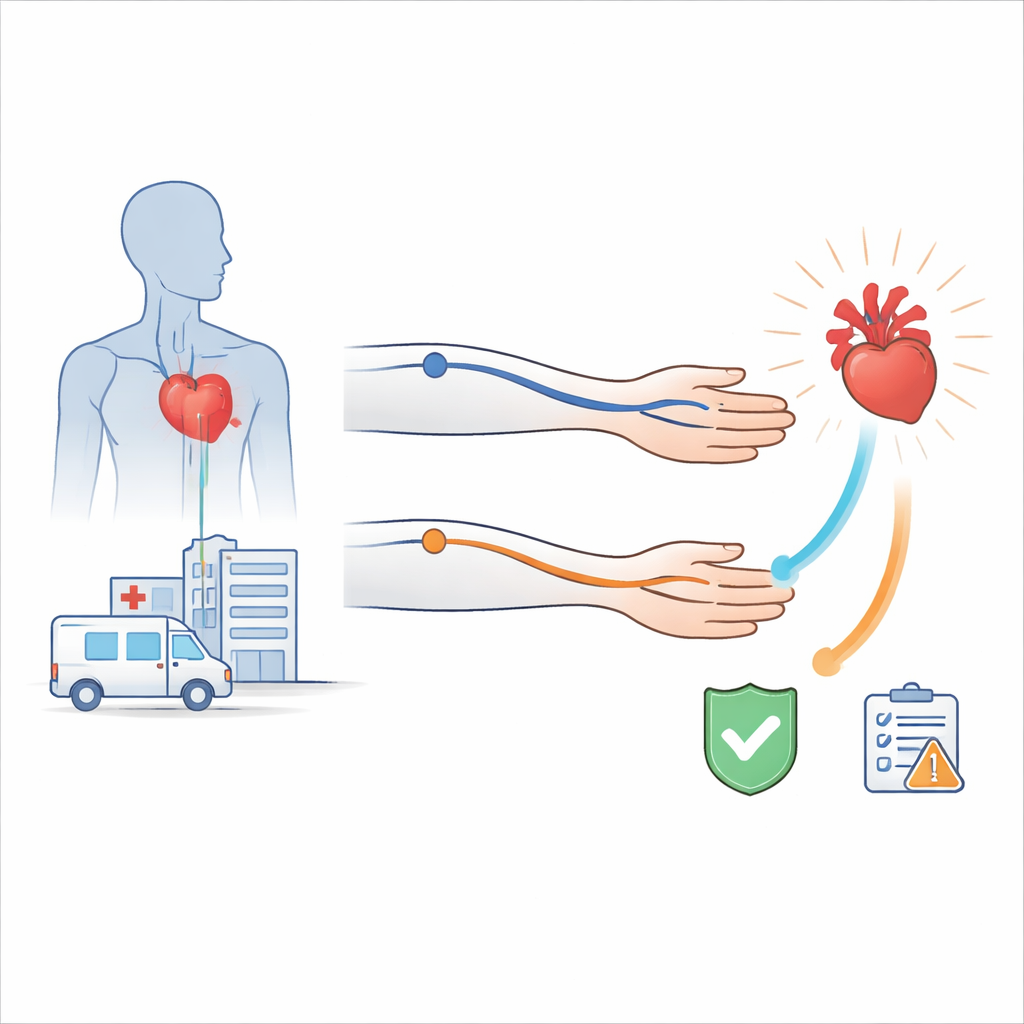
Two Different Paths to the Same Heart
For years, heart specialists have favored entering the body through the main wrist artery instead of the leg, because it usually causes less bleeding and helps patients recover faster. Recently, some centers have started using an even more distant point in the same artery, closer to the hand, often called the “snuffbox” route. This newer path may better preserve blood flow to the arm and reduce soreness or bruising, but it can be technically trickier because the vessel is smaller. Until now, it has not been clear whether this more delicate approach is practical when doctors are racing the clock to treat a severe heart attack known as ST‑elevation myocardial infarction (STEMI).
What the Researchers Did
The authors looked at detailed records from a larger Japanese trial called SPEEDY PCI, which followed people treated for STEMI at many busy hospitals. From 370 patients who were treated through the wrist, they compared 63 who had the newer, more distant wrist route with 307 who had the standard wrist entry. Because the choice of route depended on the doctor and patient, the groups were not identical. To make the comparison fairer, the team used a matching method that paired patients with similar illness severity and timing from arrival to first arterial puncture. This allowed them to focus on whether the route itself seemed linked to differences in speed, success, and safety.
Speed and Safety in the Heat of the Moment
After matching, the group treated through the distal, thumb‑side spot reached key treatment milestones faster. The time from placing the tube in the artery to inflating the balloon that opens the blockage was a few minutes shorter. The overall time from arriving at the hospital to balloon treatment was also shorter by more than 10 minutes on average. X‑ray exposure and time under the imaging camera were lower as well, even though both methods had very high success rates in restoring blood flow in the blocked artery. Importantly, short‑term and one‑year outcomes—such as death, stroke, or serious bleeding—were similar between the two groups, suggesting that the newer route did not sacrifice safety.
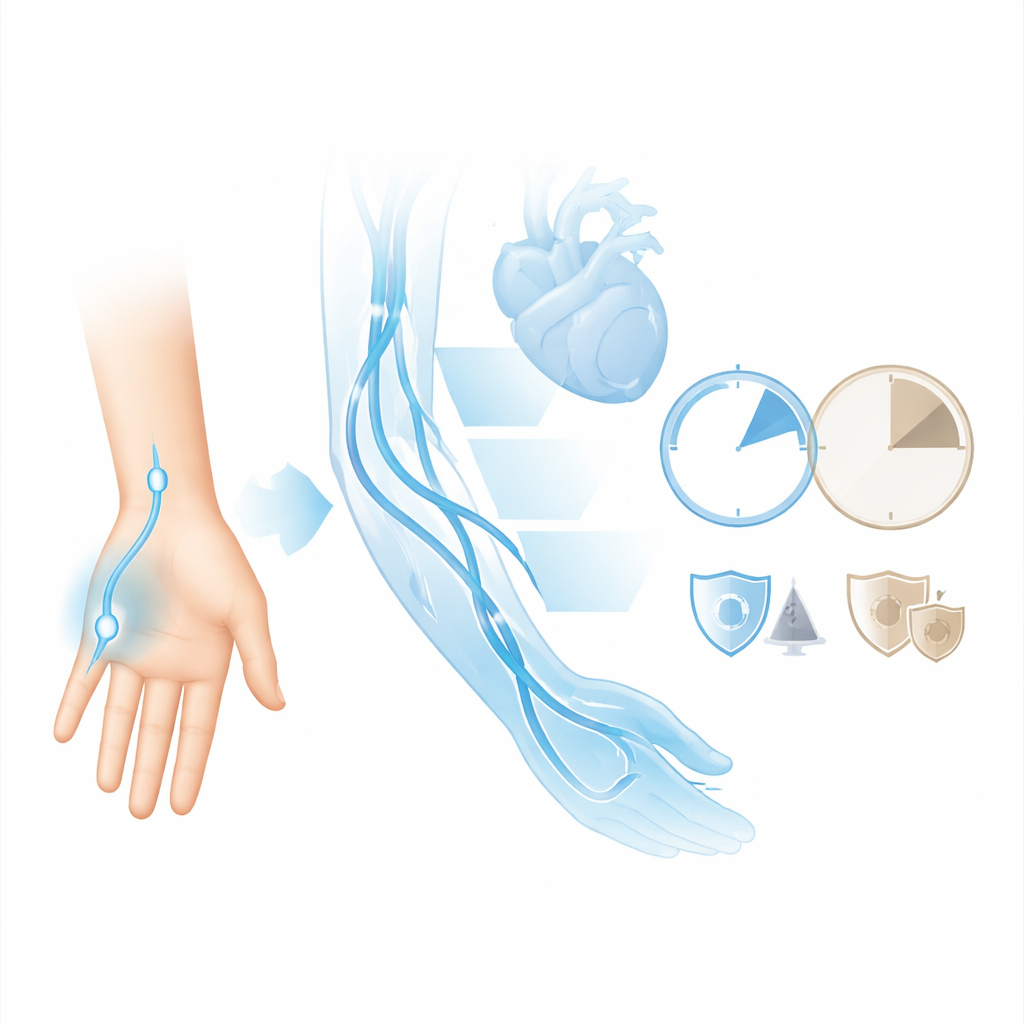
Why Faster May Not Tell the Whole Story
At first glance, the quicker times might make it seem that the distal route is clearly better. But the study’s deeper look suggests the story is more nuanced. Doctors who chose the distal path were more likely to use thinner, sheathless tools and to work from the right wrist, patterns that may reflect highly practiced routines in certain hospitals. These centers may have streamlined their team workflows around this approach, which could itself speed care. Because the access route was not randomly assigned, and because some other patient features still differed between groups even after matching, the authors caution that the time savings cannot be blamed—or credited—solely to where the artery was punctured.
What This Means for Patients
For people rushing to the hospital with a major heart attack, this study offers a reassuring message: when performed by experienced hands in well‑organized centers, entering through the small vessel near the thumb appears to be a safe and workable option that can achieve rapid opening of blocked heart arteries. However, the observed time advantage may reflect expert teams and carefully chosen tools rather than a magic property of the new route itself. The authors conclude that more rigorous studies, in which the access site is randomly assigned and the procedures are standardized, are still needed before declaring one wrist path clearly superior for all patients.
Citation: Takahashi, A., Torii, S., Ono, Y. et al. Feasibility and effectiveness of distal radial access in ST-elevation myocardial infarction from a SPEEDY PCI subanalysis. Sci Rep 16, 9377 (2026). https://doi.org/10.1038/s41598-026-40017-4
Keywords: heart attack treatment, wrist artery access, emergency angioplasty, distal radial approach, STEMI care