Clear Sky Science · en
A numerical simulation approach for inflatable asymmetric geometries of orthotropic fabrics
Blowing Up Strong, Light Structures
Imagine buildings, bridges, or wind turbine blades that ship flat in a box, then come to life when you pump in air. Inflatable structures already pop up in space habitats, emergency shelters, and festival pavilions, but turning thin sheets of fabric into precise, load‑bearing shapes is harder than it looks. This paper presents a new way to predict exactly how inflatable fabric forms will swell, twist, and carry weight, giving engineers a much more reliable design tool for the next generation of lightweight structures.
Why Shape Matters So Much
Inflatable devices earn their appeal from being light, compact, and quick to deploy. Yet the same qualities make them tricky to design. Before inflation, they are floppy sheets of coated fabric; after inflation, they must match a carefully defined 3D shape and resist wind, gravity, or other forces without sagging or wrinkling too much. Small errors in how the material stretches or how the seams behave can produce large distortions, especially in complex, asymmetric shapes. Up to now, most simulations have focused on simple tubes and cushions and have rarely been checked in detail against real, manufactured parts.
From Fabric Swatch to Virtual Prototype
The authors build a full workflow that starts with the actual fabric and ends with a tested virtual model. They use polyester fabric coated with PVC, a common choice for inflatable structures, and carefully measure how it stretches along and across the weave, how much load the seams can handle, and when the coating starts to deform permanently. These measurements feed into a custom computer model that treats the fabric as direction‑dependent and able to undergo large, reversible deformations, while also allowing for permanent wrinkling when loads get too high. Unlike simpler methods that just push on the surface with a uniform pressure, the new approach simulates how the air inside and the thin shell outside interact as the structure expands.
Putting Unusual Shapes to the Test
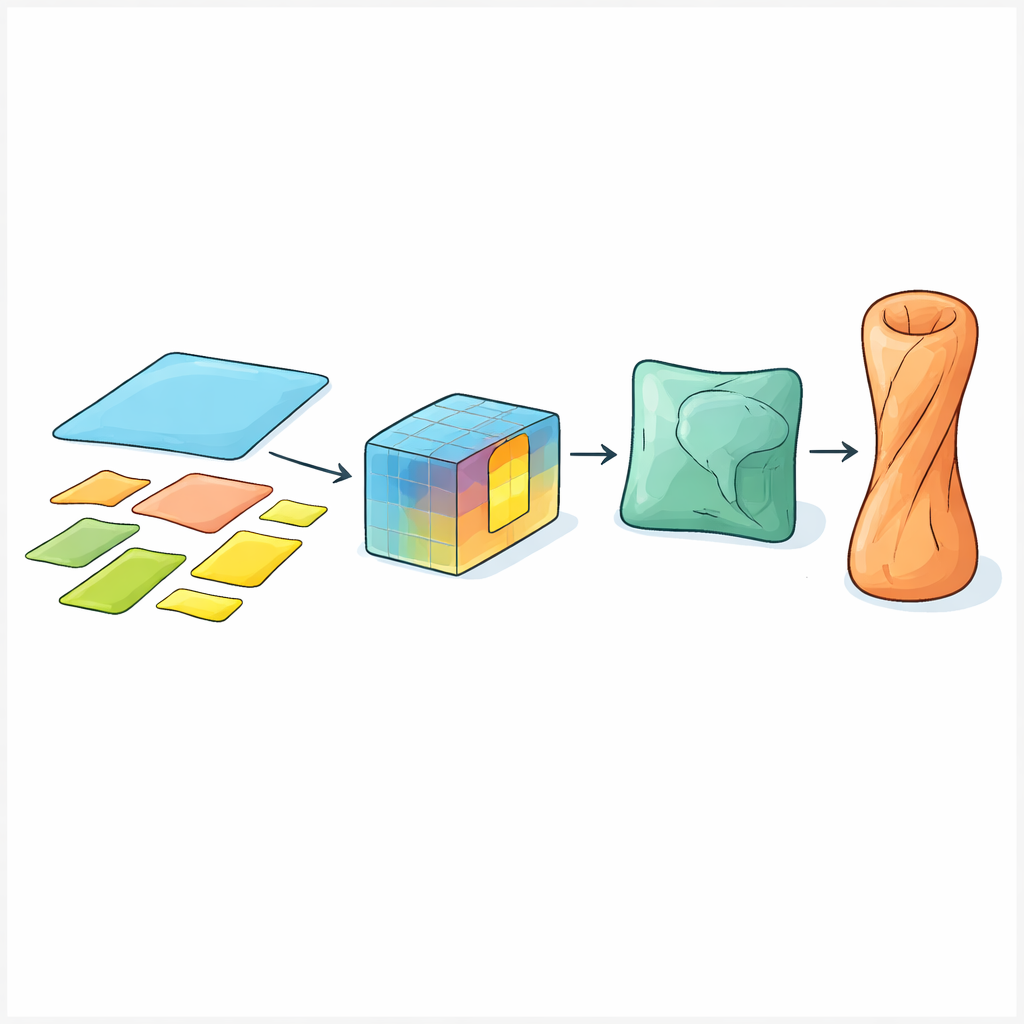
To prove the framework works in realistic situations, the team designs and builds four test pieces with rising complexity: a simple pillow made from two flat rectangles; a box‑like volume stiffened by an internal plate; a twisted, lofted form whose top is rotated relative to its base; and the same twisted shape reinforced with hidden internal strips. Each prototype is cut, welded or glued, inflated to a set pressure, and then captured using 3D photogrammetry. The scanned shapes are compared point‑by‑point with the computer predictions. For the box and the stiffened twisted shape, differences are only a few millimeters over dimensions of hundreds of millimeters, showing that the model can reproduce not just the overall outline but also local bulges and subtle twist changes.
How Air, Seams, and Stiffeners Share the Work
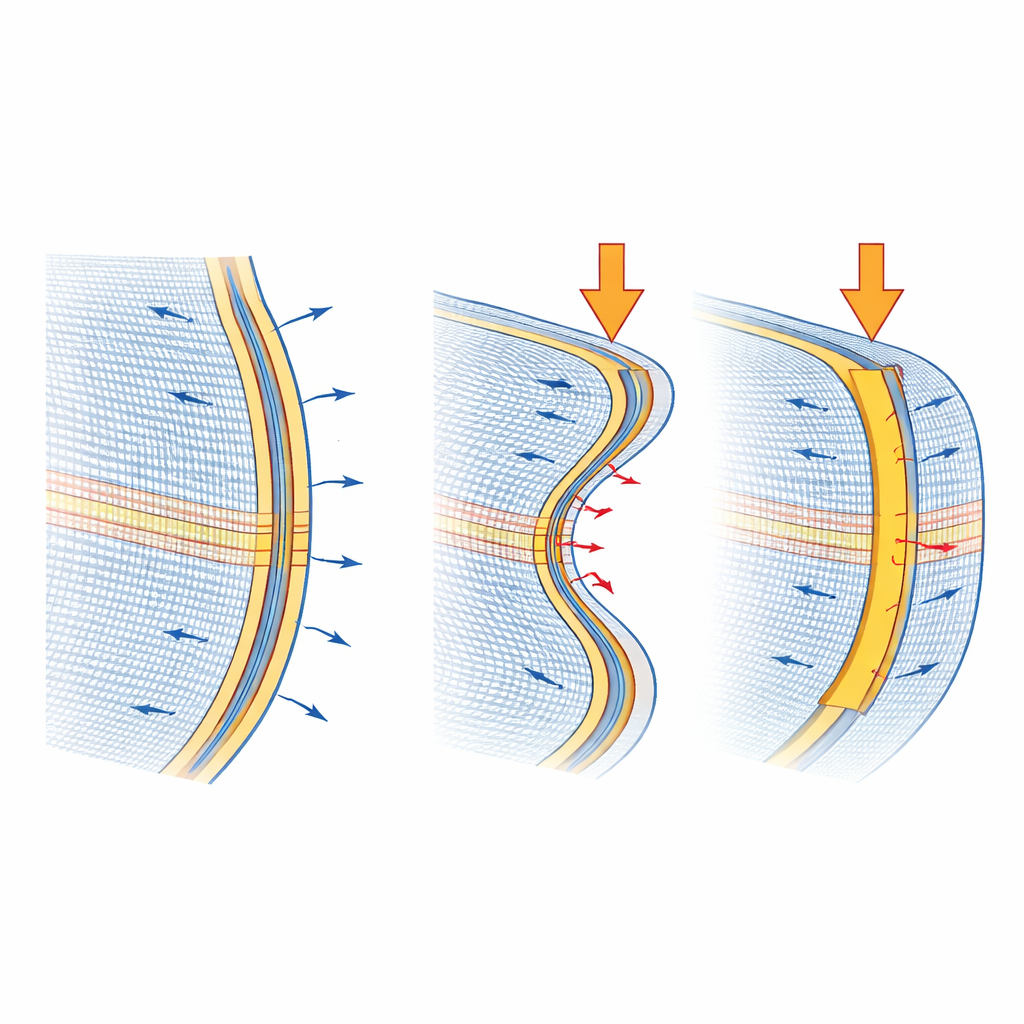
The study also looks at how these inflatable forms behave when pushed and bent. The researchers clamp the twisted shapes and compress them in a test machine while maintaining internal air pressure, recording how much force is needed to achieve a certain deflection. They repeat the same load cases in the virtual model. The predicted stiffness closely matches the experiments, including the point where wrinkles suddenly appear and the structure softens. By adding or rearranging internal stiffeners—flat strips of fabric welded inside—they show how loads can be diverted away from weak seam regions and how the unavoidable tendency of twisted shapes to “untwist” under pressure can be reduced, an insight that matters directly for inflatable wind turbine blades.
What This Means for Real‑World Designs
In plain terms, the authors have turned inflatable structures from guess‑and‑check craftwork into a predictable engineering problem. Their framework links the actual fabric and seam behavior to accurate 3D simulations that match real, intricate geometries and their response to load. Designers can now experiment on the computer with new forms and internal layouts before cutting any material, improving dimensional accuracy and safety while reducing wasteful prototyping. This capability opens the door to serious use of inflatables in architecture, aerospace, and renewable energy, where light but trustworthy air‑filled structures could replace heavier rigid counterparts.
Citation: Abdelmaseeh, A.S.A., Elsabbagh, A. & Elbanhawy, A.Y. A numerical simulation approach for inflatable asymmetric geometries of orthotropic fabrics. Sci Rep 16, 8596 (2026). https://doi.org/10.1038/s41598-026-40016-5
Keywords: inflatable structures, fabric simulations, finite element modeling, lightweight design, wind turbine blades