Clear Sky Science · en
Reasonable drilling angle and technology application for pre-cracking thick-hard roofs before driving gob-side roadways in ultra-thick seams
Making Deep Coal Mining Safer
In some of China’s largest coal mines, underground tunnels must be kept open right next to huge, empty spaces left after coal is removed. These passages, called gob-side roadways, are vital for ventilation and transport. But when very thick, stiff rock “roofs” hang over these openings, they can suddenly break and crash down, crushing supports and warping the tunnels. This study explores a way to weaken that hard roof in advance, using carefully angled drilling and carbon dioxide–based cracking, so that the rock breaks in a controlled way away from the roadway instead of violently above it.
Why Thick Roofs Are a Hidden Threat
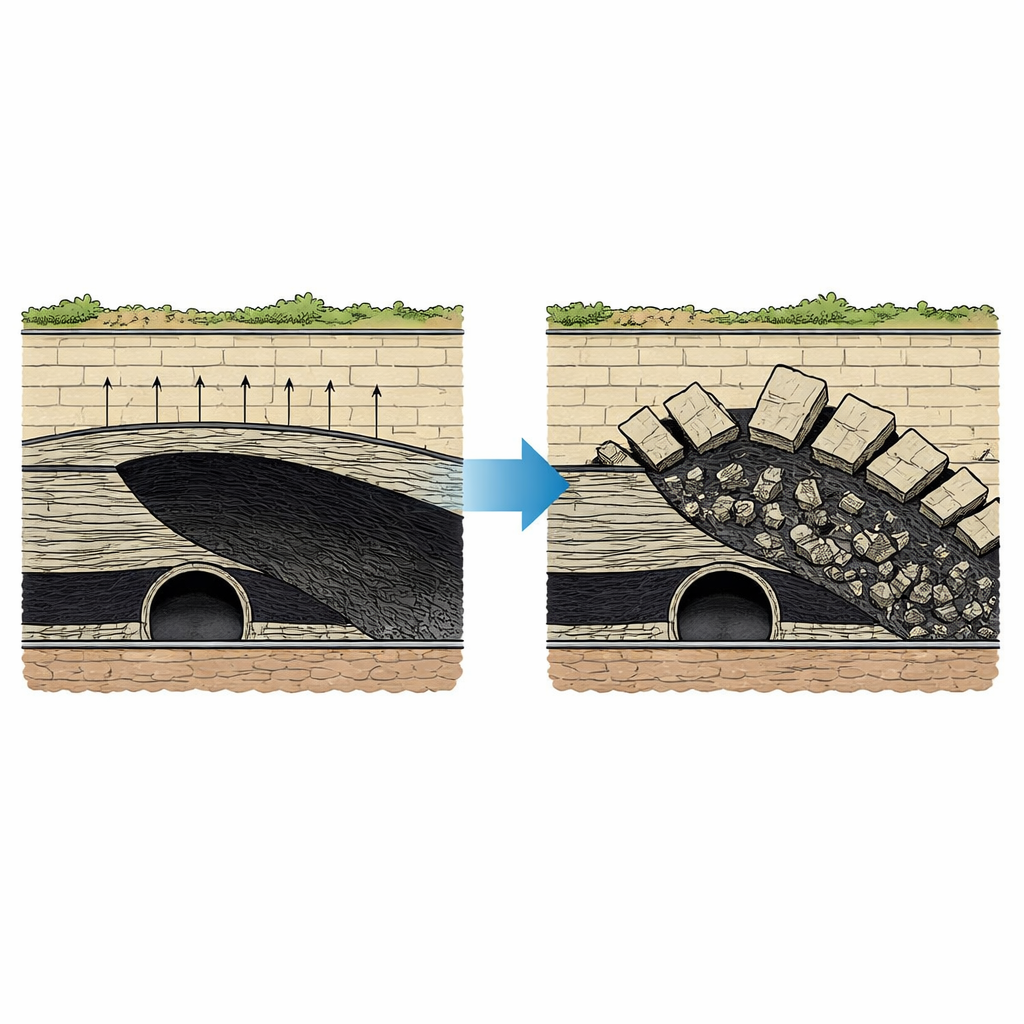
In ultra-thick coal seams more than 20 meters thick, mining leaves behind large empty cavities. Above them, a thin, weak layer sits under a much thicker, very strong rock roof. Because the broken rock in the mined-out zone (the goaf) does not fully fill the space, the thick roof can form a long, rigid overhang that reaches into the coal left to support the tunnel. When this overhanging slab finally breaks and rotates, it slams extra load onto the roadway’s walls and floor, bending steel beams, snapping anchor cables, squeezing coal pillars, and sometimes nearly closing the tunnel. Field observations at the Madaotou Mine documented extreme roof sagging, wall spalling, and floor heave under such conditions when no advance roof treatment was used.
Breaking the Roof Where It Does the Least Harm
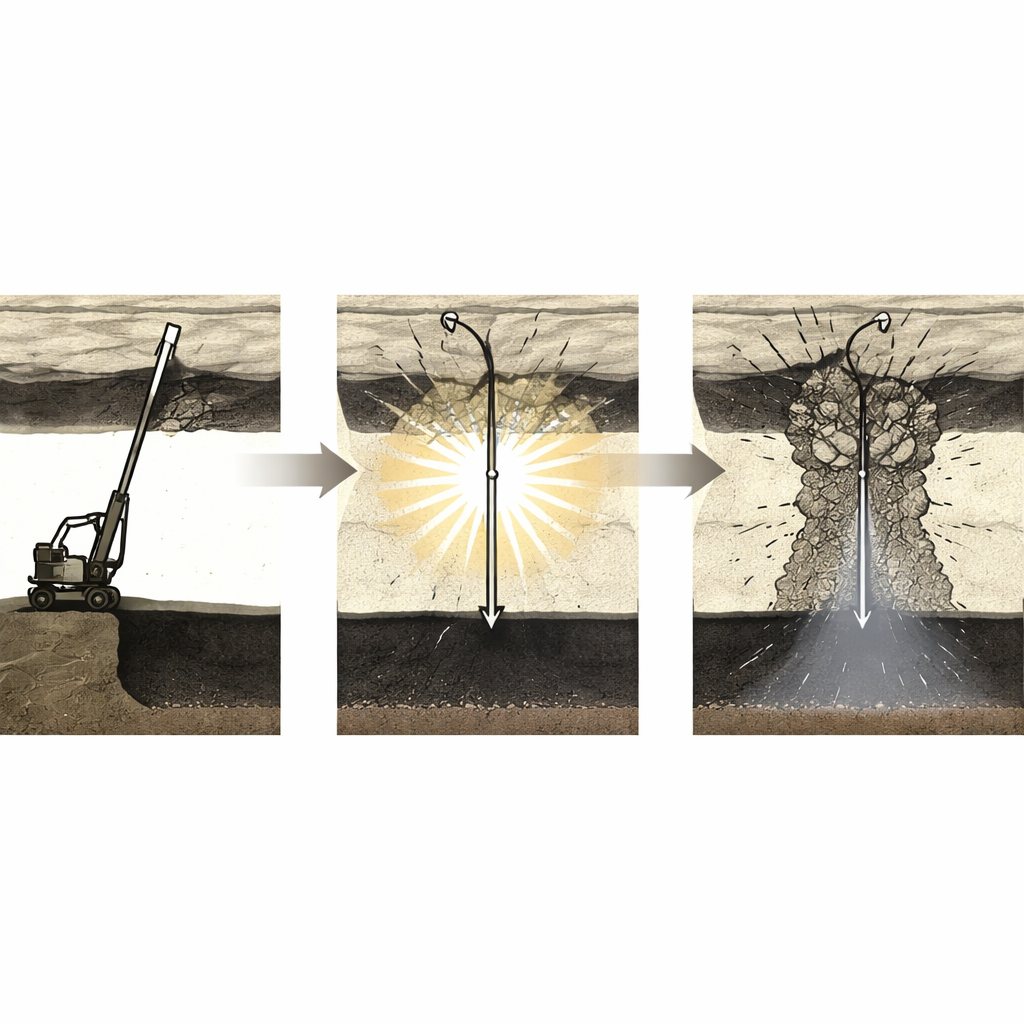
The authors propose turning this problem on its head: instead of reacting after the roof fails, deliberately crack the thick, hard roof in advance, before driving the new gob-side roadway. By drilling long holes from an adjacent roadway at a chosen angle and then fracturing the rock along these holes, they can force the key rock blocks to break and collapse into the already mined-out area rather than above the new tunnel. Using a structural model that treats the overlying rock as a stack of beams, they show that the angle of these pre-cracks controls where the roof breaks, how it bends, and how forces are transferred sideways into the coal. When the crack direction guides blocks toward the goaf, the roadway is mainly loaded by more gently bending rock farther away, instead of by a stiff cantilever directly overhead.
Finding the Best Drilling Angle
To move from concept to design rules, the team built a detailed mathematical model of how roof blocks bend and push on the coal wall for different crack angles. They then used computer simulations (FLAC3D) to see how stresses and damage zones around the roadway change as the drilling angle increases from no cracking, through 60°, 70°, and 80°, up to 90°, and slightly beyond. Two key indicators were examined: the size of the plastic (permanently deformed) zone in the coal and roof, and a measure of stored distortion energy (J2) that signals how much “spring energy” is waiting to be released. As the pre-cracking angle grew from 60° to 90°, the peak side pressure on the coal wall fell by about 18%, the plastic failure zone shrank from roughly 32 m to 20 m, and J2 in both the coal and roof dropped markedly. However, when the angle exceeded 90°, the fractured blocks tended to push more directly onto the roadway again, expanding the damaged zone and crushing the coal so badly that it could no longer carry load safely.
Cracking the Roof with Supercritical CO2
Guided by these calculations, the researchers selected a cracking height that reached the key roof layer (about 45 m above the seam) and a near-vertical 90° drilling angle as optimal. In the Madaotou Mine’s 2209 roadway, they drilled groups of deep boreholes along the side closest to the goaf and used supercritical carbon dioxide to fracture the roof. The CO2 is stored as a dense fluid in sealed cartridges; when triggered, it rapidly expands into gas, prying open fractures in the rock in a more controlled, low-shock way than explosives. Field inspections of the boreholes and water injection tests confirmed that fractures connected well between holes, forming a continuous weakened band above the roadway that encouraged roof blocks to break and fall into the goaf as the face advanced.
From Violent Collapse to Controlled Movement
Comparing two otherwise similar roadways—one without pre-cracking and one with the CO2-based treatment—the difference was striking. Without pre-cracking, roof sag reached nearly half a meter during excavation and more than a meter during mining; walls and floor also moved by hundreds of millimeters, requiring repeated repairs. With pre-cracking at 90°, roof movement during excavation dropped to only a few centimeters, and during mining the deformations of roof, coal pillar, solid coal, and floor were reduced by 75–82%. The roadway walls remained relatively smooth, the roof stayed intact, and support failures were rare. For non-specialists, the takeaway is clear: by choosing the right drilling angle and pre-cracking the hard roof ahead of time, engineers can “tell” the rock where to break—away from the tunnel instead of above it—turning a dangerous, sudden collapse into a safer, controlled settling of the ground.
Citation: He, F., Wu, Y., Wang, D. et al. Reasonable drilling angle and technology application for pre-cracking thick-hard roofs before driving gob-side roadways in ultra-thick seams. Sci Rep 16, 9354 (2026). https://doi.org/10.1038/s41598-026-40014-7
Keywords: coal mine roadway stability, roof pre-cracking, gob-side entry, CO2 rock fracturing, ultra-thick coal seams