Clear Sky Science · en
Effect of a chiral dopant on hysteresis phenomena induced by external fields in liquid crystals
Twisting Light-Sensitive Liquids
Many of today’s screens, sensors, and smart windows rely on special liquids whose molecules can easily be reoriented by tiny electric or magnetic fields. This paper explores how a subtle change in composition—adding a small amount of a “twisting” ingredient—lets researchers finely tune how these liquids switch between different internal states. Understanding this control opens the door to more energy‑efficient displays, responsive coatings, and sensitive detectors for chemicals or mechanical strain.

How a Gentle Twist Changes Everything
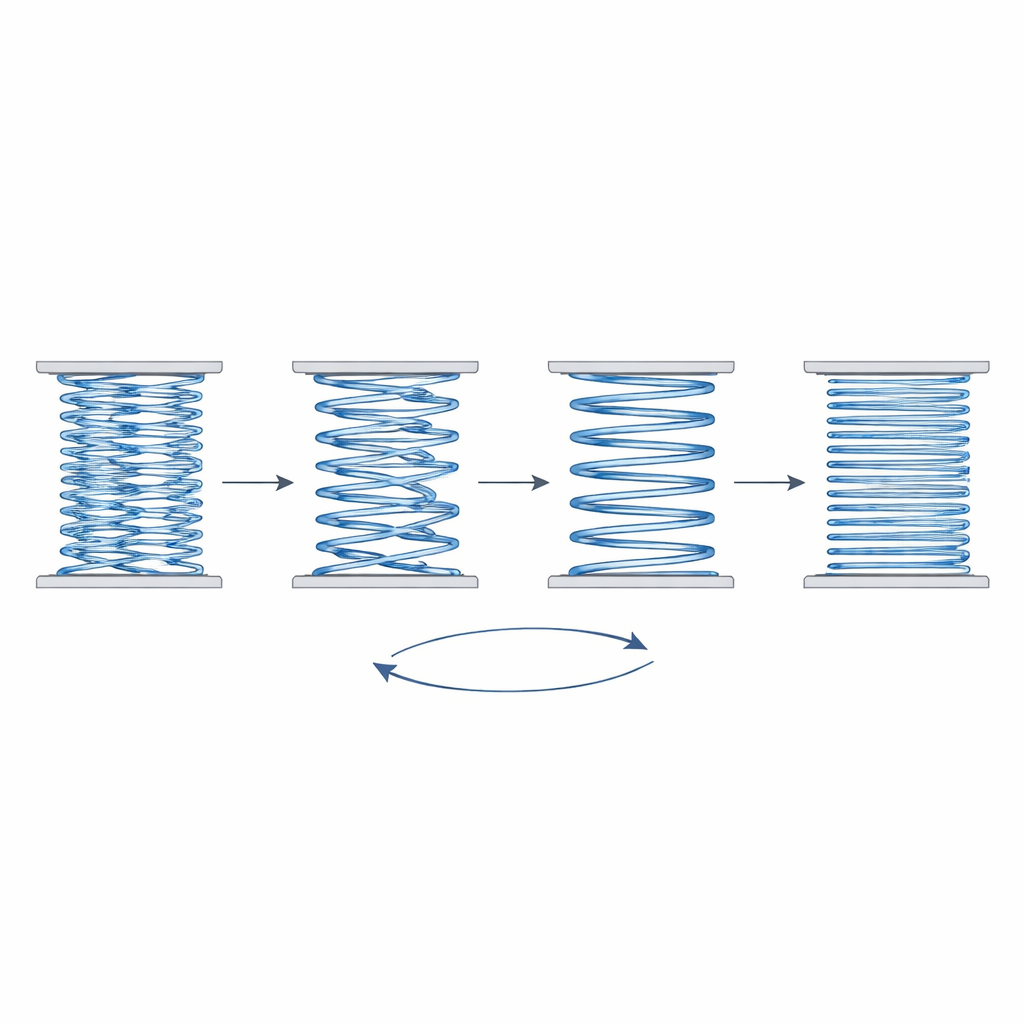
The study focuses on cholesteric liquid crystals, a class of materials whose rod‑shaped molecules naturally arrange in a gentle corkscrew, or helical, pattern. This helical structure reflects certain colors of light and responds strongly to electric and magnetic fields, making it useful in thermometers, sensors, and optical devices. Here, the base liquid crystal mixture E7 is doped with a chiral “twisting” additive called CB15. The more dopant that is added, the tighter the molecular corkscrew becomes, much like turning a loose spiral into a compressed spring. The researchers confine this material between two glass plates that force the molecules to stand upright at the surfaces, creating a competition between the preferred helical twist in the bulk and straight alignment at the boundaries.
Finding the Critical Dose of Twisting Agent
By carefully varying the amount of chiral dopant, the team discovers that below a certain low concentration the helix cannot form at all inside the thin cell. The surface treatment that enforces upright alignment effectively “untwists” the structure when the twist is too weak. Above this critical concentration, a range of patterned textures appears, including the well‑known “fingerprint” pattern of alternating bright and dark lines. These patterns reflect how many turns of the helix can fit within the cell thickness and how strongly the surfaces resist twisting. The key control parameter is the ratio between cell thickness and helix pitch, which shifts as dopant concentration shortens the pitch.
Switching with Electric and Magnetic Fields
To see how the material responds to external fields, the researchers apply stepwise electric voltages and magnetic fields and monitor both the optical textures and the electrical capacitance of the cell. Because the molecules prefer to align with the fields, strong enough fields can fully straighten the corkscrew, driving a change from the twisted cholesteric state to a straight nematic state. This switching shows up as a sudden jump in capacitance. As the dopant concentration increases and the helix tightens, higher electric voltages and stronger magnetic fields are needed to unwind it. In samples with sufficient dopant, the unwinding does not happen smoothly: instead, the helix releases twist in discrete steps, known as pitch jumps, producing clear “stairs” in the capacitance curves.
Loops, Memory, and Hidden Thresholds
When the electric or magnetic field is reduced again, the system does not simply retrace its path. Instead, it follows a different route back as the helix reforms, creating a loop in the measured response known as hysteresis. Within certain field ranges, both twisted and straight configurations can exist as stable alternatives, giving the material a kind of memory of its recent history. The authors compare their data with classic theoretical models that assume infinitely thick samples without surfaces. They find that, although the overall dependence of the critical field on dopant concentration remains roughly linear, strong surface effects shift the curve: the boundaries effectively make the helix easier to unwind and reveal a clear minimum dopant concentration needed to overcome the surface‑induced penalty against twisting.
Design Rules for Future Smart Materials
In everyday terms, this work shows how a small adjustable ingredient can act as a “twist knob” that sets how strongly a liquid crystal resists being straightened by electric or magnetic fields, and whether it switches smoothly or in sharp steps with memory. By mapping how these behaviors depend on dopant concentration in thin, device‑like cells, the study offers practical design rules for engineers who want stepwise, low‑energy switching in smart windows, reflective displays, or sensors. It also lays the groundwork for even more complex materials where magnetic nanoparticles are added, potentially enabling stronger responses and new ways to control light with modest fields.
Citation: Lacková, V., Makarov, D.V., Petrov, D.A. et al. Effect of a chiral dopant on hysteresis phenomena induced by external fields in liquid crystals. Sci Rep 16, 9009 (2026). https://doi.org/10.1038/s41598-026-40009-4
Keywords: cholesteric liquid crystals, chiral dopant, helix unwinding, hysteresis, electro-optical devices