Clear Sky Science · en
Correlations among chemical and rheological aging indices/indicators of asphalt binder at high temperatures
Why road aging matters to everyone
Anyone who has driven over rutted or cracked pavement has experienced what happens as roads age. At the heart of every asphalt road is a sticky, tar-like material called binder, which glues stones together. Over years of sun, heat, and air, this binder hardens and becomes more brittle, changing how the road behaves under traffic. This study explores how the chemical changes inside the binder show up as changes in its flow and stiffness, with the goal of making it easier to predict when roads will rut or crack and how to manage recycled materials more safely. 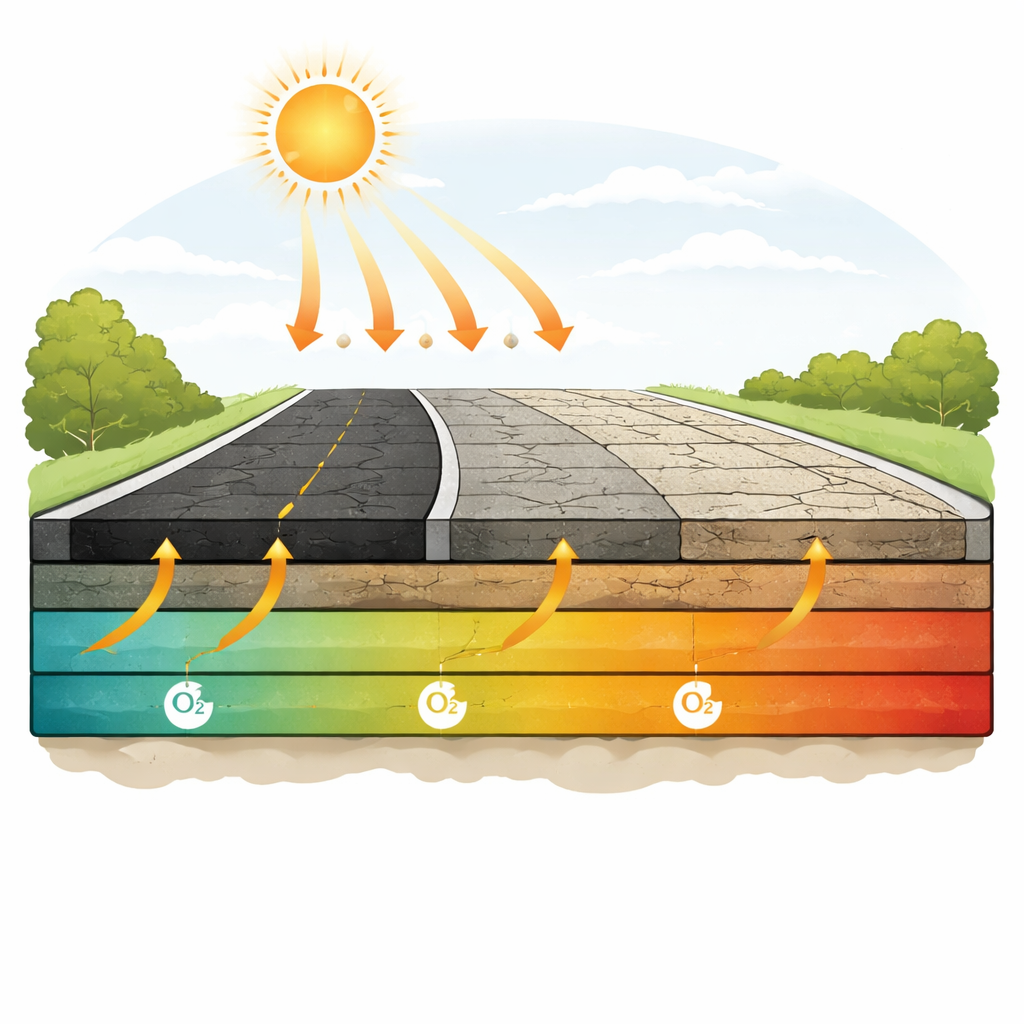
How asphalt changes with time and traffic
Asphalt binder is made of many different organic molecules that react with oxygen in the air. During mixing and paving, the binder is exposed to high temperatures and air, causing a first burst of aging that already makes new pavement stiffer before traffic ever drives on it. Then, over years of service, slower aging continues under the combined action of heat, oxygen, sunlight, and moisture. This long-term process increases stiffness further: roads may resist permanent wheel ruts better at high summer temperatures, but they also become less flexible and more prone to fatigue and cold-weather cracking. With climate change bringing more heat waves and with growing use of reclaimed asphalt pavement (RAP), understanding this balance between “good” and “bad” aging has become increasingly important.
Probing binder chemistry and feel
The researchers studied three common asphalt binders of different softness grades and subjected them to carefully controlled short-term and long-term aging in the laboratory. They used a rolling thin-film oven to mimic the heating and air exposure during mixing, then one to three cycles in a pressure aging vessel to simulate years of in-service aging. To track chemical changes, they used infrared light to measure the growth of specific oxygen-rich groups that form as the binder oxidizes. These signals were combined into a single “aging index” that rises as the binder’s chemistry moves further from its fresh state. In parallel, they measured how easily the binder flows and deforms at high temperatures using instruments that twist or rotate small binder samples, extracting quantities related to viscosity, stiffness under oscillating loads, and more detailed viscoelastic models. 
The first stage does most of the damage
Across all three binders, every indicator of aging moved in the same direction: chemical oxidation increased, high-temperature stiffness rose, and the binder’s resistance to flow grew. The jump was especially strong after the first long-term aging cycle; later cycles still increased aging but by smaller amounts. This pattern was seen in the infrared-based index, in the so‑called zero-shear viscosity that represents how the binder would flow under very slow loading, and in a widely used rutting parameter that reflects how much a pavement will resist permanent wheel-path depressions. Parameters from an advanced viscoelastic model, which describe how the binder transitions from springy to viscous behavior, also increased systematically with aging and proved sensitive to the hardening process.
Simple patterns link chemistry to performance
Looking across all the measurements, the team found clear, mathematically simple relationships between chemical and mechanical indicators. For a given binder grade, the infrared aging index rose in a straight-line fashion with the logarithm of zero-shear viscosity and with a key model parameter that shapes the stiffness curve. The rutting parameter showed a strong power-law connection to the chemical index and an exponential link to the zero-shear viscosity. High-temperature rotational viscosity—which is relatively easy and common to measure in practice—lined up closely with the rutting parameter across all binders tested and was also tightly connected to the more complex viscosity measure. These trends held consistently within each binder grade, and some, such as the link between simple viscosity and rutting stiffness, remained strong even when combining all grades made from the same crude source.
Turning trends into practical tools
To a lay reader, the key message is that the same oxidation chemistry that slowly hardens road binders leaves a clear fingerprint in how those binders flow and deform under load. By showing that one type of measurement (for example, a quick viscosity test) reliably tracks others (such as detailed chemical spectra or advanced stiffness models) within a given binder family, this work lays the groundwork for simpler, data-driven checks on road aging. Engineers could calibrate these trend lines with a few measurements and then use more accessible tests as stand-ins for harder or more expensive ones. Ultimately, that can help road agencies design pavements, choose RAP contents, and plan maintenance in ways that balance rutting resistance against cracking risk, extending pavement life while making better use of materials.
Citation: Taheri, A., Khodaii, A. & Hajikarimi, P. Correlations among chemical and rheological aging indices/indicators of asphalt binder at high temperatures. Sci Rep 16, 9186 (2026). https://doi.org/10.1038/s41598-026-40007-6
Keywords: asphalt aging, pavement durability, binder oxidation, rheology, reclaimed asphalt