Clear Sky Science · en
High power ultrafast phase-locked laser at 2060 nm from a doubly resonant optical parametric oscillator
Why this ultrafast laser matters
Lasers have quietly become the backbone of modern technology, from precise GPS timing and internet data links to medical scans and climate monitoring. This study reports a new kind of highly stable laser source that operates at a wavelength of about 2 micrometers, a “color” of infrared light that is especially useful for probing gases, tissue, and extreme light–matter interactions. By combining very short pulses, high power, and excellent stability in this spectral region, the work opens doors to sharper sensing tools and new experiments that shape light waves with exquisite control. 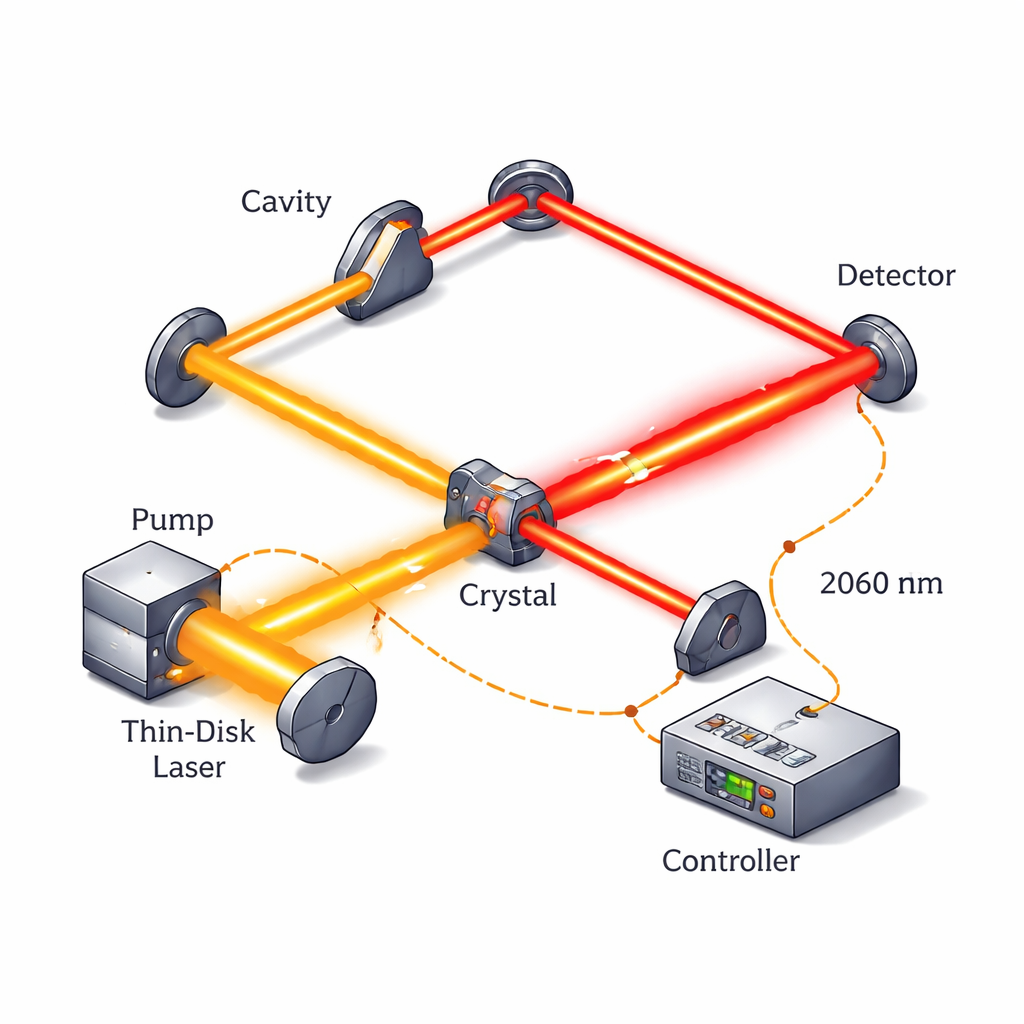
Light combs as rulers of the world
Over the past few decades, so‑called optical frequency combs have transformed how precisely we can measure time and frequency, helping earn the 2005 Nobel Prize in Physics. A frequency comb is a laser whose colors are arranged like the teeth of a comb, equally spaced and phase‑locked to one another. When such combs operate around 2 micrometers, they become powerful tools for applications ranging from measuring greenhouse gases over long distances to performing minimally invasive surgery and ultrafast medical imaging. They can also serve as ideal drivers for creating light at even longer wavelengths, such as the mid‑infrared and terahertz ranges, which carry unique information about molecules and electronic motion.
Turning one color into two perfectly linked colors
The team built their source around a device called a doubly resonant optical parametric oscillator. In simple terms, this is a resonant cavity with a special crystal that converts incoming laser light into two new colors. Here, the pump laser is a home‑built thin‑disk system that emits very short pulses (about 270 femtoseconds) at 1030 nanometers. Inside the cavity, a Beta Barium Borate crystal transforms this light so that one of the emerging colors sits at 2060 nanometers, exactly twice the wavelength. At this special “degenerate” point, the two generated colors merge into one, and the phases of all three fields — pump and output — become tightly linked. The result is a pair of inherently phase‑locked colors around 1 and 2 micrometers that are ideal for experiments requiring precisely timed electric fields, such as generating tailored terahertz bursts known as Brunel radiation.
Keeping a delicate light machine steady
Achieving this behavior in a long, high‑power cavity is technically challenging. The optical path is about nine meters, making it very sensitive to tiny length changes caused by vibrations, temperature shifts, or air currents. Rather than using traditional “dither” methods that deliberately shake the system and add noise, the authors rely on a clever, modulation‑free scheme. A small amount of unwanted red light is naturally produced inside the cavity when the pump and generated light mix. By passing this “parasitic” signal through a narrow color filter and detecting it with a photodiode, they obtain an error signal that tells them whether the cavity length is slightly too long or too short. A simple electronic controller then nudges mirrors on piezoelectric mounts to keep the cavity locked at the optimal point. This strategy stabilizes the system without extra chattering and helps maintain very low noise.
Power, pulse shape, and quiet operation
With stabilization engaged and the cavity dispersion carefully balanced using a thin zinc selenide plate, the oscillator delivers an average output power of about 5.6 watts at 2060 nanometers, with pulses just over 200 femtoseconds long. This corresponds to a conversion efficiency of roughly 35 percent from the pump — a record figure for an actively stabilized system of this type at 2 micrometers. Measurements of intensity noise show that the feedback loop dramatically calms slow fluctuations, cutting the cumulative noise by more than a factor of thirty compared with the free‑running system. Long‑term monitoring over 90 minutes reveals that the output power varies by less than one percent, and interference measurements confirm that the pump and output remain phase‑locked over extended periods. 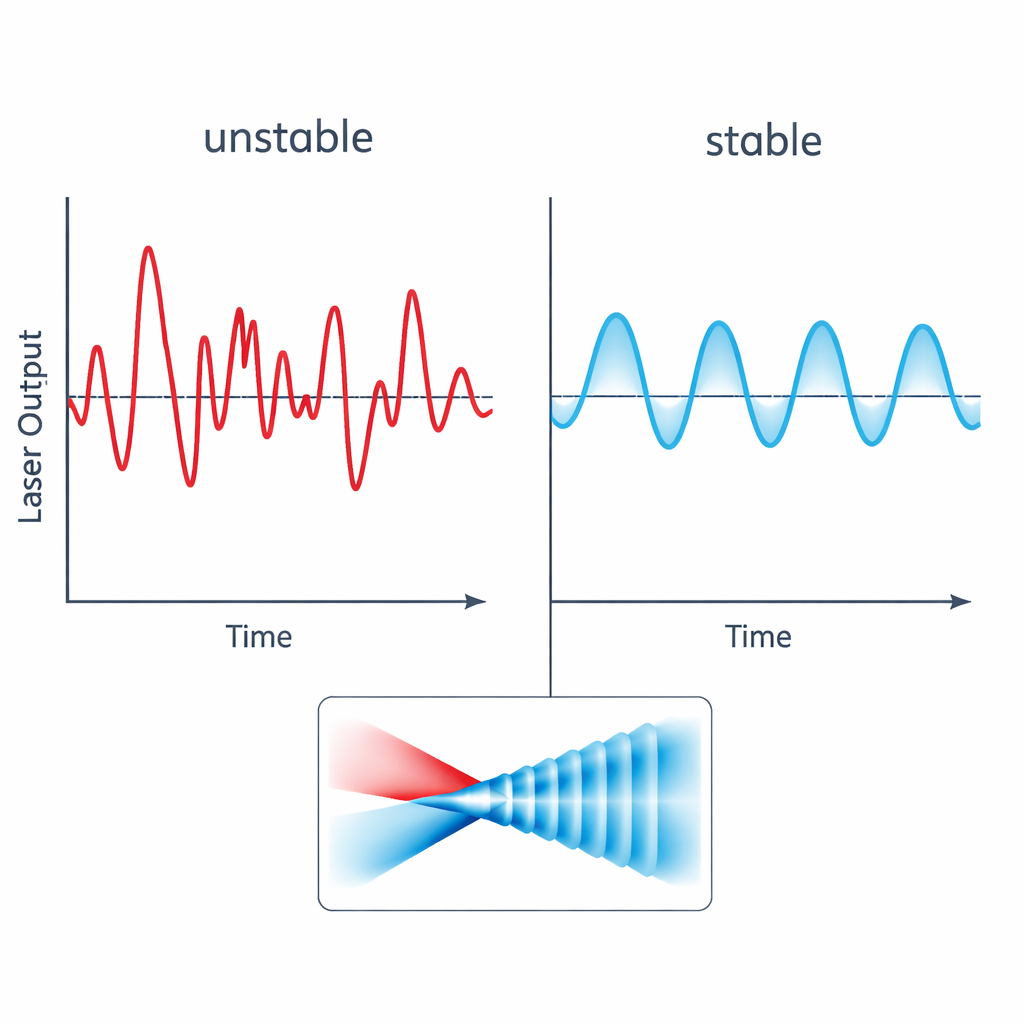
What this means going forward
For non‑specialists, the key takeaway is that the authors have built a bright, remarkably stable infrared “light comb” that keeps two colors marching in step with high precision, without relying on noisy stabilization tricks. Such a source can act as a robust engine for future experiments that sculpt electric fields on femtosecond time scales, drive strong interactions in gases and solids, and improve remote sensing of molecules in the atmosphere. In practical terms, it brings laboratory‑grade precision closer to real‑world uses, from advanced imaging to environmental monitoring, by providing a powerful and dependable laser tool in a very useful corner of the spectrum.
Citation: Rao, H., Mevert, R., Geesmann, F.J. et al. High power ultrafast phase-locked laser at 2060 nm from a doubly resonant optical parametric oscillator. Sci Rep 16, 7169 (2026). https://doi.org/10.1038/s41598-026-40002-x
Keywords: optical frequency comb, ultrafast laser, infrared spectroscopy, optical parametric oscillator, laser stabilization