Clear Sky Science · en
A novel geotechnical approach: non-destructive prediction of strength and swelling behavior of nano-alumina and cement stabilized clays using ultrasonic pulse velocity
Why problem soils matter for everyday life
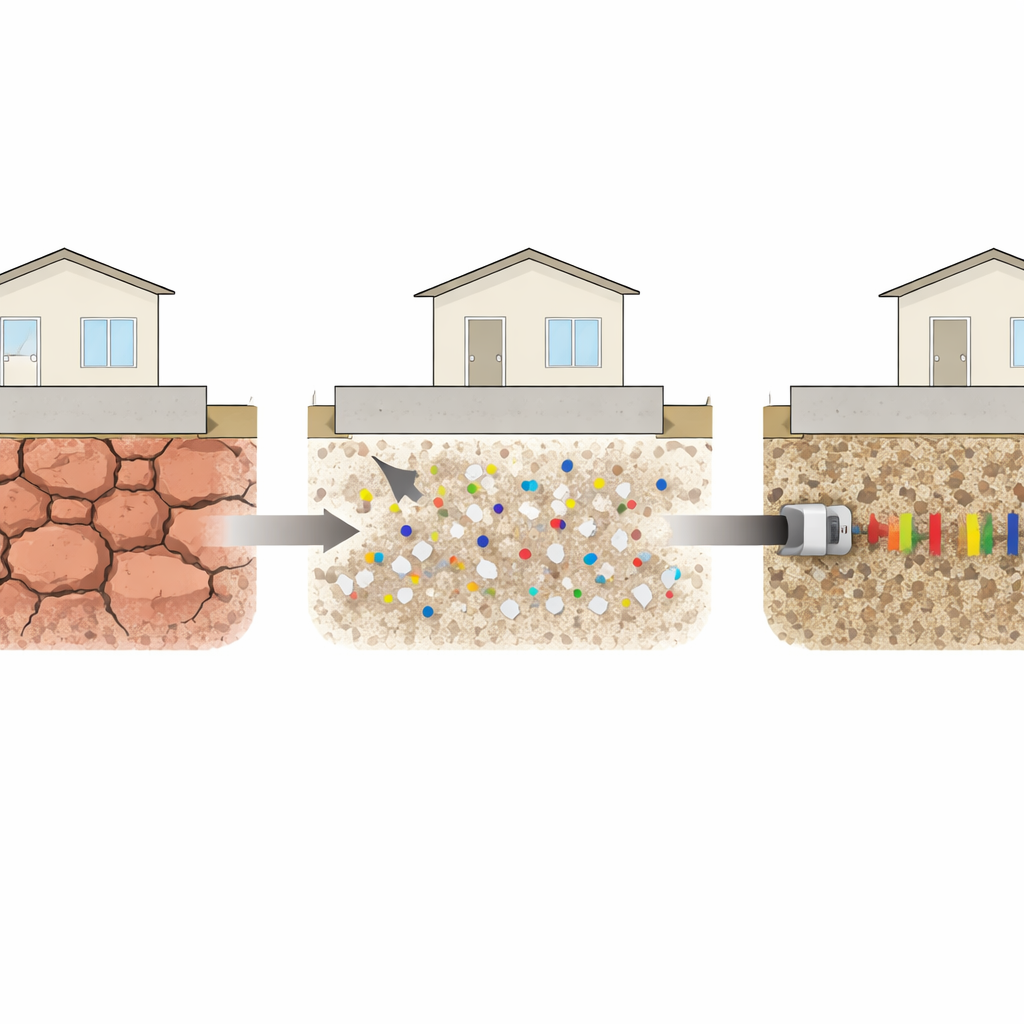
Many houses, roads, and pipelines are built on clay-rich ground that quietly swells when wet and shrinks when dry. This repeated movement can crack walls, warp pavements, and damage buried structures, leading to costly repairs. Engineers usually test and strengthen such problematic soils using methods that destroy samples and take time. This study explores a faster, non-destructive way to judge how well a clay soil has been strengthened, using sound waves traveling through the ground, while also cutting down on cement use by adding tiny particles called nano-alumina.
Turning weak clay into a sturdier base
The researchers worked with an expansive clay that naturally has low strength and a strong tendency to swell. They mixed this soil with small amounts of ordinary Portland cement and extremely fine aluminum oxide particles, known as nano-alumina. Cement contents of 0%, 3%, and 7% by dry soil weight were tested, and for each cement level, nano-alumina was added at several dosages relative to the cement, ranging from none up to 1.5%. The mixed soils were compacted into standard shapes and allowed to cure for 7, 28, or 90 days to simulate how properties evolve over time in the field.
Listening to the soil with sound waves
To find out how the treated clays behaved, the team carried out a wide suite of traditional tests: compressing and pulling the samples until they failed, shearing them under different pressures, and measuring how much they swelled when soaked with water. At the same time, they used an ultrasonic pulse velocity (UPV) test, in which a short, high-frequency sound pulse is sent through the specimen and its travel speed is recorded. Faster waves indicate a stiffer, more continuous internal structure. Microscopic tools—scanning electron microscopy to image the fabric and X-ray diffraction to identify minerals—helped reveal how the cement and nano-alumina changed the soil at very small scales.
Finding the sweet spot for nano-additives
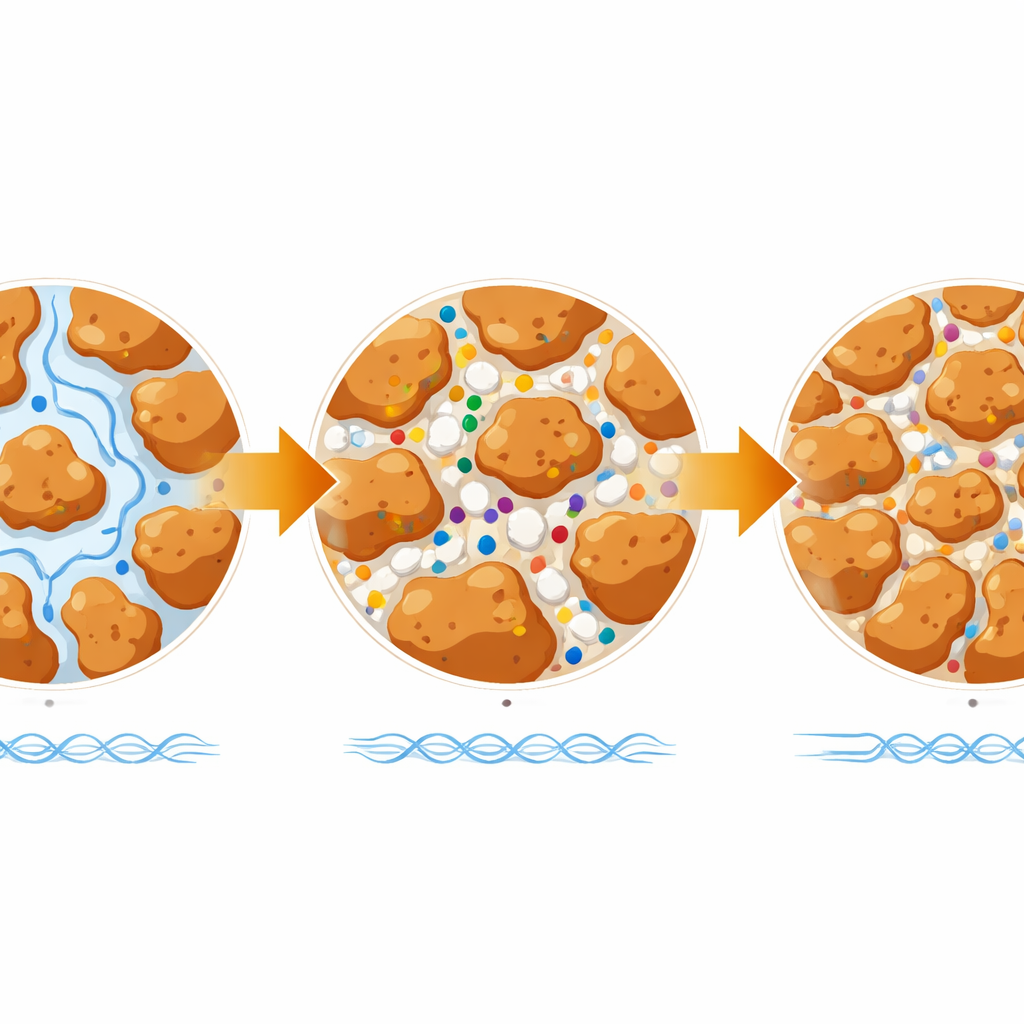
The experiments showed that both cement and nano-alumina substantially improved the soil. As cement content rose, sound waves traveled faster, and strength and shear resistance increased, while swelling dropped. Adding nano-alumina gave an extra boost, but only up to a point. An addition of about 0.9% nano-alumina relative to cement gave the best overall performance: ultrasonic velocity rose by roughly one-third, compressive strength increased by more than a quarter, and the soil’s tendency to swell was sharply reduced compared with cement alone. Microscopy revealed that this optimum dosage produced a denser, more uniform matrix with fewer voids and stronger bonds between particles. Mineral tests showed that nano-alumina helped convert weaker hydration products into stiffer gel-like phases and reduced the activity of the swell-prone clay minerals.
From sound speed to strength and swelling
Because measuring UPV is quick and does not damage the sample, the authors asked whether it could reliably stand in for slower, destructive tests. Using statistical techniques, they built equations that link two easy-to-measure quantities—the ultrasonic velocity and the maximum dry density achievable by compaction—to key engineering properties such as compressive and tensile strength, shear parameters, and swelling strain and pressure. The predicted values from these equations matched the laboratory measurements closely; for example, the correlation was about 0.93 for compressive strength and 0.96 for cohesion, and above 0.8 for swelling measures. This means that, in many cases, engineers could infer how strong and swell-resistant a treated clay is simply by checking how fast a sound pulse passes through it and knowing how densely it has been compacted.
What this means for safer, more sustainable ground
For a layperson, the takeaway is that we can make troublesome clays both stronger and less likely to heave by combining small amounts of cement with carefully chosen nano-sized additives. At the same time, we can monitor how well this treatment is working using harmless sound waves instead of breaking many samples apart. This approach offers a faster and potentially cheaper way to ensure the ground under our homes and infrastructure is behaving as intended, while reducing reliance on large quantities of cement. In the long run, such techniques could lead to more durable structures, fewer cracks and failures, and more sustainable ground improvement practices.
Citation: Azizi, G., Janalizadeh Choobbasti, A. & Soleimani Kutanaei, S. A novel geotechnical approach: non-destructive prediction of strength and swelling behavior of nano-alumina and cement stabilized clays using ultrasonic pulse velocity. Sci Rep 16, 8461 (2026). https://doi.org/10.1038/s41598-026-40001-y
Keywords: expansive clay, soil stabilization, nanomaterials, ultrasonic testing, cement alternatives