Clear Sky Science · en
Mine pressure behavior law and fault activation response of normal fault zones in thick coal seams under mining disturbance
Why Shifts Deep Underground Matter at the Surface
Modern society still leans heavily on coal, but the rock above a mine does not always cooperate. When engineers dig into very thick coal seams that are sliced by geological faults, the ground can lurch, cave, or even burst, putting miners and equipment at risk. This study looks inside one such underground setting in China, asking a simple but vital question: as a coal face advances toward a steep normal fault, how do the rocks bend, crack, and shift—and when does that fault wake up? 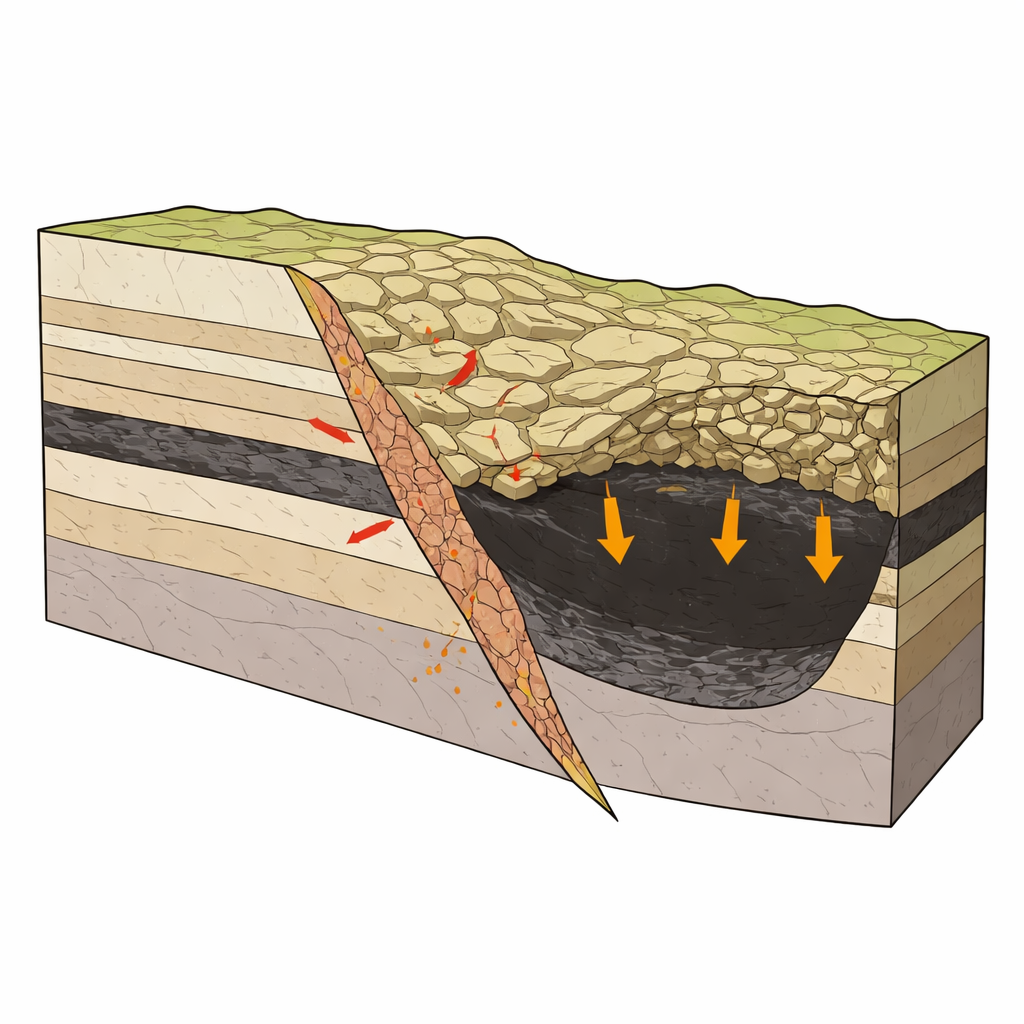
A Hidden Break in the Rock
The research focuses on a coal mine in the Ordos Basin, where a thick seam—14 to 20 meters of coal—is cut by a normal fault that dips at about 70 degrees. In a normal fault, one block of rock has dropped relative to the other, leaving a sloping break that can act like a locked but ready-to-move landslide deep underground. As miners cut coal along a longwall face, they leave behind a large empty space. The rock layers over this space sag and fracture, and that motion can load and then jolt the nearby fault. Because thick seams create extra-large voids, the overlying rock behaves more dramatically than in thinner seams, making this kind of setting especially hazardous.
Building a Scaled-Down Earth in the Lab
To safely watch these events unfold, the team built a large physical model that mimics the real mine. They stacked layers of sand, gypsum, lime, and other materials inside a steel frame, matching the relative thickness, weight, and strength of each rock layer in the actual mine. A sheet of mica formed the weak, sloping surface of the fault. A hydraulic system pressed down on the top to reproduce the weight of hundreds of meters of overlying rock. Then they “mined” the model step by step by removing strips of the coal layer while cameras and sensors tracked how the layers cracked, how far the roof sank, and how stresses built up near the fault.
How the Roof Sags and the Floor Reacts
As mining progressed toward the fault, the roof above the extracted coal repeatedly broke and collapsed in roughly 20-meter steps. Far from the fault, this behavior was fairly regular. Closer in, the pattern became more violent and asymmetric. The overall roof subsidence followed a broad U-shaped curve, but near the fault it developed local M-shaped dips and humps as blocks rotated and collided. The largest roof drop—over 13 meters in the full-scale equivalent—occurred about 30 meters from the fault on the lower side. The floor beneath the seam responded with sharp pulses of stress: readings shot up suddenly as the roof fell, then dropped back, with the highest peak stress, about 20 megapascals, recorded nearest to the fault. These jumps show why equipment and roadways near faults face a much higher chance of sudden damage.
When the Fault Starts to Slip
Beyond describing what happened, the authors used a simple mechanical model to explain why the fault activates. In essence, mining changes the balance between vertical and horizontal squeezing around the fault. As the coal is removed, the vertical load from above increases while side-to-side confinement is relieved. The calculations show that when the vertical stress becomes three to four times larger than the horizontal stress, the fault is primed to slip. The experiments support this picture: stress sensors revealed that vertical forces began to rise tens of meters before the coal face reached the fault, but actual instability—sudden sliding and collapse—occurred only after the horizontal grip had weakened enough. This means that the key trigger is not just weight from above, but the loss of sideways support. 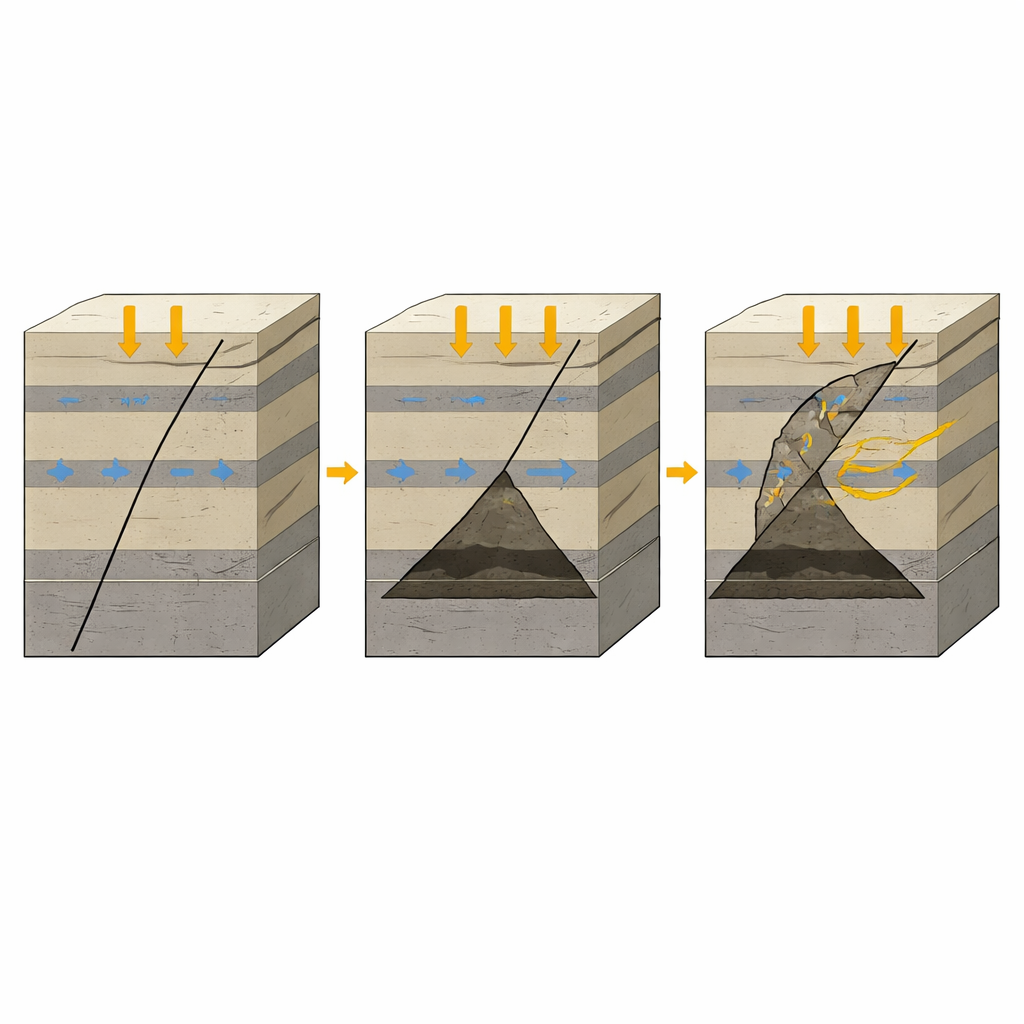
Turning Insight into Safer Mining
Armed with these findings, the authors suggest practical steps for mines that must cross similar faults in thick seams. Support systems—such as combined bolts, mesh, and cables—should be strengthened over a wider zone as the face nears a fault. The speed of advancing roof supports should be carefully controlled so that the roof is never left hanging too far. Finally, roadway designs should allow some controlled deformation and include space for stress release, rather than trying to hold the rock perfectly rigid. In simple terms, the study shows that near steep faults, thick-seam mining greatly raises the chances of sudden roof and floor failures because it loads the rock vertically while loosening it sideways. Recognizing this pattern helps engineers anticipate where the danger is greatest and design supports that let mines tap deep coal reserves with a larger margin of safety.
Citation: Xin, T., Ji, Y., Wang, J. et al. Mine pressure behavior law and fault activation response of normal fault zones in thick coal seams under mining disturbance. Sci Rep 16, 9491 (2026). https://doi.org/10.1038/s41598-026-40000-z
Keywords: coal mining, fault slip, ground pressure, roof collapse, mine safety