Clear Sky Science · en
Permeability evolution and microstructural regulation of clay cement grouted body under coupled seepage and stress conditions
Why stopping water in mines matters
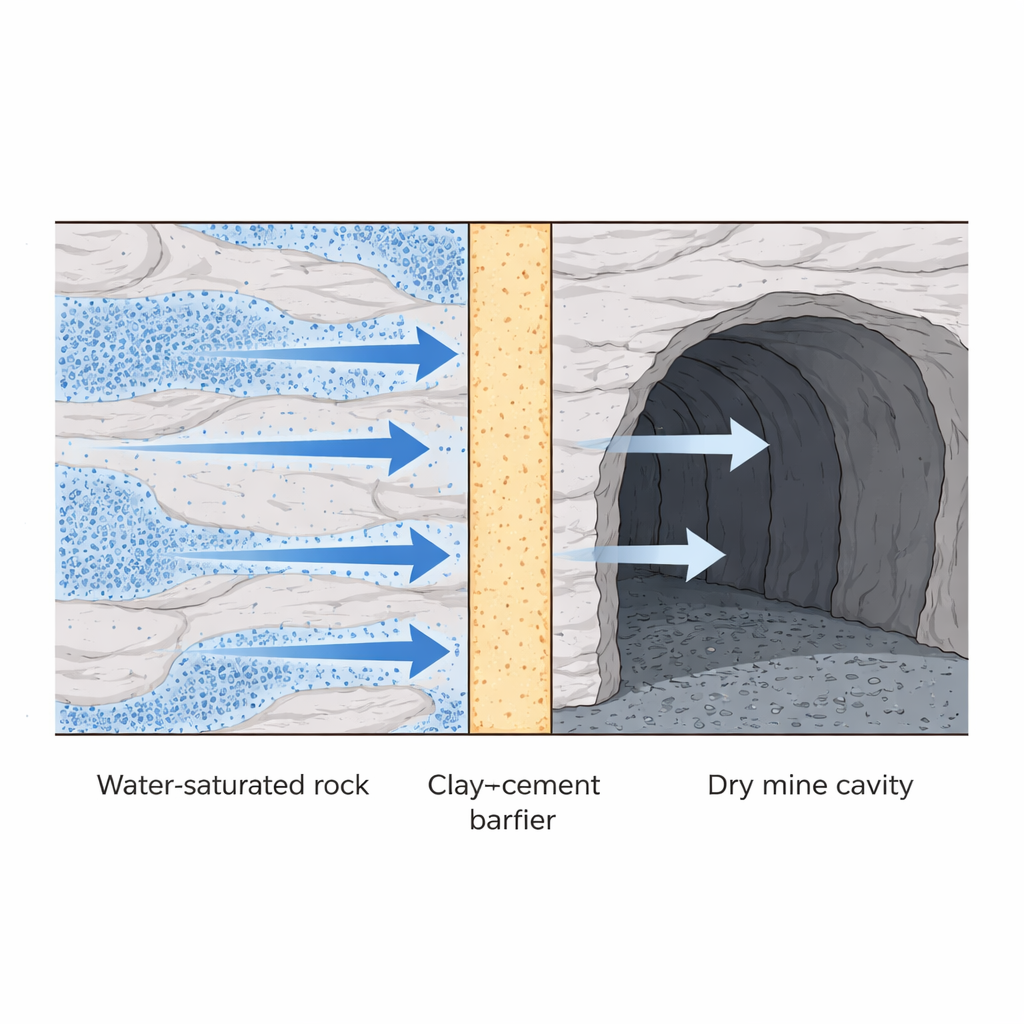
Deep underground mines often fight a constant enemy: unwanted water rushing in through cracks in the rock. If that water is not controlled, it can flood tunnels, halt production, and even cost lives. One promising solution is to inject a mixture of clay and cement into the rock, creating an underground wall that blocks the flow. This study asks a practical but crucial question: how well does that clay‑cement wall hold back water over time while it is being squeezed by rock pressure and attacked by moving groundwater?
Building an underground shield
The researchers worked with a “grouted body” made from red clay, ordinary cement, and water—materials widely available and relatively environmentally friendly. They prepared solid cylinders of this mixture with three different cement contents: 50%, 70%, and 90% by mass. These cylinders stand in for the hardened barrier that forms in a mine after grout is injected into the surrounding rock. After curing the samples for nearly a month, the team placed them in a special device that can squeeze them from all sides, push water through them under pressure, and track how easily that water moves over several hours.
Watching water move through tiny pathways
In the test system, the samples experienced two kinds of forces at once. Water pressure pushed fluid through them, mimicking groundwater trying to seep into a mine, while an external “confining” pressure squeezed the material the way overlying rock would in the real world. The scientists measured how fast water flowed, how easily it passed through (permeability), and how much empty space existed inside the material (porosity). At the start of each test, water rapidly filled the largest pores, flow rates spiked, and permeability peaked. Over the next couple of hours, confining pressure gradually compacted the material, shrinking pores and narrowing water channels until the flow and permeability leveled off at much lower, stable values.
How cement content changes the inner maze
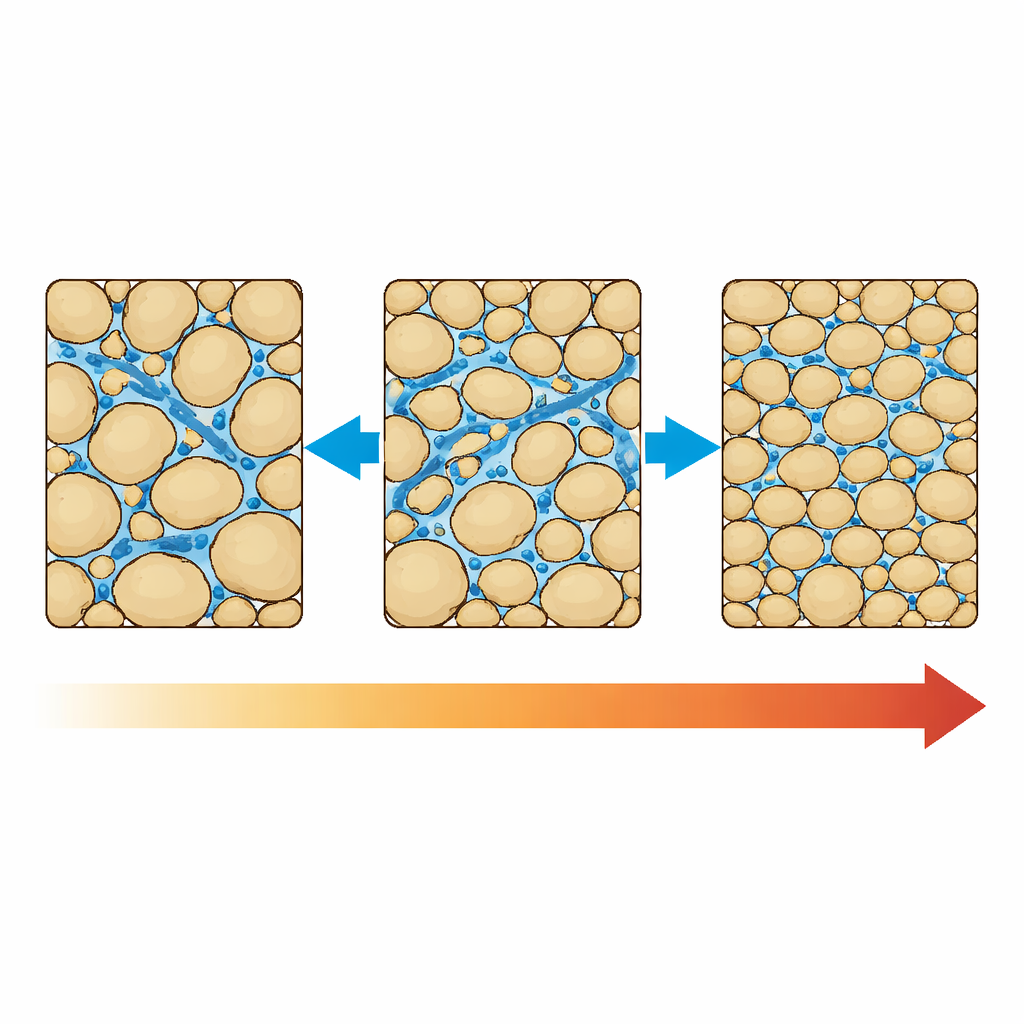
To see what was happening on a microscopic scale, the team used nuclear magnetic resonance, X‑ray diffraction, and electron microscopy to probe the internal structure before and after testing. They found that increasing cement content dramatically tightened the material’s internal maze of pores. Going from 50% to 90% cement reduced both permeability and total pore space, and shifted the pore population from larger pathways to mostly tiny pores. Chemical products formed as the cement hardened filled the gaps between clay particles, turning a relatively open network into a dense skeleton with fewer connected water routes. Samples with only 50% cement had more medium‑to‑large pores that linked together to form efficient water channels, while 90% cement samples were packed with micropores that slowed flow to a crawl.
A tug‑of‑war between water and pressure
The study revealed that the barrier’s performance is controlled by a competition between water’s tendency to open pathways and pressure’s tendency to close them. Higher water pressure gave the flowing fluid more energy to erode and widen pores, converting many tiny pores into larger ones and raising permeability. In contrast, higher confining pressure squeezed the material, closing medium‑sized pores and reinforcing the dominance of narrow pathways that resist flow. The balance between these two effects determined whether the barrier became leakier or tighter over time. Because the cement chemistry also controls how easily pores can be compacted or eroded, the mineral makeup of the hardened grout is a key lever for engineers.
Practical choices for safer, greener mines
For non‑specialists, the takeaway is straightforward: by tuning how much cement is mixed with clay, engineers can design underground barriers that let through almost no water, or allow limited flow where total blockage is not needed. The authors suggest using about 90% cement where mines border major aquifers and demand the strongest, least permeable shield; about 70% cement where moderate protection and cost balance are desired; and only 50% cement in low‑risk zones with modest water pressure. In essence, this work links what is happening in invisible microscopic pores to real‑world decisions about mine safety and environmental protection, showing how a carefully designed clay‑cement wall can keep water where it belongs.
Citation: Lujun, C., Yaoxiang, W., Kun, W. et al. Permeability evolution and microstructural regulation of clay cement grouted body under coupled seepage and stress conditions. Sci Rep 16, 9758 (2026). https://doi.org/10.1038/s41598-026-39995-2
Keywords: mine grouting, groundwater control, clay cement barriers, rock permeability, underground safety