Clear Sky Science · en
Frequency controlled energy absorption in parametric mixing
Turning Down Unwanted Signals with Moving Parts
Modern wireless devices are crowded with signals, and engineers often need ways to selectively quiet specific frequencies without disturbing everything else. This paper explores a new route to do that by using circuits whose electrical properties are rhythmically “shaken” in time, rather than relying on ordinary resistive losses. The authors show that by carefully choosing how different tones in a circuit interact, a circuit can be made to soak up energy from a chosen frequency band in a controllable way, pointing toward new kinds of tunable filters for radios, sensors, and future communication systems.
How Signals Normally Share Energy
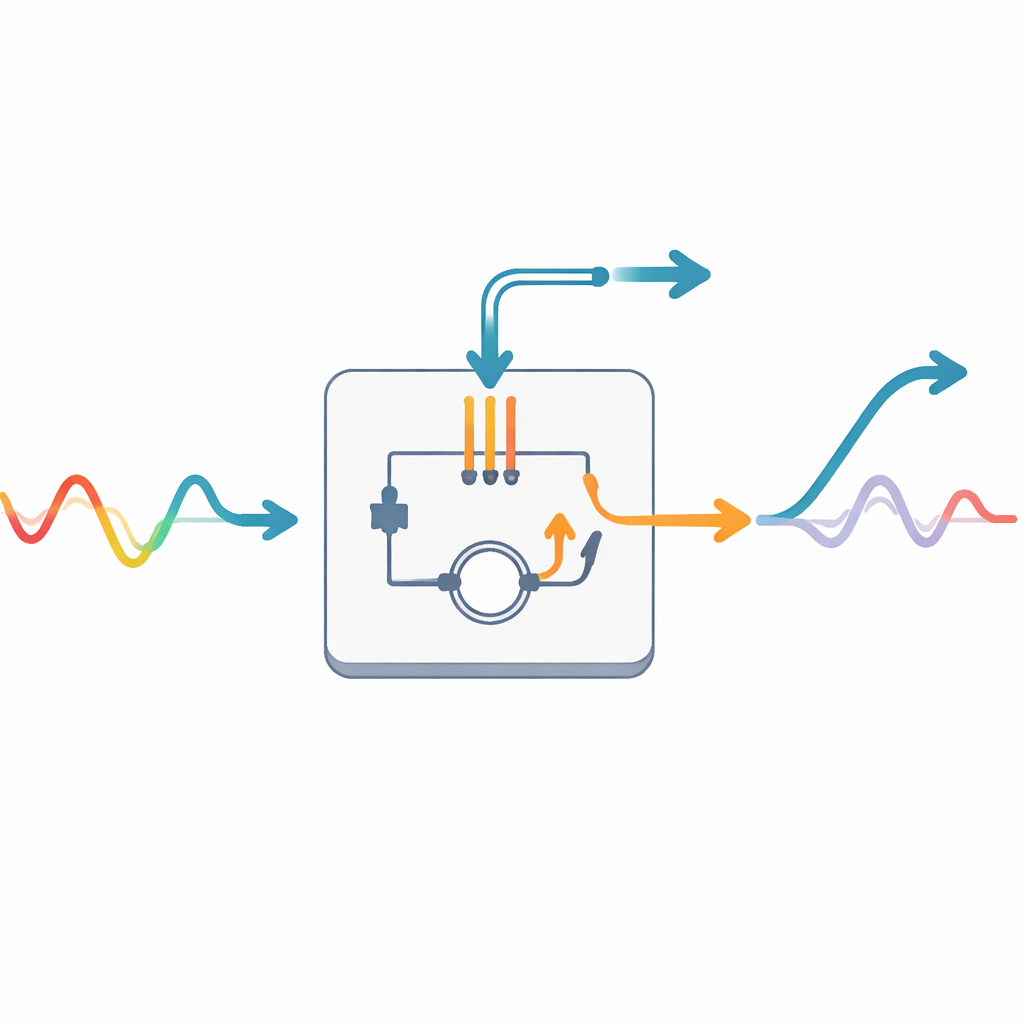
In many electronic and optical systems, a strong “pump” signal can cause a smaller “signal” to mix and produce a third “idler” tone at a different frequency. Traditionally, this effect has been used to build amplifiers and frequency converters, where the pump transfers energy into the signal and idler, boosting them without relying on ordinary resistors that turn energy into heat. Most past work has focused on the case where the idler frequency is lower than the pump, which produces a kind of negative resistance and leads to gain. In that familiar picture, the time-varying circuit element—often a voltage-controlled capacitor called a varactor—acts like a lossless energy trader between the three tones.
Flipping the Direction of Energy Flow
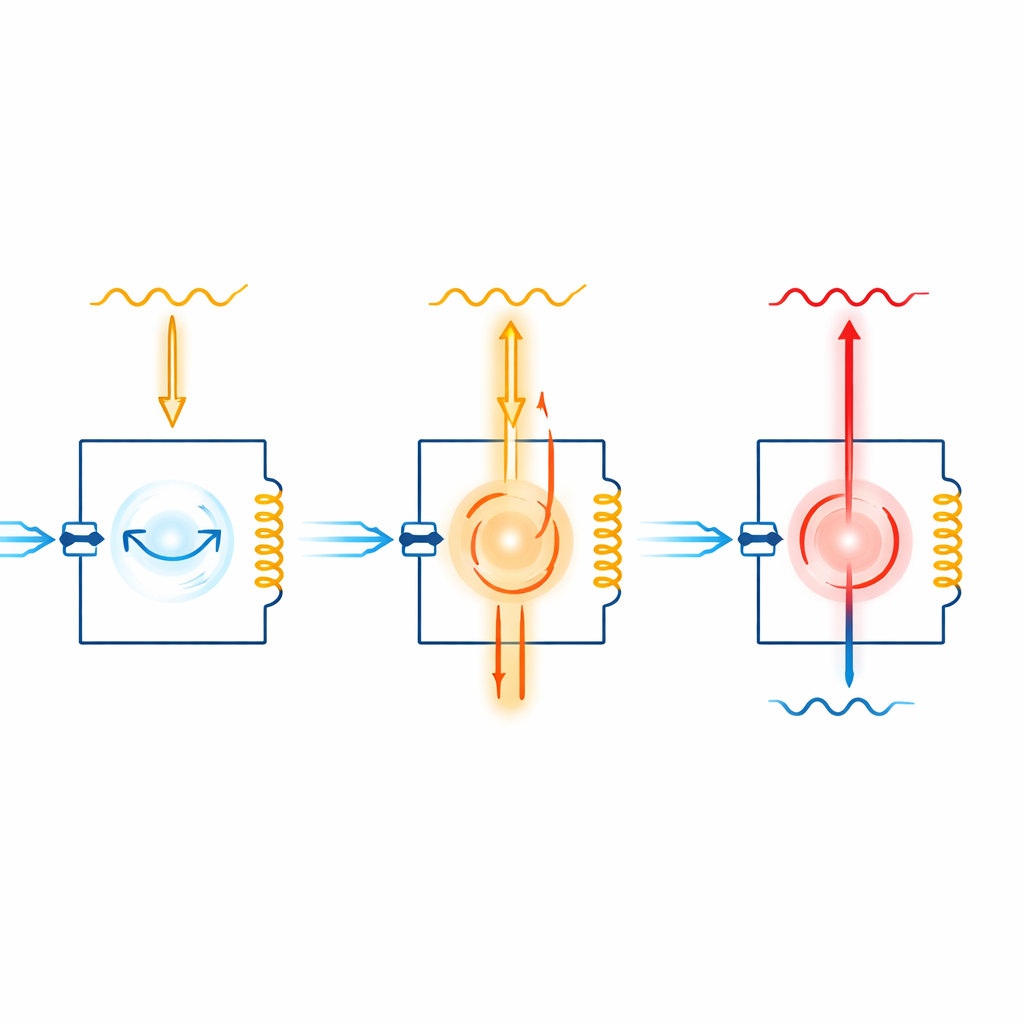
This study zooms in on the less explored complementary case, where the idler frequency is higher than both the pump and the signal. Under this different ordering of frequencies, the same style of time-varying capacitor produces the opposite behavior: instead of acting like a source, the circuit looks as if it has a real, positive resistance at the signal frequency. In other words, from the signal’s point of view, energy is being pulled out of its band. The authors build a mathematical description showing that this apparent resistance is not ordinary material loss, but a bookkeeping effect of energy being diverted into the idler and pump channels in a way that still respects overall energy-conservation rules known as the Manley–Rowe relations.
Designing a Circuit that Soaks Up Selective Tones
To turn this idea into a practical tool, the team analyzes a simple resonant network built around a varactor and an inductor. The idler frequency is fixed by the resonance, while the pump tone is swept. Whenever the signal frequency satisfies the relation that it adds with the pump to reach the idler, the circuit presents an extra conductance at that signal, creating a “notch” in transmission. Their theory shows that the strength of this synthetic loss is governed by two knobs: how strongly the capacitor is being modulated by the pump, and how sharply the idler resonator rings, quantified by its quality factor. Stronger modulation and higher quality factor both deepen the notch, because they enhance the rate at which signal energy is siphoned into the idler path instead of passing through.
From Equations to a Working Chip
The authors then build a monolithic microwave integrated circuit that embodies this model and operates between 1.3 and 2.3 gigahertz, a range relevant to many wireless links. The chip splits an incoming radio signal into two branches that share a common resonant “idler tank” but are driven by a pump in opposite phase, which helps confine the idler energy and keep the three frequency paths separate. When the pump is off, the circuit behaves like a simple low-pass line. When the pump is on, measurements show a clear moving dip in transmitted power whose center tracks the pump frequency exactly as the theory predicts. Although the depth of the dip—about 3.5 decibels—is modest, careful comparison with simulations and the analytical formulae shows close agreement, indicating that the observed loss truly arises from the engineered parametric interaction rather than from unintended hardware imperfections.
Why This Matters for Future Filters
In the broader context of filter design, this approach occupies a new niche alongside traditional notch filters that rely on static resonators, tuning diodes, switches, or explicit resistive loads. Here, the unwanted energy is steered away by time-varying reactance, not simply burned off in a resistor. The authors discuss paths to stronger performance, such as using higher quality resonators—potentially acoustic devices—or adding carefully controlled negative resistance at the idler to cancel unavoidable losses. With such improvements, these parametric absorbers could enable reconfigurable, power-efficient filters and frequency-selective surfaces where a single pump knob dynamically sets which slice of the spectrum is quietly removed.
Big-Picture Takeaway
In simple terms, this work shows that by rhythmically varying a capacitor at the right frequencies, engineers can make a circuit that selectively “drinks up” energy from chosen radio tones without relying on conventional resistors. Theory, simulation, and a real chip all confirm that this pump-controlled absorption can produce tunable notches whose depth is set by how sharply the auxiliary resonance rings and how hard it is driven. This lays the groundwork for future radios and wave-based devices that sculpt energy in time and frequency with far more subtlety than static components allow.
Citation: Chen, S.C., Yeung, L.K., Runge, K. et al. Frequency controlled energy absorption in parametric mixing. Sci Rep 16, 9509 (2026). https://doi.org/10.1038/s41598-026-39994-3
Keywords: parametric mixing, tunable notch filters, time-varying circuits, RF energy absorption, frequency-selective surfaces