Clear Sky Science · en
Dyadic family hardiness and coping styles on fear of cancer recurrence in adolescent malignant bone tumor patients and caregivers
Why this study matters for families facing cancer
For many teenagers with cancer, the scariest part is not just the treatments, but the worry that the disease might come back. Their parents or other caregivers often share this fear, or even feel it more intensely. This study looks at how families can weather that fear together. It focuses on adolescents with malignant bone tumors and their caregivers, asking how the way they cope and how strong their family unit feels can shape both sides’ ongoing fear of cancer returning.
Two lives, one shared worry
The researchers studied 269 pairs of adolescents with malignant bone tumors and their main caregivers in two large hospitals in China. Each teen and caregiver filled out questionnaires about how strongly they feared the cancer returning, how they usually handled stress (through more hopeful, problem-solving approaches or more avoidant, pessimistic ones), and how resilient their family felt overall—its ability to pull together and adapt when life gets hard. By looking at both members of the pair at the same time, the team could see not just how each person’s mindset affected their own fear, but how it spilled over to the other person.
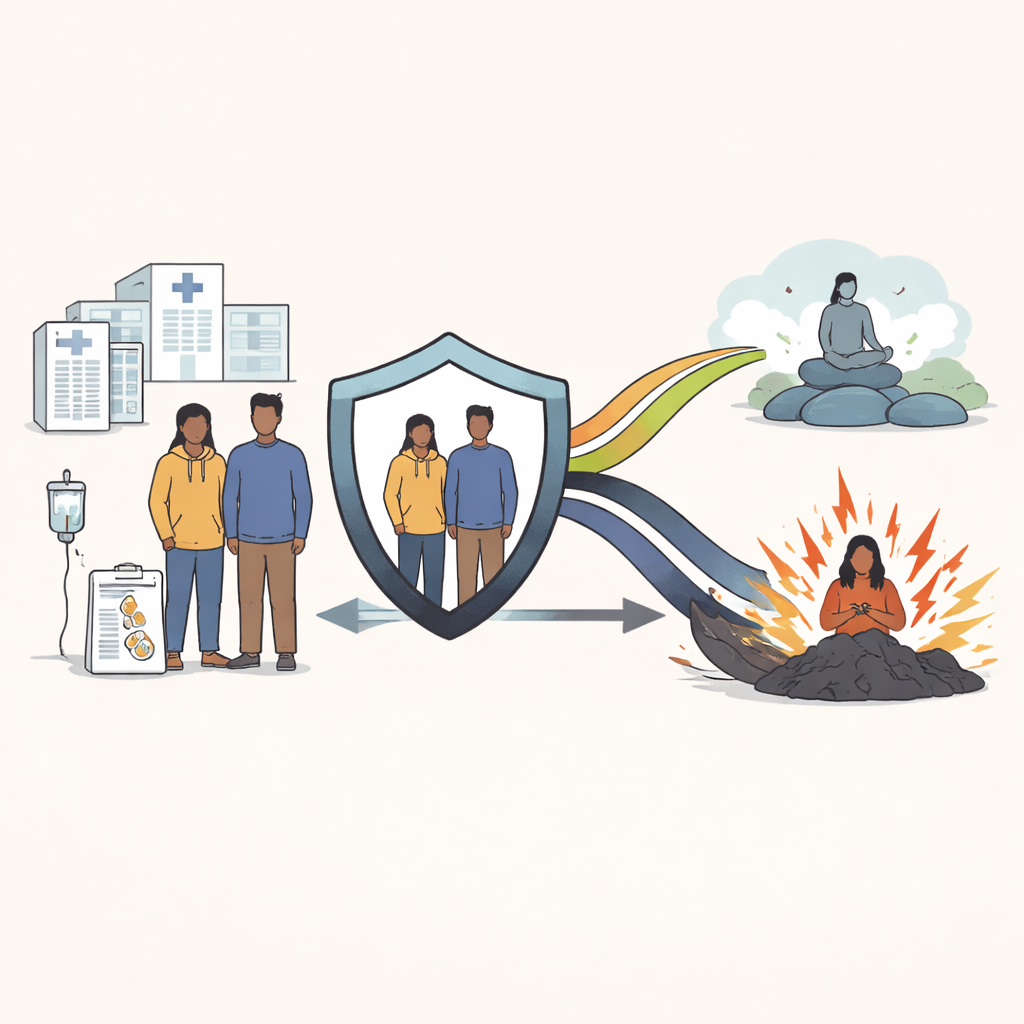
How families respond to stress
The study used a framework that treats the teen and caregiver as a connected unit rather than as two isolated individuals. In this approach, “actor” effects describe how a person’s own coping style and sense of family strength influence their own fear. “Partner” effects describe how those same traits shape the other person’s fear. Using statistical models, the authors examined how positive coping (such as seeking support and planning ahead), negative coping (such as avoidance or denial) and family hardiness (confidence, shared responsibility and a belief that challenges can be faced together) related to the fear of cancer coming back.
What the numbers reveal about fear
Overall, caregivers reported stronger fear of recurrence than the adolescents themselves, likely because they shoulder financial, practical and emotional responsibilities over the long term. Across both groups, positive coping was linked with lower fear, while negative coping was tied to higher fear. Families that scored higher on resilience tended to have lower fear in both teens and caregivers. Crucially, the study showed that these patterns were not confined to individuals. When adolescents showed stronger positive coping and greater family resilience, it not only eased their own fear but also reduced their caregivers’ fear. Likewise, when teens coped in more negative ways, both their own fear and their caregivers’ fear were higher.
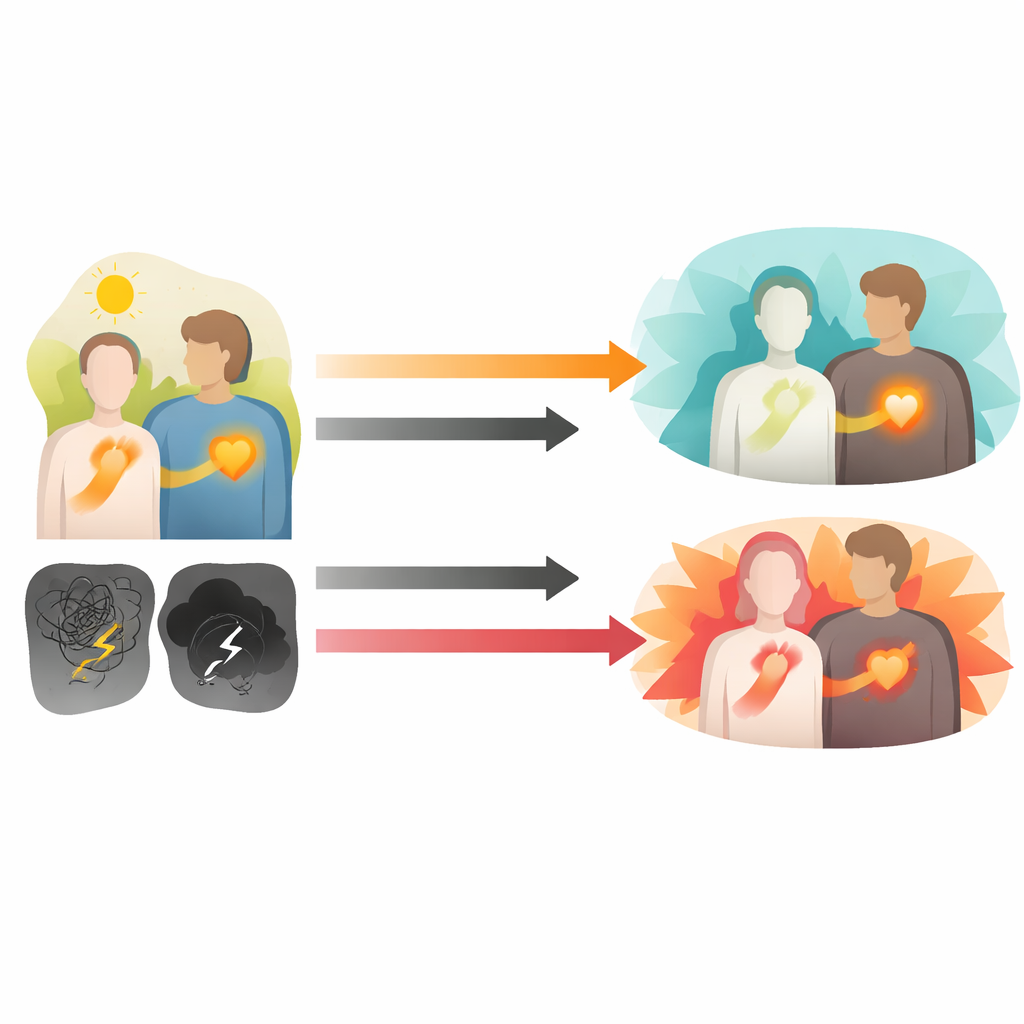
How one person’s stress affects the other
The emotional flow also ran in the other direction. Caregivers’ ways of coping—especially when more negative—were closely tied to the teenager’s fear of the cancer returning. Caregivers’ positive coping helped ease teens’ fear, and their negative coping was associated with higher teen fear, even though those coping patterns did not clearly change the caregivers’ own fear levels. The family’s overall hardiness strongly predicted how fearful caregivers felt, but did not show the same spillover effect on teens. Together, these findings support the idea of emotional “contagion” and co-regulation within families: moods and habits of response do not stay contained within one person, but echo back and forth.
What this means for care and hope
This study suggests that supporting teenagers with cancer cannot stop at the edge of the hospital bed. Because patient and caregiver influence each other so strongly, health professionals need to see them as a team. Programs that help families build resilience—by strengthening communication, sharing responsibilities, and recognizing small successes—may lower fear on both sides. Training both teens and caregivers in healthier coping strategies, such as open emotional expression, relaxation techniques and problem-focused planning, could reduce reliance on avoidance and despair. In simple terms, when families learn to face the possibility of recurrence together with more skills and support, the fear itself becomes less overwhelming for everyone involved.
Citation: Ye, Q., Ma, Yj., Wang, Z. et al. Dyadic family hardiness and coping styles on fear of cancer recurrence in adolescent malignant bone tumor patients and caregivers. Sci Rep 16, 9312 (2026). https://doi.org/10.1038/s41598-026-39980-9
Keywords: adolescent cancer, family resilience, caregivers, coping styles, fear of cancer recurrence