Clear Sky Science · en
Interspecific interactions modulate bioturbation efficiency and nutrient dynamics in freshwater benthic communities
Why pond mud matters to clean water
Beneath the still surface of ponds and lakes, armies of tiny animals are constantly churning the mud. Their digging and grazing help decide how much nitrogen and phosphorus – the key plant nutrients that can trigger algal blooms – escape from the bottom into the water. This study asks a deceptively simple question: is it the number of species that matters most, or the particular kinds of animals and the way they behave? By watching snails, worms and insect larvae in miniature ponds, the researchers show that who is present – and how they move sediment – can strongly steer the health of freshwater ecosystems.
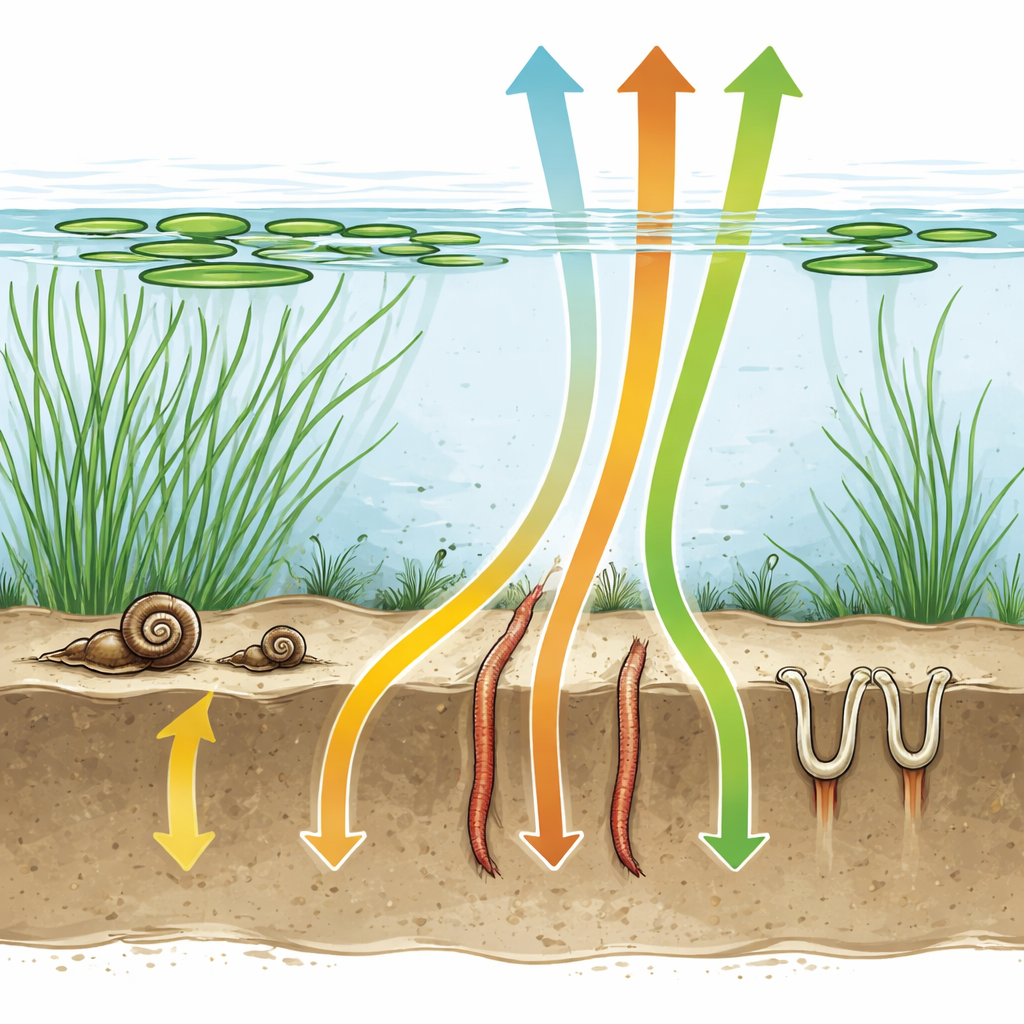
Life in the hidden world underfoot
The work focuses on four common bottom‑dwelling creatures found in Indian freshwater ponds: two snails (Filopaludina bengalensis and Gabbia orcula), tubificid worms, and the larvae of non‑biting midges known as chironomids. All live in or on the sediment and feed on fine organic debris, but they interact with the mud in very different ways. The worms build vertical galleries and convey particles upward; the chironomid larvae live in small tubes and pump water downwards; the snails crawl and graze across the surface, pushing and bulldozing the top layer. These different lifestyles, or functional traits, are expected to change how easily nutrients locked in the mud are stirred up and released into the water.
Miniature ponds to track nutrient leaks
To untangle these effects, the team set up glass columns filled with pond sediment and water, creating controlled microcosms of the lake bottom. In one set of experiments, each species was added alone at densities similar to those seen in nature, and changes in nitrogen and phosphorus in the water were tracked over four weeks. In another set, chironomid larvae were combined with worms and one or both snail species to see how living together altered their activity. The researchers also measured how many larval burrows survived over time, how porous and water‑holding the sediment became, and how well algae growing on plastic strips – a simple stand‑in for natural bottom plants – fared in each treatment.
When snails, worms and larvae meet
The results reveal that not all mud‑mixers are equal. On their own, snails and worms generally caused larger releases of nitrogen and phosphorus into the water than did chironomid larvae, especially when differences in body mass were taken into account. In mixed communities, combinations containing chironomids with F. bengalensis and tubificid worms produced some of the strongest nutrient fluxes from sediment to water. Surprisingly, simply adding more species did not guarantee higher nutrient levels; instead, certain pairings mattered more than total species count. For example, chironomids paired with F. bengalensis sometimes drove stronger nitrogen release than when all three groups were present together.
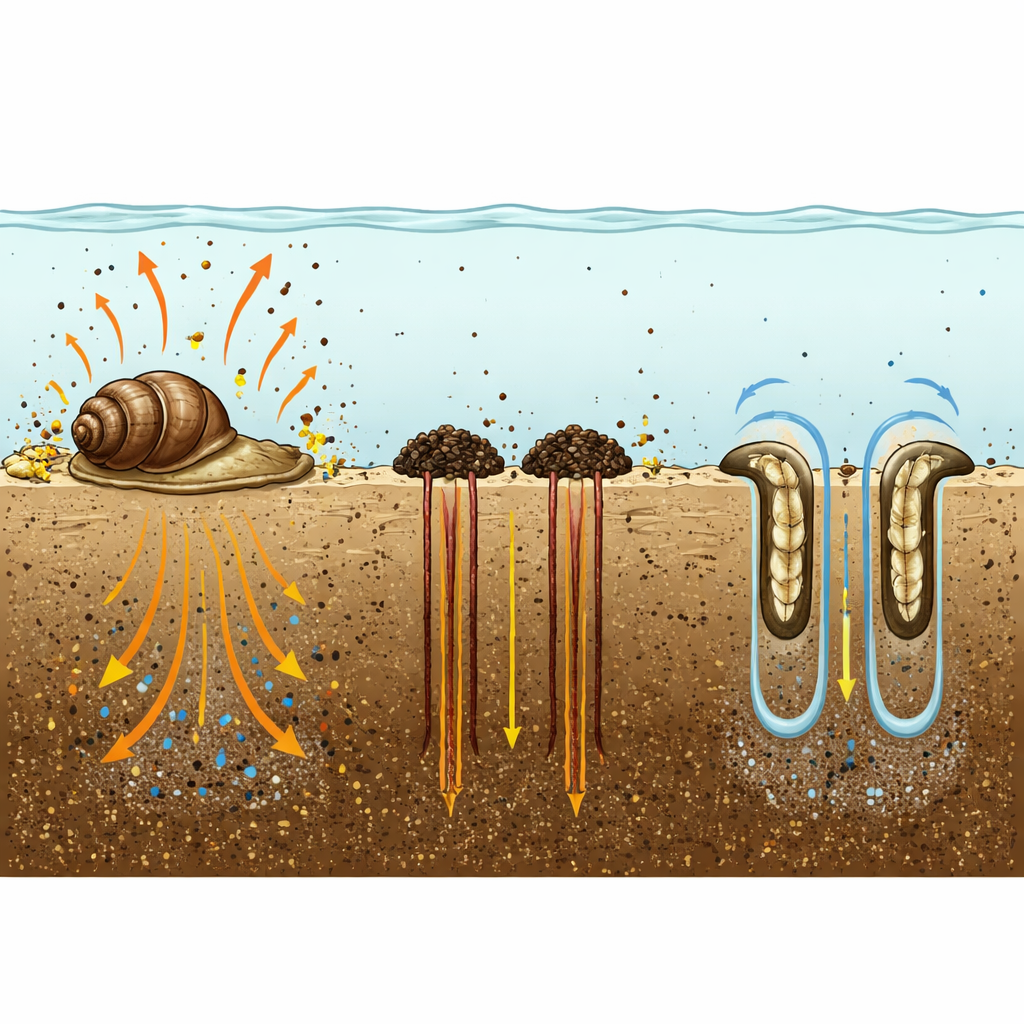
Burrows lost and mud reshaped
The animals also reshaped the physical structure of the sediment in different ways. Chironomid larvae normally build delicate tubes that act like tiny pumps, but these structures decayed much faster when snails were present. As snails grazed and bulldozed across the surface, they collapsed the tubes, sharply shortening how long burrows lasted and reducing their density. Tubificid worms, by contrast, interfered less with the larvae, likely because their own galleries occupy different depths. Across treatments, the overall number of burrows turned out to be a poor predictor of nutrient release; direct disturbance of the sediment surface by the larger snails and the worms’ deeper reworking were more important drivers of nitrogen and phosphorus leaking into the water.
Algae, water clarity, and managing ponds
Algal growth on the plastic strips tended to be lower in all tanks with bottom animals than in bare controls by the end of the experiment. This drop likely reflects a tug‑of‑war between two forces: on one side, snails and other grazers scrape away algae; on the other, their stirring of the mud releases nutrients that could fertilize new growth, while increased cloudiness can shade algae and slow photosynthesis. The balance of these forces depends on which animals are present and in what numbers, suggesting that deliberately assembling certain combinations could help managers fine‑tune algal growth and nutrient levels in small, nutrient‑rich water bodies.
What this means for healthy freshwater
For non‑specialists, the main message is that the “jobs” species perform – how they move, feed and reshape their habitat – matter more for nutrient cycling than simply counting how many species live in the mud. Large, active snails, tube‑building larvae and burrowing worms each contribute differently to nitrogen and phosphorus release, and their interactions can either amplify or dampen these effects. In practical terms, managing eutrophication is not only about reducing fertilizer runoff from land, but also about understanding and, where possible, guiding the community of small animals that engineer the lake bottom. Choosing the right mix of bioturbating species could become a subtle tool for keeping freshwater ecosystems clearer and more resilient.
Citation: Chakraborty, A., Saha, G.K. & Aditya, G. Interspecific interactions modulate bioturbation efficiency and nutrient dynamics in freshwater benthic communities. Sci Rep 16, 8679 (2026). https://doi.org/10.1038/s41598-026-39976-5
Keywords: bioturbation, freshwater sediment, nutrient cycling, benthic invertebrates, eutrophication