Clear Sky Science · en
Titanium-induced phase changes and tribological behavior in cantor-based high entropy alloys
Harder Metals for Tough Jobs
From jet engines to drilling tools, many machines fail not because their parts break in half, but because their surfaces slowly grind away. This study looks at a new class of metallic coatings designed to stand up to severe rubbing and sliding. By carefully adding titanium to a special “cocktail” alloy, the researchers show how tiny changes in recipe can reshape the material from the inside out, making it harder, more wear resistant, and even tuning its magnetic behavior. 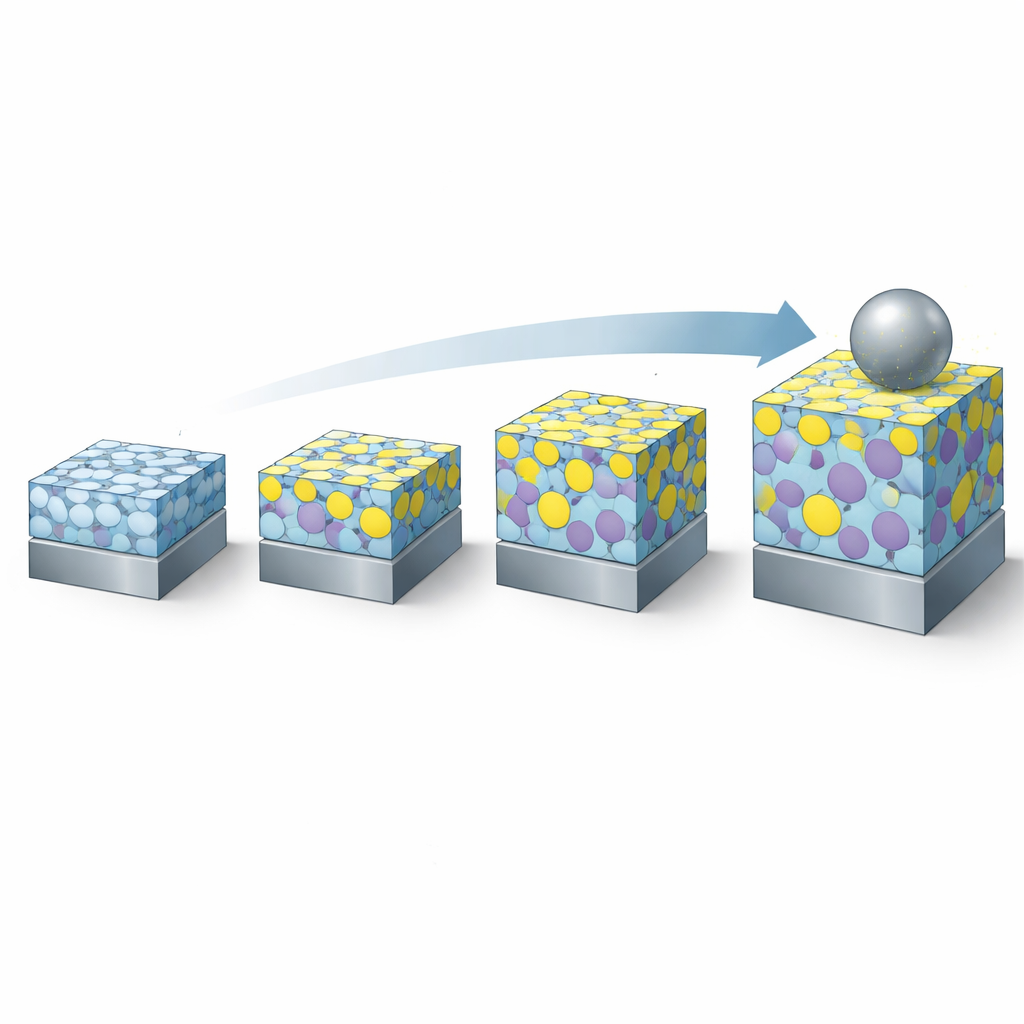
Mixing Many Metals into One
Traditional alloys usually revolve around one main metal, like iron in steel. High‑entropy alloys are different: they mix five or more metals in nearly equal amounts, creating a crowded atomic landscape that can yield unusual strength, stability, and corrosion resistance. The base material in this work is the well‑known Cantor alloy, made from iron, chromium, cobalt, nickel, and manganese. It is tough and ductile, but not hard enough for the most demanding sliding contacts. The team’s idea was simple but powerful: introduce titanium into this mix in controlled amounts, and see how the inner structure and properties change.
From Soft Grids to Stiff Skeletons
At the atomic scale, metals can arrange themselves in different repeating patterns, a bit like different ways of stacking oranges in a crate. The original Cantor alloy prefers a tightly packed pattern that is relatively soft. As titanium is added, the structure gradually shifts toward a more open, body‑centered pattern that can better accommodate the larger titanium atoms. Along the way, very hard, ordered regions—known as intermetallics—and titanium‑rich carbides begin to appear. Together these act like a stiff skeleton threaded through the softer background, blocking the motion of defects in the metal and significantly raising hardness. Careful laboratory measurements and computer simulations both confirmed this trend from a soft, single‑phase material to a tougher, multi‑phase one as titanium content increases.
Making and Testing Protective Coatings
To turn these powders into useful surface layers, the researchers used a technique called spark plasma sintering, which rapidly bonds the alloy particles onto a steel substrate under pressure and pulsed heating. This fast process helps preserve the fine grain structure created by mechanical alloying and encourages the formation of hard phases. The resulting coatings were then polished and tested under sliding against a hard ball, while their hardness, wear rate, and friction behavior were carefully recorded. Across the series, more titanium meant higher hardness—rising from about 686 to roughly 1030 on the Vickers scale—and a steady drop in wear rate, falling to less than half of the original value. Microscopy of the worn tracks showed that the coatings with the most titanium suffered fewer deep grooves and less material peeling, consistent with their improved resistance to damage. 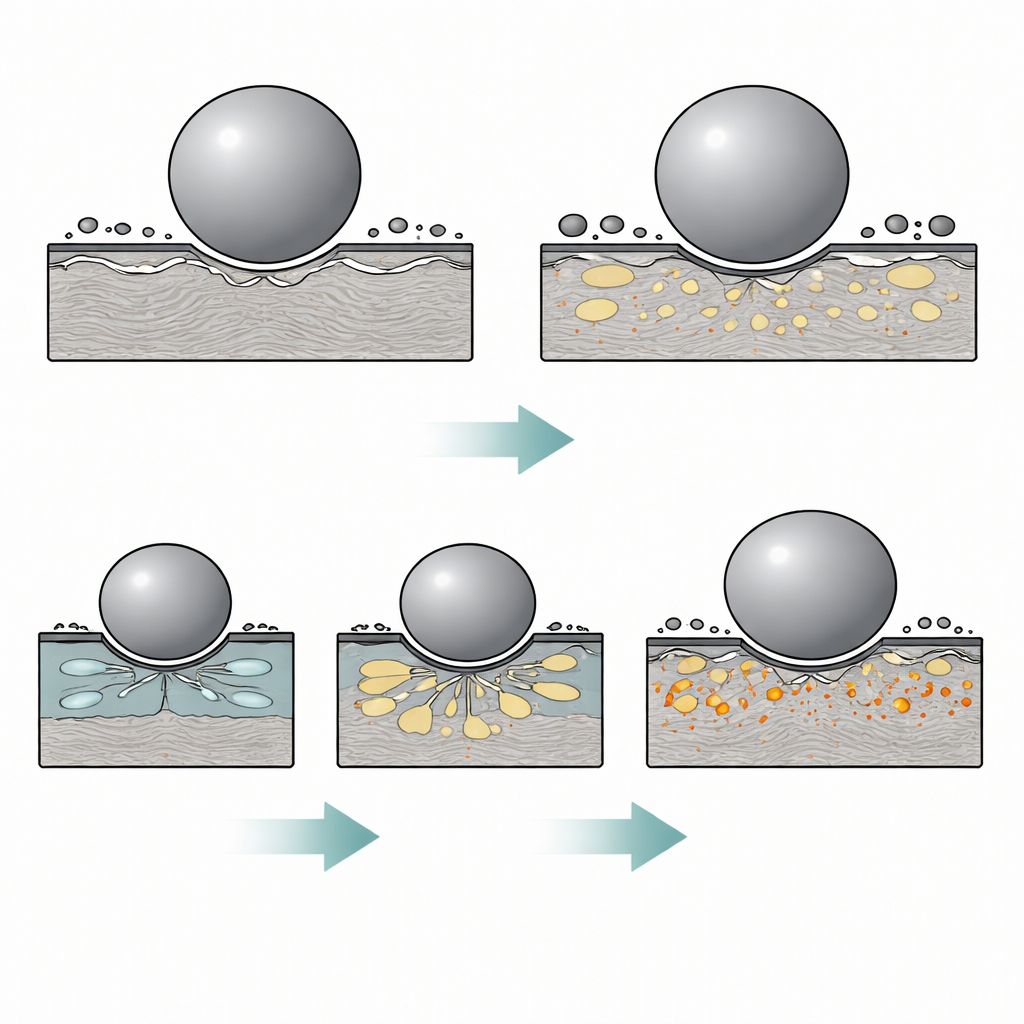
Magnetism and Heat Endurance
Interestingly, the internal rearrangements driven by titanium also altered how the alloys respond to magnetic fields. All compositions remained ferromagnetic, but the strength of their magnetization dipped at intermediate titanium levels—where non‑magnetic hard particles occupy more volume—then recovered when the body‑centered matrix became dominant again and richer in strongly magnetic elements like iron and cobalt. This non‑linear behavior highlights how magnetism in these complex alloys depends not just on which elements are present, but on how they partition between different internal regions. The team also heated selected powders to 900 °C and found that their main structures survived without breaking down, an encouraging sign for high‑temperature use.
Why This Matters
In plain terms, this work shows that tweaking the recipe of a multimetal alloy with titanium can turn a good but relatively soft material into a hard, wear‑resistant coating that still keeps its structure at high temperatures and offers tunable magnetic behavior. The best version combines a tough backbone phase with hard intermetallic and carbide particles formed during processing, which share the load and protect the surface from grinding away. Such coatings could extend the lifetime of moving parts in harsh environments, reduce maintenance costs, and open doors to components that need both durability and specific magnetic properties, such as advanced bearings, electric machines, or shielding parts.
Citation: Alizadeh, M., Bakhshi, SR., Dehnavi, MR. et al. Titanium-induced phase changes and tribological behavior in cantor-based high entropy alloys. Sci Rep 16, 9246 (2026). https://doi.org/10.1038/s41598-026-39973-8
Keywords: high entropy alloys, titanium alloying, wear resistant coatings, microstructure evolution, magnetic materials