Clear Sky Science · en
Educational impact and cost efficiency of AI-enhanced videos in pediatric surgery training: a quasi-experimental study
Why Better Training Videos Matter
For children who need surgery, the skill of their doctors can be a matter of life and death. Yet around the world, young surgeons are getting fewer chances to practice children’s operations in real hospitals. This study explores whether modern artificial intelligence (AI) can help fill that gap by turning simple, low-budget teaching videos into polished, studio-like lessons that are easier to follow—without the high price tag of a professional film crew.
The Problem of Learning with Fewer Real Cases
Medical trainees today see far fewer children’s operations than in the past. Many residents log only a few dozen pediatric surgeries before graduating, and most of those cases involve the same routine procedures. The COVID-19 pandemic made things worse by sharply cutting operating room time and lowering trainee confidence. At the same time, medical schools are moving toward “Education 4.0,” a vision where learning is flexible, technology-rich, and tailored to students. High-quality videos are a natural fit for this approach, but producing professional lectures normally requires special studios, bright green screens, complex lighting, and expensive technical staff—resources that many hospitals and universities, especially in low- and middle-income countries, simply do not have.
Turning Plain Walls into Studio-Style Lessons
In this study, faculty at Al-Azhar University in Cairo created lecture videos on five common children’s surgery topics, such as undescended testes and bowel problems. Every version of each lecture used the exact same script, voice, and medical diagrams. The only difference was how the teacher appeared on screen. In the standard version, the presenter stood against a plain wall, with simple editing. In the AI-enhanced version, the team used open-source software running on a consumer laptop to digitally replace the bare wall with a brighter, studio-like background. Crucially, the AI was allowed to touch only the surroundings: the presenter’s face, body, gestures, and voice were left completely unchanged to avoid any distortion of human features or medical details. 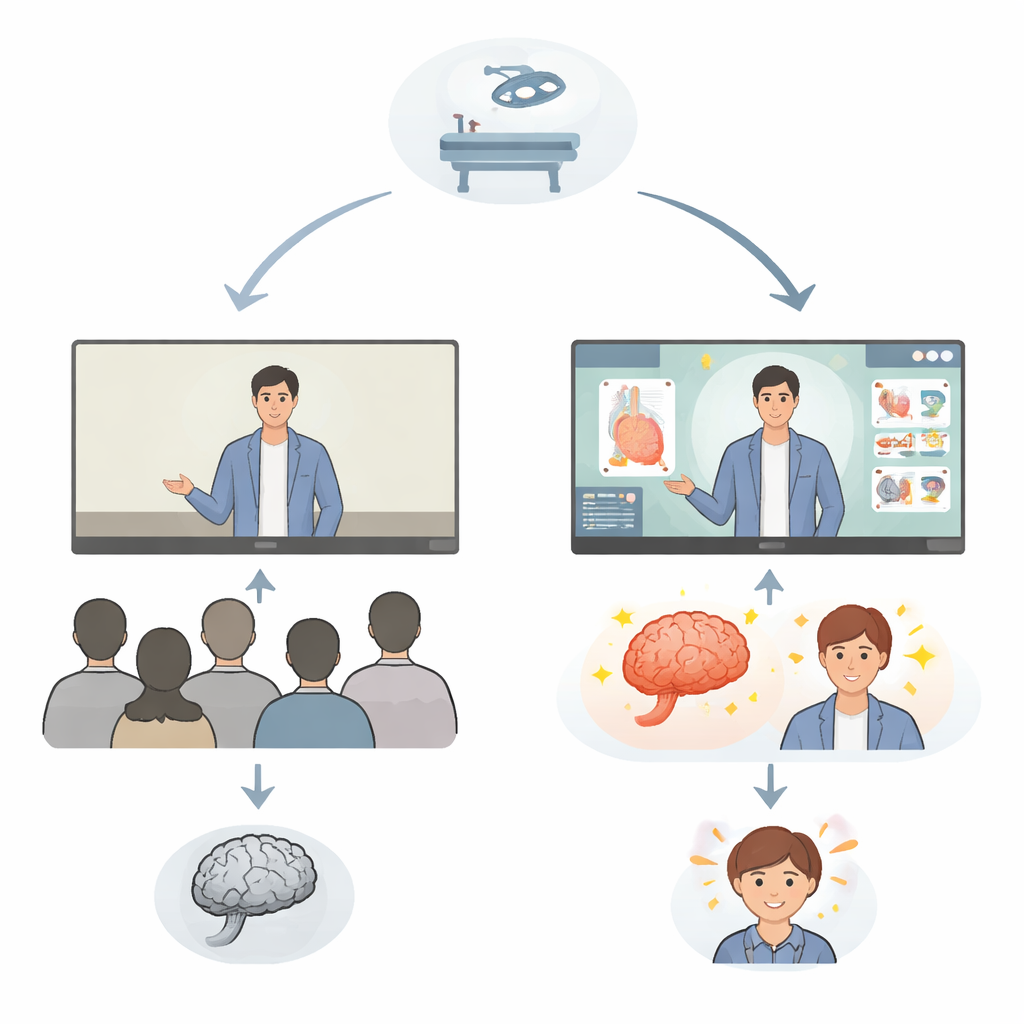
How the Study Was Run and What Was Measured
The researchers enrolled 240 learners—mostly medical students, plus some pediatric surgery residents—who watched one of the two video styles as part of their usual teaching sessions. Groups were formed based on class schedules rather than random assignment, but both groups were similar in age, training level, and prior exposure to the topics. Immediately after viewing, participants answered a 40-question multiple-choice test and rated the videos on how clear they were, how comfortable they were to watch, how professional they looked, and whether they would recommend this format to others. The team also compared the costs of their do-it-yourself AI approach with traditional studio production, including equipment, space, editing services, and faculty time. 
Clearer Learning and Lower Costs
Learners who watched the AI-enhanced videos not only felt more confident in what they had learned, they also performed better on the knowledge test. On average, their scores were about seven percentage points higher, roughly equal to getting three more questions right out of forty. They rated the enhanced videos as clearer, more visually comfortable, and more professional, and were more likely to say they preferred them to reading a textbook. These gains held true across all five topics and for both students and residents. Financially, the AI method cut per-video production costs by an estimated 72 to 94 percent compared with hiring a professional studio, even after accounting for the extra faculty time needed to oversee the AI processing.
What This Means for Future Doctors and Patients
This work suggests that educators do not need expensive studios or fully synthetic AI presenters to create engaging, high-quality teaching materials. By using open-source tools carefully and limiting AI’s role to improving the background, teachers can keep the human connection on screen while making lessons easier to watch and understand. For hospitals and schools with tight budgets, especially in resource-limited regions, this approach offers a practical way to upgrade their training materials and reach more learners. The study looked only at short-term test scores, so future research will need to show whether these benefits last and translate into better performance in the operating room. Still, the findings point toward a future where smart, modest use of AI can help train safer surgeons for children everywhere.
Citation: Abdelmohsen, A., Elshehawy, N., Abdel Razek, M. et al. Educational impact and cost efficiency of AI-enhanced videos in pediatric surgery training: a quasi-experimental study. Sci Rep 16, 8952 (2026). https://doi.org/10.1038/s41598-026-39961-y
Keywords: pediatric surgery education, AI-enhanced videos, medical training technology, video-based learning, low-cost teaching tools