Clear Sky Science · en
Machine learning techniques based multi-parameter analysis and design of nonlinear helical structures considering internal structure collisions
Why car springs matter more than you think
Hidden deep inside high‑performance car engines are tightly wound metal springs that open and close the valves thousands of times per second. These helical springs do more than simply bounce; they store energy and tame violent vibrations. But under extreme speeds, the same springs can suddenly generate sharp force spikes that damage parts and shorten engine life. This study explains where those spikes come from and shows how modern computer simulations and machine learning can help engineers redesign springs to be both durable and effective vibration absorbers.
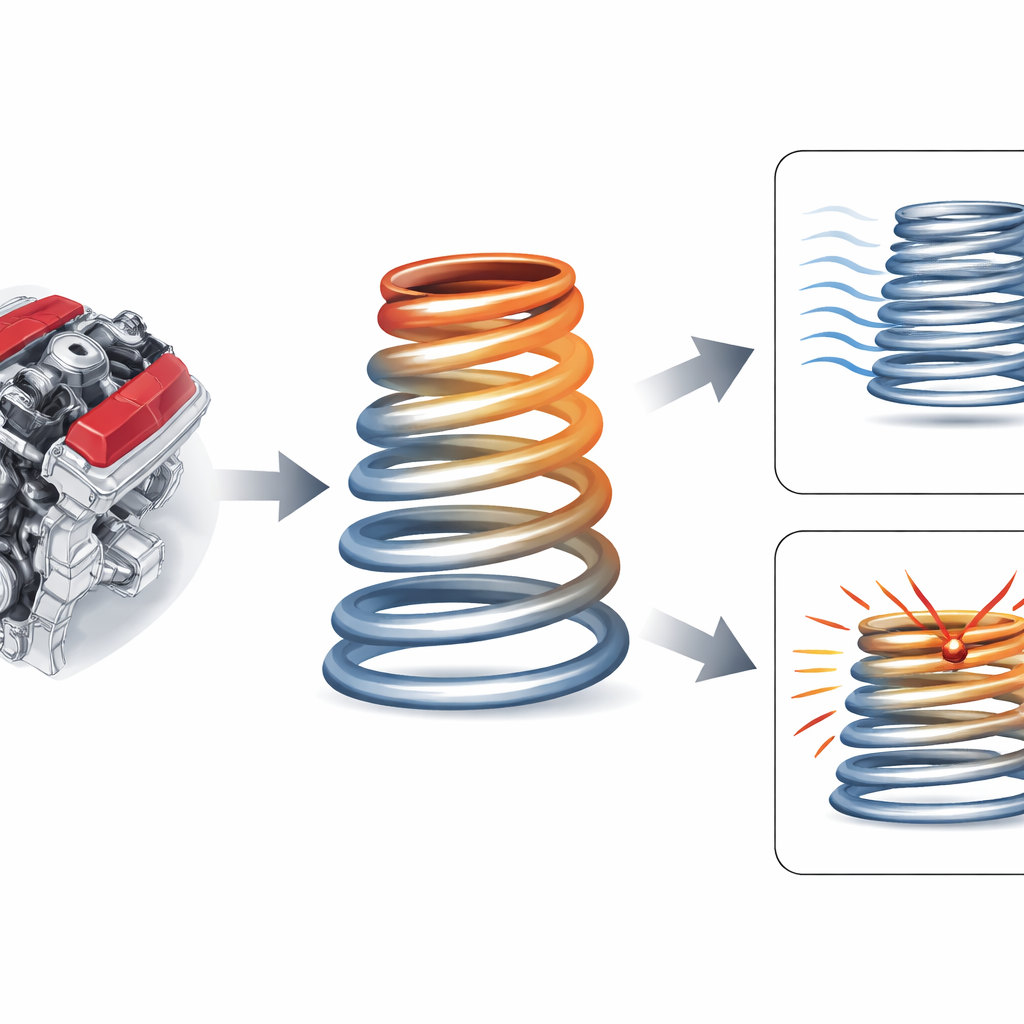
Springs under extreme engine speeds
The researchers focused on a “beehive” valve spring used in a high‑speed sports car engine. Unlike a simple straight spring, this one changes diameter along its height and has coils that are closer together in some regions than others. The team mounted the spring in a real V8 engine driven by an electric motor and measured the forces it produced while the engine spun between 6500 and 16,000 revolutions per minute. At lower speeds, the peak forces stayed near 900 newtons and fluctuated smoothly, as expected from ordinary vibration. But around 7800 revolutions per minute and again at higher speeds, the measured forces suddenly jumped to more than 1500–1800 newtons. These unexpected peaks hinted at a different, more violent process taking place inside the spring.
Looking inside the spring with virtual tests
To see what was happening between the coils, the team built a highly detailed computer model of the spring using a standard engineering technique called finite element analysis. They recreated the exact spring geometry and material, included frictional contact between neighboring coils, and drove the model with the same camshaft motion as in the engine. When they ran the simulation at 7800 revolutions per minute, the predicted forces matched the engine measurements very closely, including the sharp spike at a specific point in the cam cycle. By tracking the motion of individual coils, they found that two neighboring coils in a narrow‑gap region briefly slammed together and then separated within a few thousandths of a second. This rapid collision launched a strong elastic wave through the spring, which appeared as the observed force spike.
How coil collisions can help and hurt
These collisions turned out to be a double‑edged sword. On one hand, when coils hit each other they dissipate some vibrational energy and can reduce ongoing oscillations—useful for keeping the valve motion stable. On the other hand, the very same impacts create short‑lived but very large forces that can accelerate fatigue and lead to early failure. The key design challenge is therefore not to eliminate contact entirely, but to tune the spring’s geometry so that collisions are mild enough to avoid damaging spikes while still helping to damp vibration. Because the spring shape is defined by many linked dimensions—such as coil diameter and vertical “height” at several positions—testing every possible combination directly in the engine or with full simulations would be far too time‑consuming.
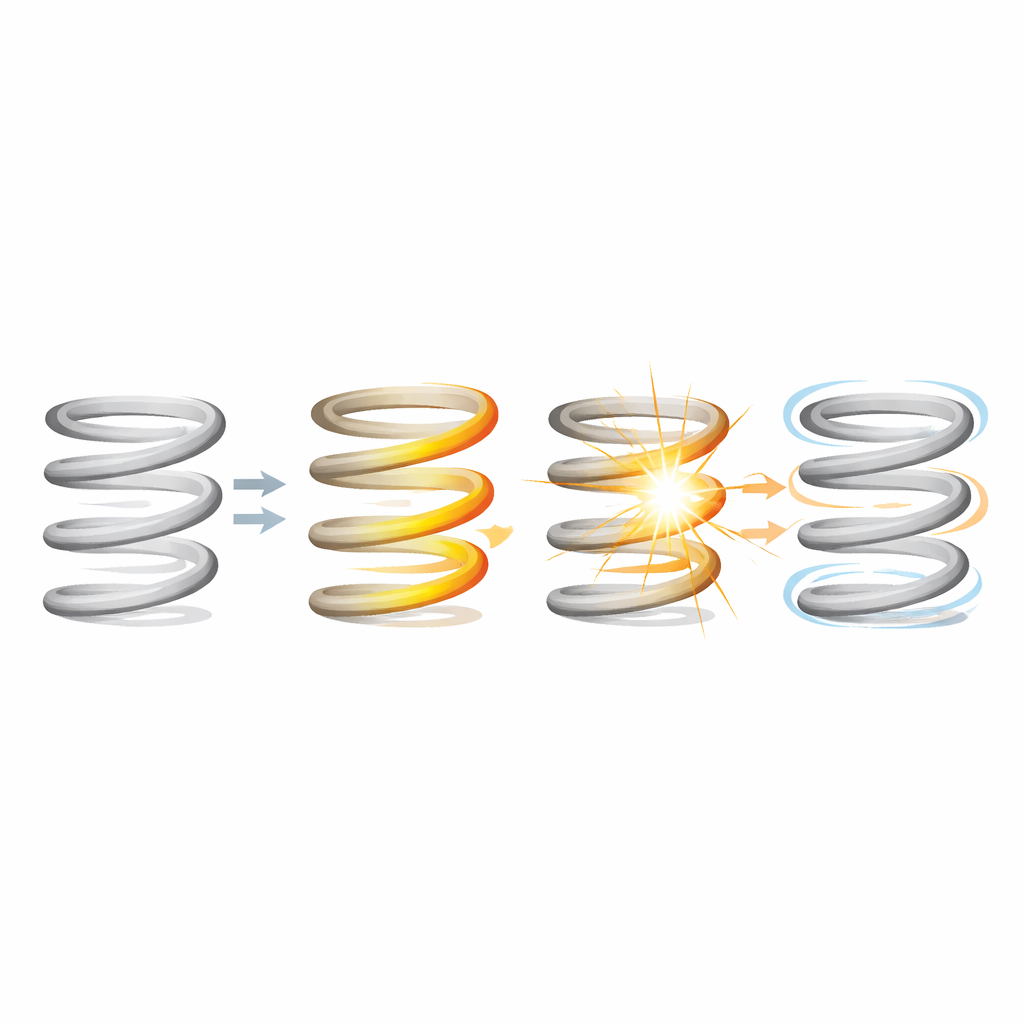
Letting algorithms learn the best shapes
To tackle this multi‑parameter puzzle, the researchers used machine learning. They varied four key geometric features of the two tightly spaced coils, created 60 different virtual spring designs, and simulated each one at the critical engine speed. For every design they recorded the maximum dynamic force. These data were then fed into two types of learning algorithms: a deep neural network that acts as a powerful pattern‑recognition black box, and a genetic programming model that produces explicit mathematical formulas. The neural network achieved the higher prediction accuracy, closely reproducing the simulated peak forces even for designs it had not seen before. Using this trained model, the team could sweep across thousands of virtual designs almost instantly and map out how changes in coil diameter and height altered the resulting force spikes.
Finding safer and smoother spring designs
By scanning this learned design space, the authors highlighted regions where peak forces stayed below levels linked to damage, yet collisions—and thus useful damping—still occurred. In simple terms, they showed how carefully adjusting the size and position of just a couple of coils can turn a harsh, spike‑prone spring into one that manages engine vibrations more gently. Their approach combines realistic high‑speed simulations with data‑driven models to guide design choices without endless physical testing. While this work focuses on a specific valve spring, the same strategy could be applied to many helical devices, from train suspensions to wearable exoskeletons, helping engineers create components that are both tough and quiet under extreme conditions.
Citation: Gu, Z., Liu, Y., Kong, X. et al. Machine learning techniques based multi-parameter analysis and design of nonlinear helical structures considering internal structure collisions. Sci Rep 16, 8595 (2026). https://doi.org/10.1038/s41598-026-39953-y
Keywords: valve springs, vibration damping, coil collisions, machine learning design, high speed engines