Clear Sky Science · en
Contact with dogs is associated with improved survival in cancer patients
Why Dogs Matter for People with Cancer
Many people feel that their dog helps them get through hard times, but can that bond actually affect how long someone with cancer lives? This study looked at medical records from millions of patients around the world to ask a simple question with big emotional weight: do cancer patients who have regular contact with dogs survive longer than those who do not?
Turning Medical Records into a Natural Experiment
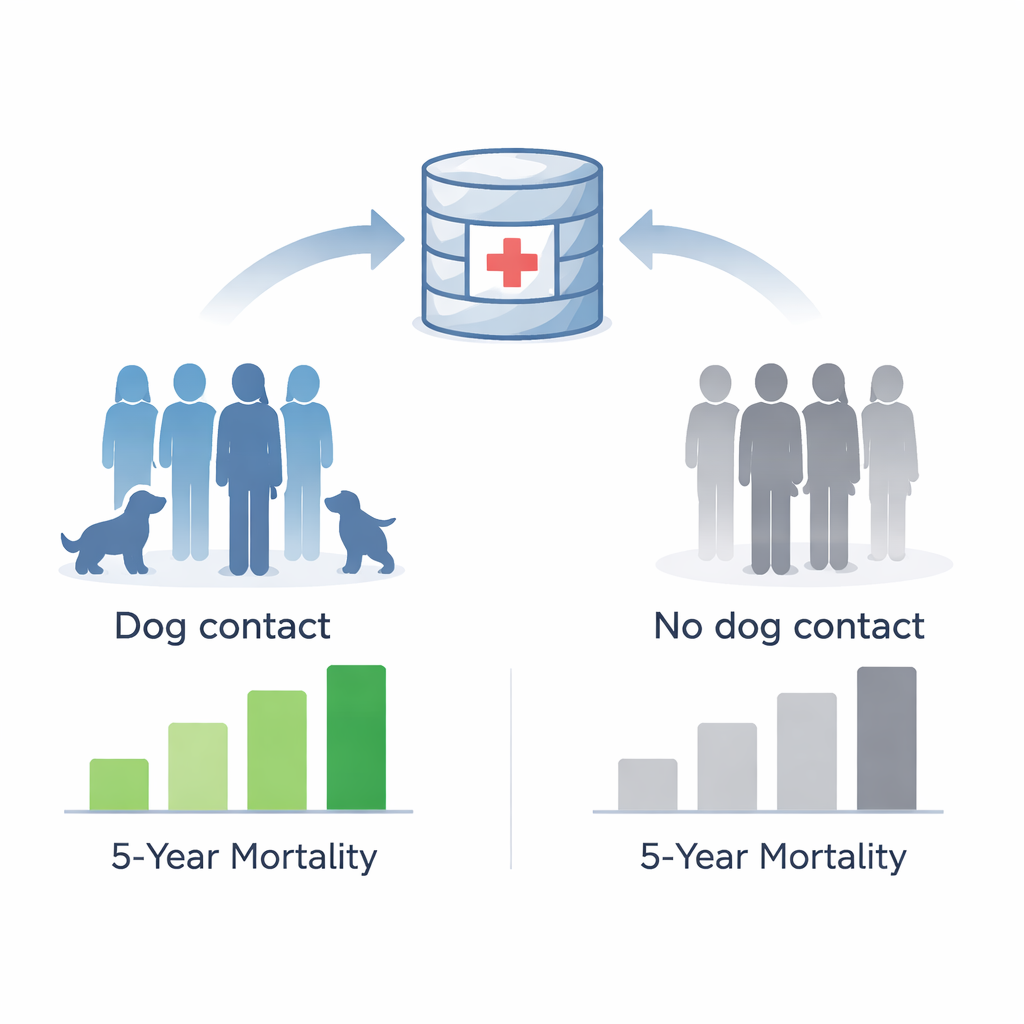
To explore this, researchers tapped into a huge international database of electronic hospital records. They focused on people who had been hospitalized with any type of cancer and then split them into two groups. One group had clear, documented contact with dogs, such as owning a dog or being treated for a dog-related incident. The other group had no such record of dog contact. Because the two groups were very different in size and background, the team used a matching method to pair patients by age and sex, ending up with about 55,000 people, half with dog contact and half without. This careful matching helped make the two groups as similar as possible, aside from their dog exposure.
What Happened Over Five Years
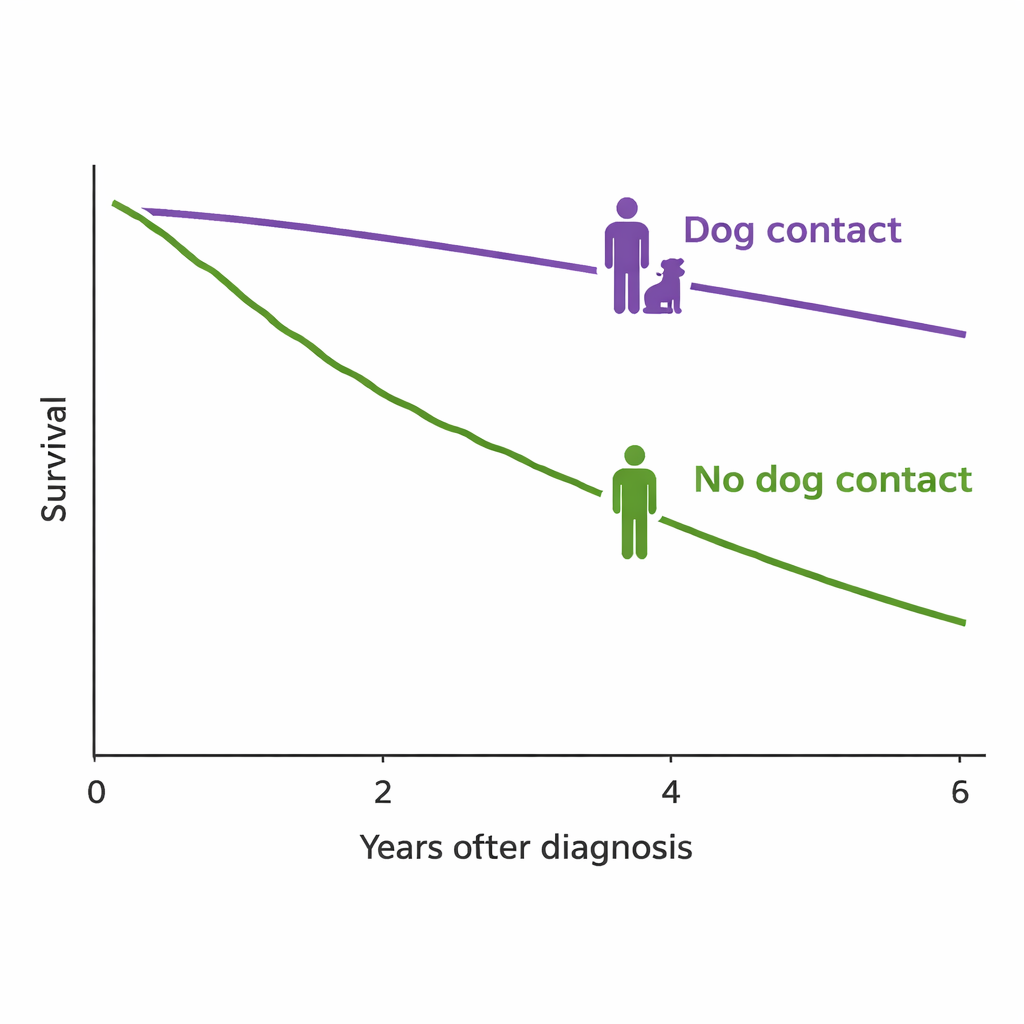
The main outcome the researchers cared about was simple: whether a patient died from any cause within five years of their cancer diagnosis. Among those who had contact with dogs, about 4 out of every 100 patients died in that period. In the group without dog contact, nearly 10 out of 100 patients died. When the researchers compared the two matched groups statistically, they found that patients with dogs had a 56% lower risk of dying within five years, and their overall chance of being alive at the end of five years was almost 95%, compared with about 87% for those without dog contact. In other words, in this large set of real-world data, dog contact strongly lined up with better survival.
Possible Reasons Behind the Difference
The study did not directly test why dogs might be linked to longer survival, but it drew on earlier research to suggest some likely pathways. Dogs tend to nudge their humans into moving more, especially through regular walks. For people recovering from cancer treatments, even light daily activity can help maintain heart and lung function, preserve muscle, and improve energy levels. Dogs also provide steady companionship that can ease anxiety, depression, and loneliness—emotional burdens that are known to worsen cancer outcomes. When people feel less isolated and more hopeful, they may cope better with treatment, follow medical advice more closely, and handle stress in healthier ways. On a more biological level, sharing a home with a dog can subtly change the bacteria living in the human gut, which in turn can influence the immune system and inflammation—two factors closely tied to how cancers behave.
Why the Findings Need Careful Interpretation
Despite the striking numbers, the authors are cautious. This was a retrospective study, meaning it looked backward in time at existing records rather than following people as they adopted dogs. That makes it impossible to prove that dogs directly caused the improved survival. Important details are missing from medical records, such as cancer stage, exact treatments, income level, and how deeply patients were bonded with their pets. It is also possible that people who are healthier or more active to begin with are more likely to own dogs, or that those with very advanced disease have less contact with pets. In addition, the study focused on hospitalized patients, who tend to be older and sicker than people treated only as outpatients, so the results may not apply to all cancer patients.
What This Means for Patients and Families
For now, the safest conclusion is that regular contact with dogs is strongly associated with better five-year survival in hospitalized cancer patients, but it has not yet been proven to be the cause. Still, the pattern fits with what many patients and doctors already suspect: that gentle activity, emotional support, and a healthier internal environment all matter for living longer and better with cancer. The authors call for future long-term studies that track people and their pets in more detail to confirm whether dogs truly help protect against cancer-related death. If these results hold up, welcoming a dog into a patient’s life—when practical and safe—could become a meaningful part of comprehensive cancer care, supporting both body and spirit.
Citation: Preissner, R., Yang, Z., Preissner, S. et al. Contact with dogs is associated with improved survival in cancer patients. Sci Rep 16, 7171 (2026). https://doi.org/10.1038/s41598-026-39952-z
Keywords: dog ownership, cancer survival, pet companionship, physical activity, gut microbiome