Clear Sky Science · en
Digital image-based morphometrics and mixed effects inference resolve environment sensitive and stable traits in onion (allium cepa L.)
Why onion shape and size matter to everyone
Onions may seem like humble pantry staples, but their size, shape, and firmness quietly control everything from how farmers harvest them to how well they store in your kitchen. This study from Korea asks a deceptively simple question: how much of an onion’s look and feel comes from its genes, and how much is shaped by where it is grown? By pairing digital photography with advanced statistics, the researchers show which bulb features are reliably baked into the variety and which are highly sensitive to local weather and soil. Their findings can help breeders, farmers, engineers, and ultimately consumers get onions that are easier to grow, handle, and enjoy.
Two onion-growing worlds
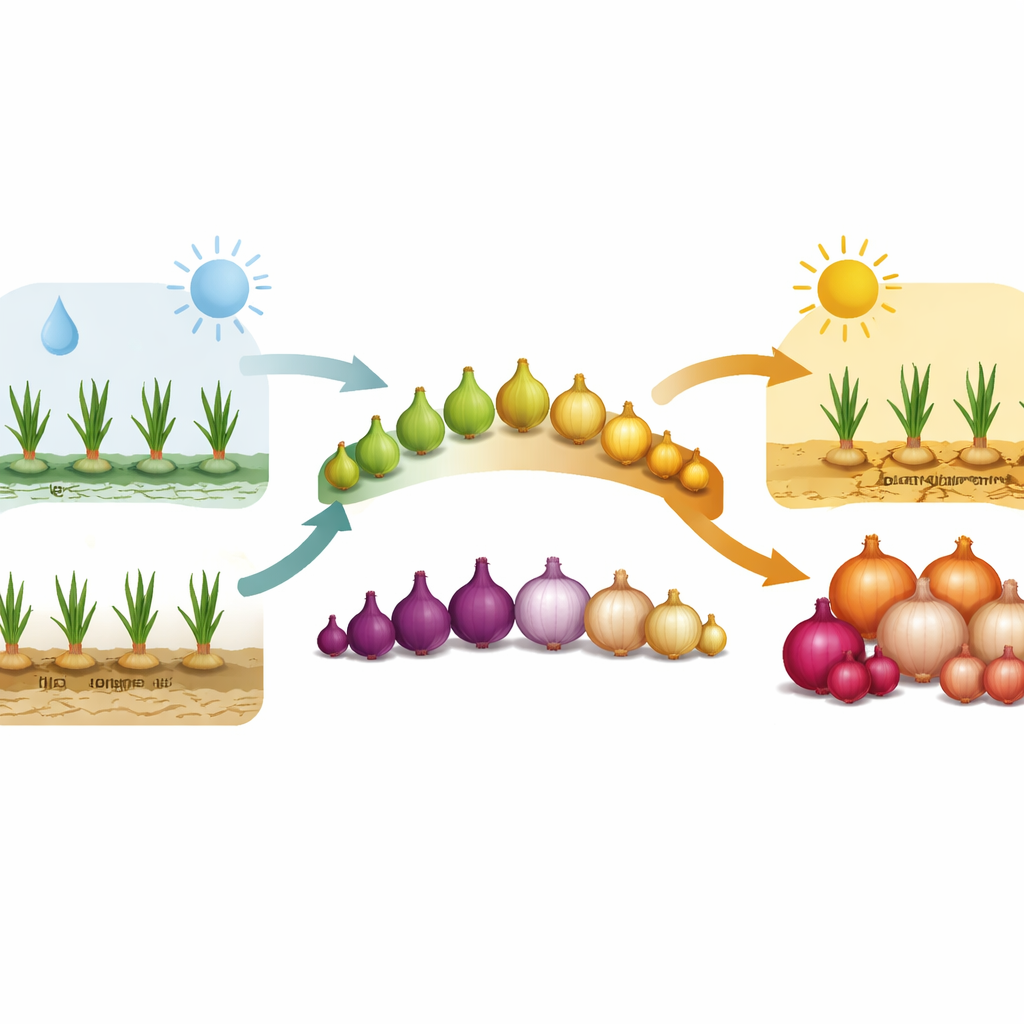
The team worked with six widely grown onion varieties in the Republic of Korea, including popular yellow and red types. They planted them in two major production regions with very different conditions: coastal Muan, with milder temperatures and higher humidity, and inland Changnyeong, which is drier with warmer days and lighter soils. These contrasting environments offered a natural test bed for seeing how the same variety behaves under different field realities. At each site, onions were grown in carefully laid-out plots to keep comparisons fair, then harvested at full maturity using standard farming practices.
Measuring onions by camera
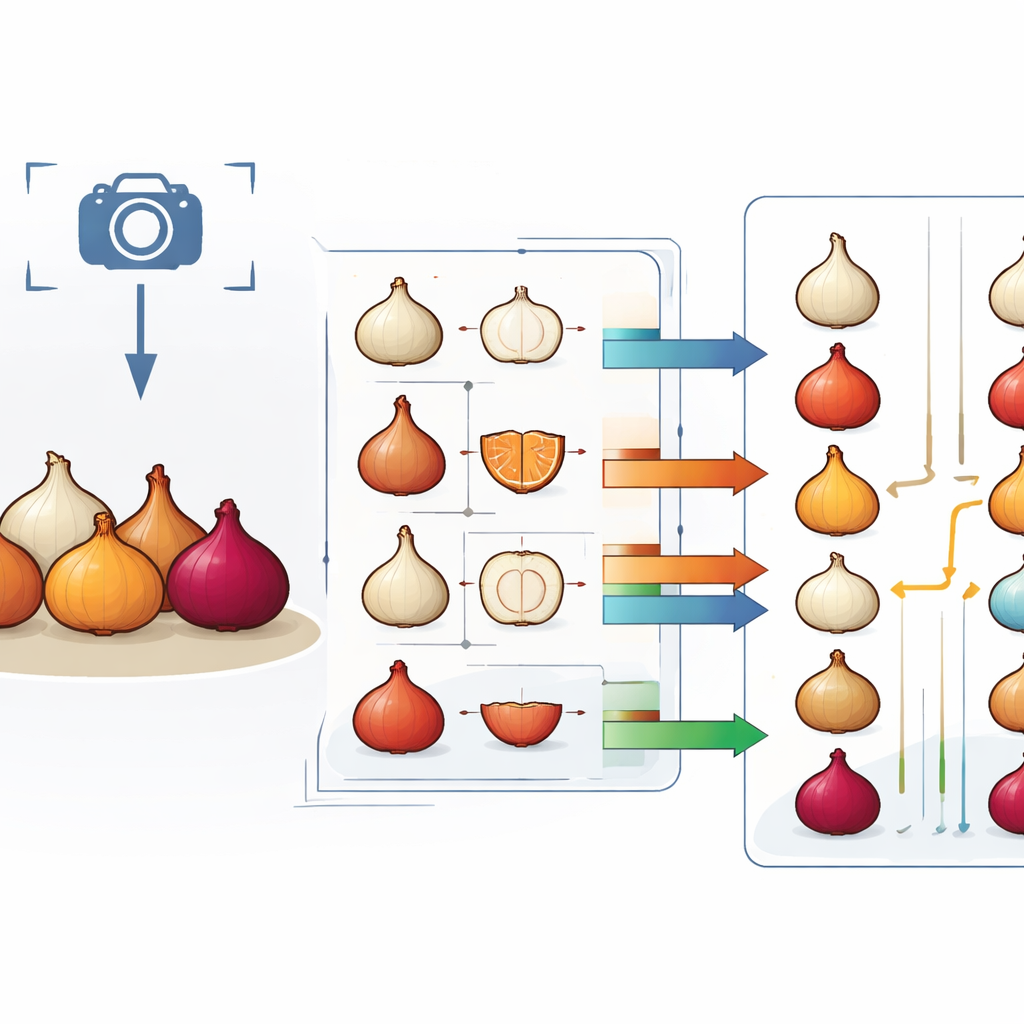
Instead of relying on rulers and calipers alone, the researchers turned to digital image-based morphometrics—essentially, precise measurements taken from photographs. Each bulb was weighed and then photographed from above under controlled lighting with a high-resolution camera. Using the ImageJ software, they traced key features such as bulb height and width, the thickness of the “neck” where leaves attach, and the apparent thickness of the bulb itself. From these simple dimensions they computed a suite of geometry-inspired traits, including overall size, how round or elongated a bulb is, and how much surface area it presents for drying and storage. This workflow made it possible to capture many traits across many onions quickly and consistently.
What changed with place, and what stayed firm
When the team analyzed the numbers with mixed-effect statistical models, a clear picture emerged. Most bulb traits were influenced both by the variety’s genetics and by the growing location, and many also showed strong interactions between the two—meaning some varieties reacted much more to the environment than others. Classic yield-related features such as bulb weight, thickness, and average diameter tended to be strongly controlled by genetics and showed high “heritability,” indicating that breeders can reliably select for bigger bulbs. In contrast, details of bulb form—how round it is, how tall versus wide, and subtle shape indices—shifted more with local conditions and had lower, more environment-dependent heritability. Some varieties, such as Spring Breeze, Katamaru, and Healthy Q, consistently produced large, well-formed bulbs in both regions, while others, including Cheonjujeok and Eomji Nara, remained smaller or more changeable.
Patterns hidden in many traits at once
To make sense of the full web of measurements, the researchers used multivariate tools that look at all traits together. Principal component analysis showed that a single dominant axis of variation was tied mainly to bulb size and related dimensions, which together explained most of the differences among onions. A second, smaller axis captured finer differences in shape and how weight is distributed. Other techniques, including supervised classification and clustering heatmaps, confirmed that size and surface-related traits tend to rise and fall together, while shape traits form partly separate groups. Certain measurements, such as equatorial (side-to-side) diameter, neck thickness, and bulb sphericity, stood out as especially powerful for distinguishing varieties and for revealing how strongly each one responds to its environment.
What this means for onions on the farm and on the plate
For a non-specialist, the bottom line is that an onion’s basic size is largely written into its genes, but its exact shape and some quality features are highly tuned by where it is grown. The study shows that digital image analysis is a practical way to capture these details and that a handful of traits can reliably guide breeding and cultivar choice. Varieties like Spring Breeze, Katamaru, and Healthy Q appear especially promising for producing large, stable bulbs across different regions, making them attractive for both farmers and processors. At the same time, the strong environment effects uncovered here argue for region-specific recommendations rather than one-size-fits-all varieties. As this image-based, statistics-rich approach is extended across more seasons and sites, it can help build onion types that travel more smoothly from field to factory to kitchen, with fewer losses and more consistent quality.
Citation: Ochar, K., Im, D. & Kim, SH. Digital image-based morphometrics and mixed effects inference resolve environment sensitive and stable traits in onion (allium cepa L.). Sci Rep 16, 9158 (2026). https://doi.org/10.1038/s41598-026-39943-0
Keywords: onion morphology, crop breeding, genotype environment interaction, digital phenotyping, postharvest quality