Clear Sky Science · en
Risk identification and assessment for multitype safety events under the coupling of environmental factors
Why hidden patterns in industrial data matter
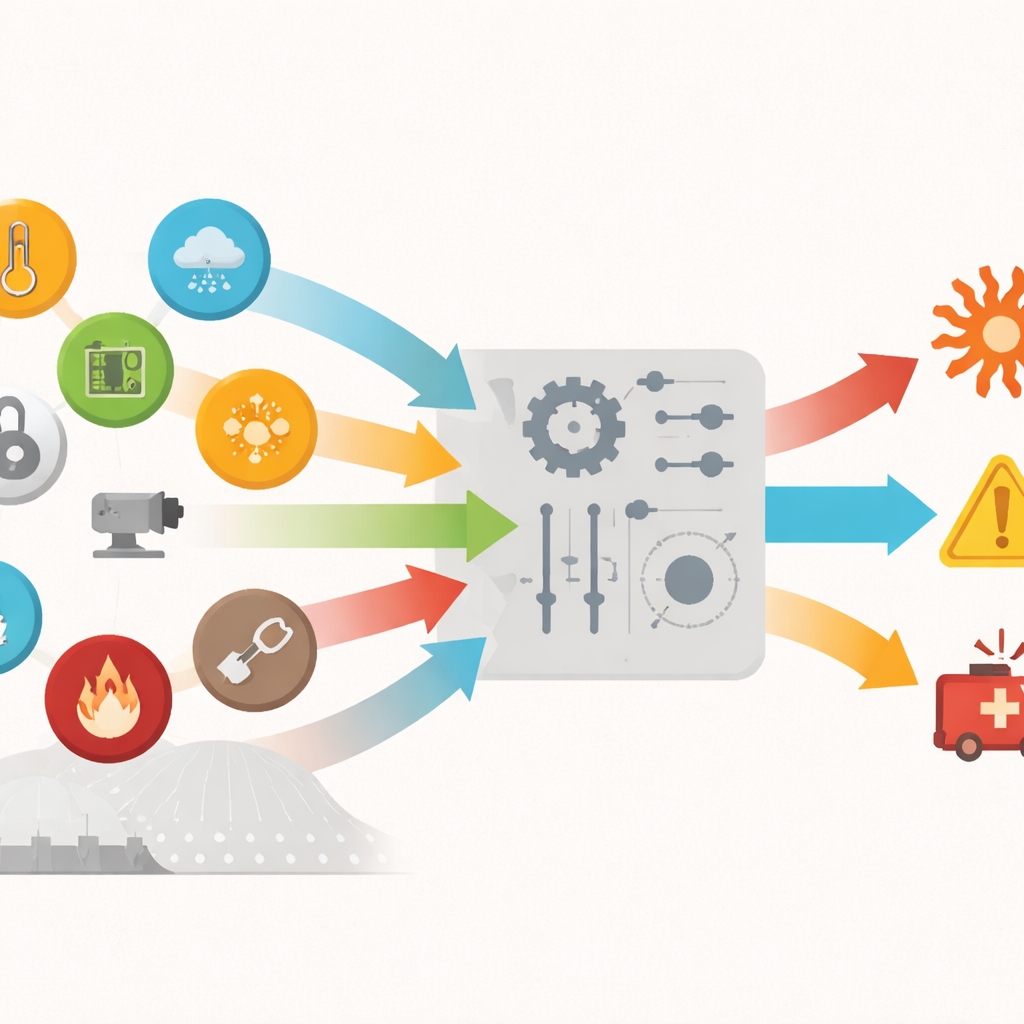
Modern factories, tunnels, and coal mines are blanketed with sensors that quietly record gas levels, vibration, temperature, and more. Yet serious accidents still happen because it is not just one reading that signals danger, but the way many changing conditions push a system toward failure together. This paper shows how to turn those tangled streams of data into a clearer picture of risk, so that operators can spot early warning signs of multiple types of trouble at once—before minor disturbances cascade into harmful events.
From simple cause-and-effect to tangled chains of events
Classic safety models often imagine accidents as straight lines: a human error here, a failed barrier there, and finally a fire, explosion, or collapse. Over the past century, theories such as domino chains, the Swiss cheese model, and system-theory approaches have tried to capture this logic. But with today’s high‑speed, multi-source monitoring, those simple diagrams fall short. They struggle to describe how dozens of factors interact, fluctuate over time, and nudge each other in ways that make some combinations especially dangerous. The authors argue that to make sense of this complexity we must treat safety events as outcomes that “emerge” from a web of interacting conditions across different scales.
Layers of conditions that build toward danger
The study distinguishes between three layers of environmental conditions. At the core are disaster-causing factors, such as the physical structure of coal, the stress inside surrounding rock, or how much gas is stored in a seam. Around them sit derived factors that reflect these core conditions but may be hard to measure directly. Finally come measurable environmental factors—such as gas flow from boreholes, drilling cuttings, and electromagnetic signals—that sensors can readily track. These measurable quantities are strongly linked to the deeper, harder-to-observe causes. When groups of them drift into unstable ranges together, they generate early-warning events, which can then chain and overlap to create serious accidents.
Seeing events as networks, not isolated incidents
Instead of treating each safety event on its own, the authors describe a network in which events can trigger or amplify one another. A small gas anomaly today might raise the chance of a ventilation problem tomorrow, which in turn could make an explosion more likely the next day. Shared environmental factors connect these events: the same measurable signals may foreshadow different types of trouble. The paper formalizes this idea as cross-scale interaction. Changes in measurable conditions spread through their own network, while events at the larger scale form a chain of causes and consequences. Understanding how information flows through both networks at once is key to predicting which combination of readings truly means “act now.”
A learning model that weighs what matters most
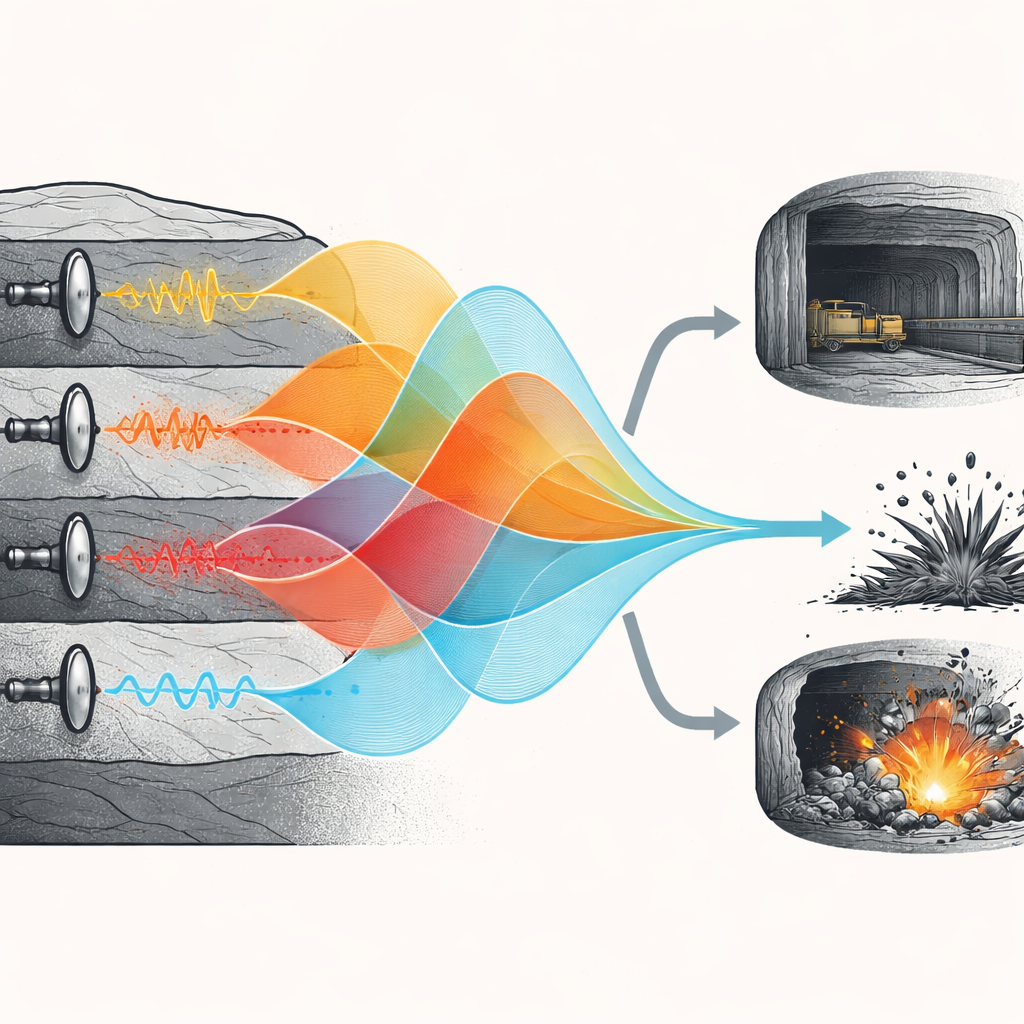
Building on this framework, the authors introduce a risk identification and assessment model (RIAM) that learns directly from sensor data. First, it standardizes readings from different sensors and embeds them into a shared internal representation. A “key information capture” module then learns which factors tend to vary together, capturing the hidden couplings among them. A cross-scale mapping module links these patterns to specific safety events, producing a matrix of contributions that shows how strongly each measurable factor influences each type of event. Finally, the model outputs the probability that one or more events are underway or about to occur. Because it keeps track of contributions explicitly, it not only flags risk but also points to which signals are driving the warning, improving transparency for human decision‑makers.
Putting the approach to the test underground
To test RIAM, the researchers used real monitoring data from a Chinese coal mine where coal and gas outbursts pose a severe hazard. They focused on three types of events: the outburst itself and two precursor conditions related to gas flow and gas adsorption in drilling cuttings. Six measurable factors formed the inputs, ranging from borehole gas velocity to electromagnetic radiation signals. Because true outbursts are rare, they supplemented the limited real data with carefully designed synthetic samples that mimic sensor noise and rare operating states without distorting the underlying behavior. Using tenfold cross‑validation, they compared RIAM to standard methods such as logistic regression, support vector machines, naive Bayes, classifier chains, tree ensembles, and simple neural networks.
What this means for safer complex systems
Across both single-event and multi-event tests, RIAM consistently identified risky conditions more accurately and more reliably than competing approaches, especially when different types of events overlapped. Just as important, the model revealed which sensor readings mattered most for each event, confirming, for example, that certain gas and electromagnetic indicators play leading roles in forecasting outbursts. For non-specialists, the main takeaway is that safety in complex, high-risk settings depends less on watching one “magic” number and more on understanding how many shifting factors combine over time. By treating accidents as emergent results of cross‑linked conditions—and by using data-driven models that preserve this structure—we can move from reactive explanations after the fact to proactive, interpretable early warnings that help keep workers and equipment out of harm’s way.
Citation: Liu, Q., Li, J. & Jin, Z. Risk identification and assessment for multitype safety events under the coupling of environmental factors. Sci Rep 16, 9320 (2026). https://doi.org/10.1038/s41598-026-39940-3
Keywords: industrial safety, risk assessment, sensor data, coal mine accidents, machine learning