Clear Sky Science · en
Ultra-directional and high-efficiency µLEDs via gradient index filled micro-horn collimators
Sharper, Brighter Pixels for Future Headsets
From smart glasses to virtual reality headsets, tomorrow’s displays need millions of tiny light sources that are both extremely bright and highly directional. Micro-LEDs (µLEDs) are leading candidates, but today they waste much of their light and spray it in all directions. This paper presents a new way to reshape that light right at the chip, promising sharper images, lower power use, and slimmer optics for next‑generation AR/VR devices and optical communication systems.
Why Tiny LEDs Waste So Much Light
Conventional LEDs already lose a surprising amount of light inside the chip, but the problem is even worse for µLEDs, whose dimensions are only a few micrometres across. Much of the light they generate hits the semiconductor surface at steep angles and is trapped by total internal reflection, bouncing around until it is absorbed as heat instead of escaping. At the same time, the light that does escape spreads out over a wide range of directions, like an unfocused flashlight beam. For applications such as waveguide-based AR glasses or fiber-coupled communication links, only light within a narrow cone—roughly ±15 degrees—is actually useful. Improving both the fraction of light that gets out and how tightly it is steered is therefore essential for more efficient and compact µLED-based systems.
A Tiny Metal Horn to Steer the Beam
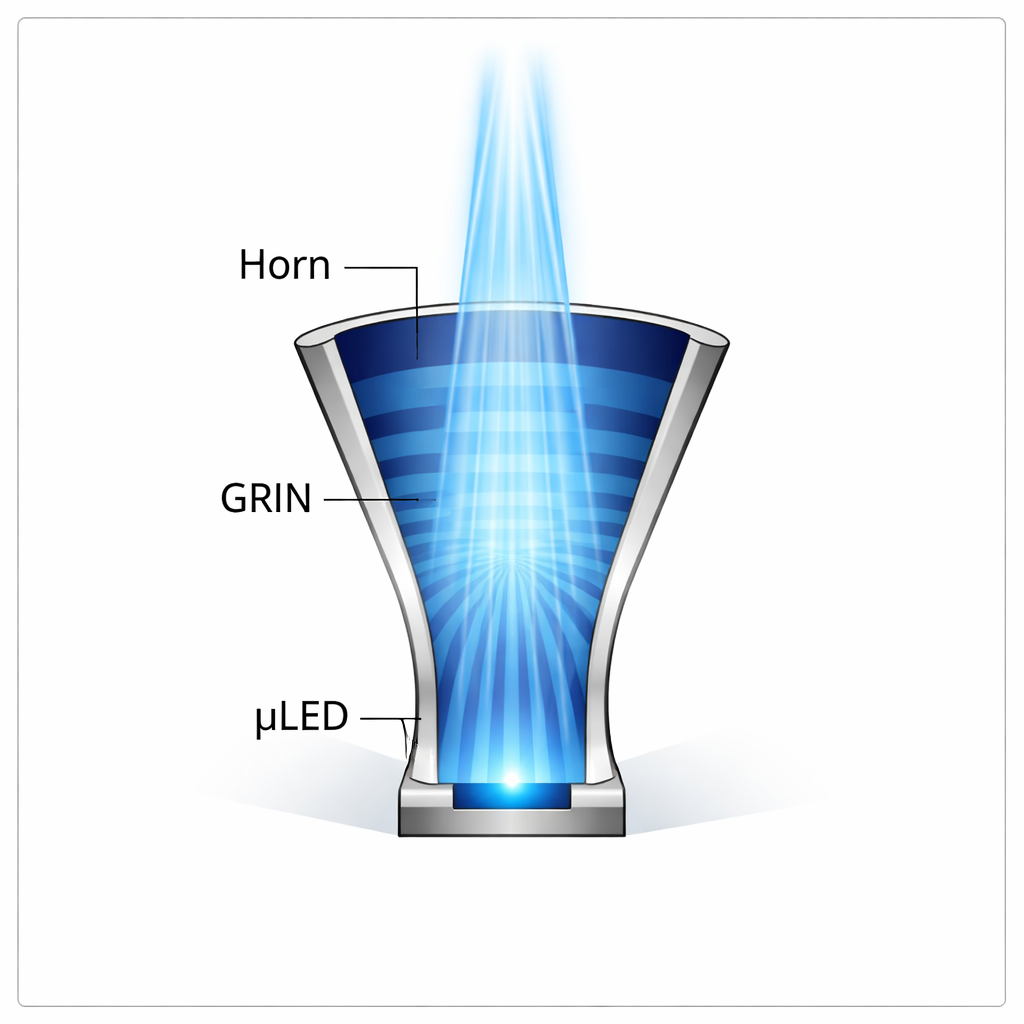
The authors borrow a concept from microwave antenna engineering: the horn antenna. They place a microscopic horn-shaped structure—called a µHorn—directly on top of the µLED pixel. The horn’s metallic sidewalls act like mirrors, designed to catch light that would otherwise shoot out at awkward angles and redirect it toward the forward direction. Crucially, the horn is not simply hollow. It is filled with materials whose optical index gradually steps down from that of the LED’s semiconductor core to that of the surrounding air. This so‑called gradient index (GRIN) region acts as a gentle optical on-ramp, allowing even very oblique rays to leave the dense semiconductor, bend gradually, and then be reflected by the horn walls into a narrow, useful beam.
Simulations Show a Tenfold Directional Boost
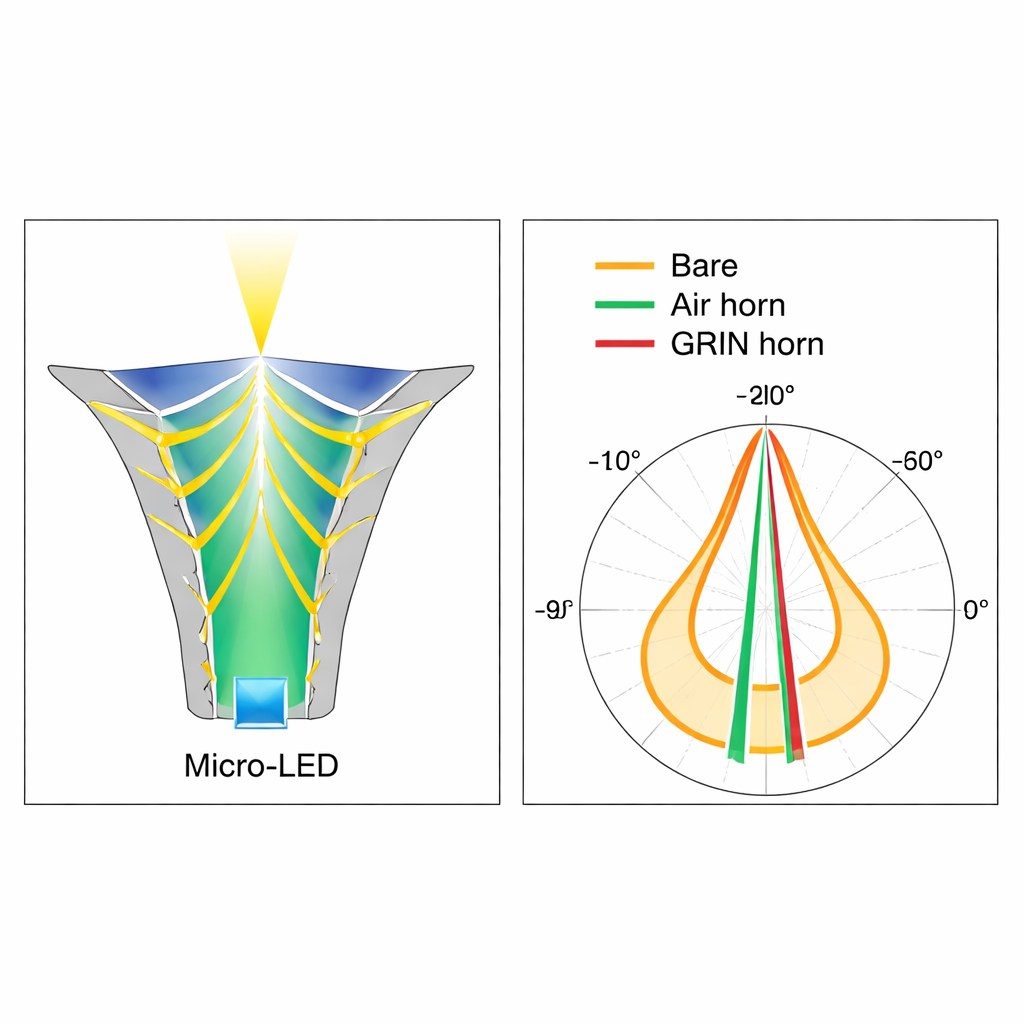
To test their idea, the researchers used detailed computer simulations that track electromagnetic waves at the nanometre scale. They first explored a simplified two-dimensional cross-section and then moved to full three-dimensional cylindrical models that more closely resemble a real pixel. They compared several cases: a bare µLED, a µHorn filled only with air, a horn filled with uniform glass-like material, and horns whose interiors were built from multiple dielectric layers that approximate a GRIN profile. Across these designs, they varied the horn height and opening angle to see which combinations delivered the best performance. The standout design was the GRIN-filled µHorn, which reached an overall light extraction efficiency of about 80%, with roughly 31% of the total emitted power concentrated inside the narrow ±15° cone. In three dimensions, this translated to about a tenfold increase in useful directional light compared with a bare pixel, and more than double the performance of a carefully optimized, but much larger, half-ellipsoidal glass lens placed on top.
Compact Powerhouse Pixels for AR/VR
A key advantage of the µHorn approach is its compactness. Traditional lenses that can collimate a µLED’s light must be many times larger than the pixel itself—tens of micrometres in diameter and height—making dense, high-resolution arrays difficult to build. By contrast, the proposed horn structure only slightly increases the device’s height while expanding the light-emitting surface to just a few times the pixel width. Because its effect does not rely on precise resonances or a single “sweet spot” inside the active region, the GRIN horn remains effective even when the position of the light-emitting quantum wells shifts within a typical fabrication tolerance. This robustness suggests that the concept can be integrated into real manufacturing flows using stacks of common dielectric materials, etched and metallized to form the horn walls.
What This Means for Everyday Devices
In practical terms, the GRIN-filled µHorn could enable µLED displays with extremely high pixel densities—on the order of 6500 pixels per inch—while simultaneously cutting power consumption and heat generation. For AR/VR headsets, more directional emission means more of the light actually enters the waveguides and optics that form the image, potentially allowing slimmer, lighter devices with brighter and crisper visuals. For visible-light communication links, it offers a way to pack more efficient, low-divergence transmitters into a very small footprint. While further optimization and fabrication work remain, this study demonstrates that carefully sculpted micro-scale horns with graded optical properties can transform how effectively tiny LEDs turn electricity into useful, well-aimed light.
Citation: Luce, A., Alaee, R. & Abass, A. Ultra-directional and high-efficiency µLEDs via gradient index filled micro-horn collimators. Sci Rep 16, 7391 (2026). https://doi.org/10.1038/s41598-026-39920-7
Keywords: micro-LED displays, AR VR light engines, light extraction efficiency, gradient index optics, beam collimation