Clear Sky Science · en
Thermal, vibrational, and electrical properties of high-purity Ag₂Te for advanced applications
Why a silver-based crystal matters for future tech
Turning wasted heat into electricity, building faster data storage, and sensing invisible infrared light all rely on special materials that can withstand harsh conditions while shuttling heat and charge in precise ways. This study focuses on one such material: a silver–tellurium compound called Ag₂Te. By growing it in exceptionally pure, carefully controlled single crystals and then probing how it behaves when heated, vibrated by light, and driven by electric fields, the researchers show that Ag₂Te could be a powerful building block for next‑generation energy devices, memory chips, and infrared detectors.
Growing a near-perfect silver crystal
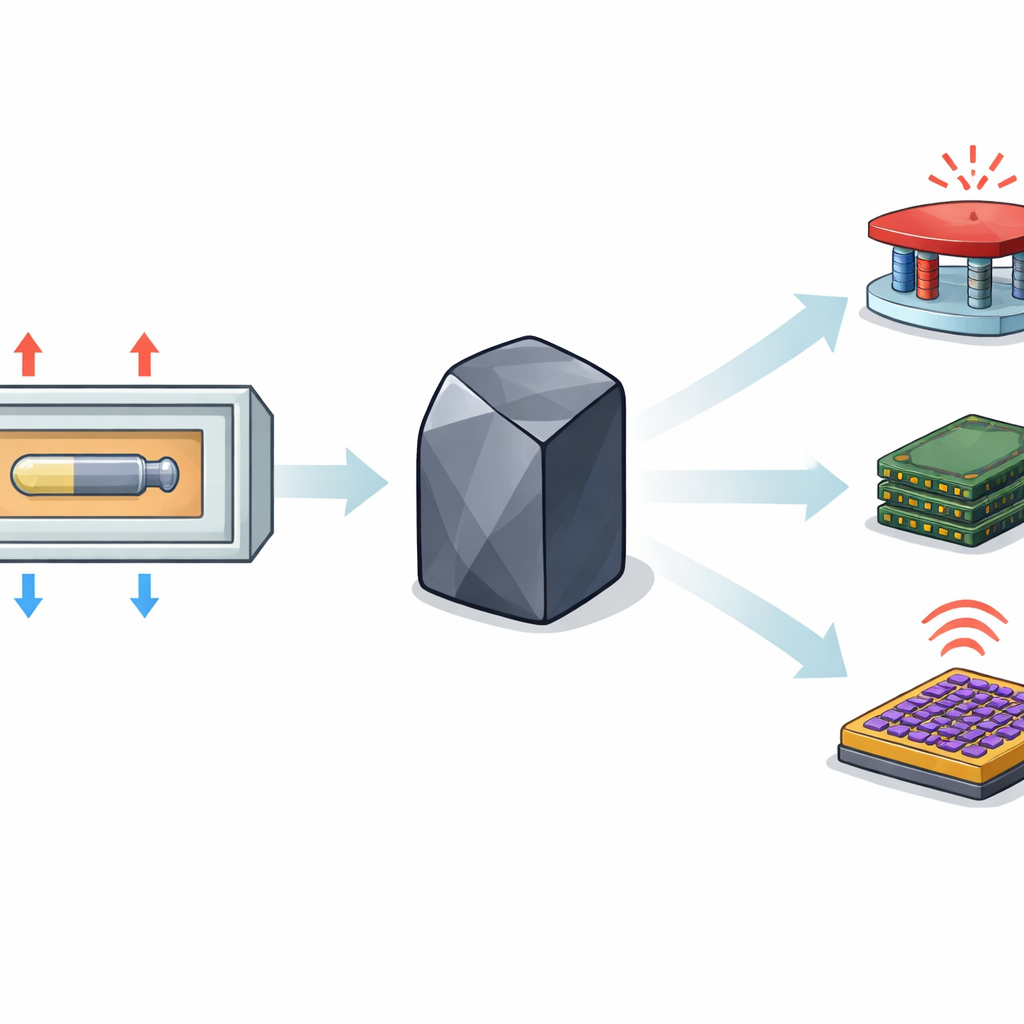
The team first set out to grow very pure Ag₂Te crystals, because small flaws can dramatically change how a material behaves. They sealed highly pure silver and tellurium inside a quartz tube, heated it in a programmable furnace to more than 1200 kelvin, and then cooled it according to a slow, carefully shaped temperature schedule. This 5–7 day treatment allowed the atoms to line up into large, well‑ordered single crystals. X‑ray measurements confirmed that the crystal adopted a single, well‑known arrangement of atoms, and density measurements showed that the material was dense and uniform. Compared with traditional growth methods, the automated furnace route delivered the same quality with better control and scalability.
Testing how the material handles heat
Next, the researchers asked a basic but crucial question: how hot can Ag₂Te get before it falls apart? Using a technique that tracks tiny changes in weight as a sample is heated, they found that the material is essentially unchanged up to about 400 °C. Around that temperature, tellurium atoms begin to evaporate, leaving behind metallic silver in a clean, single step that matches what theory predicts. Subtle kinks in the heating curve around 150 °C signal a reversible change in crystal form rather than breakdown, meaning the material can switch structure without being damaged. Together, these tests show that Ag₂Te is thermally stable across the temperatures where many devices are designed to operate, a key advantage over some widely used thermoelectric materials.
Listening to atomic vibrations with light
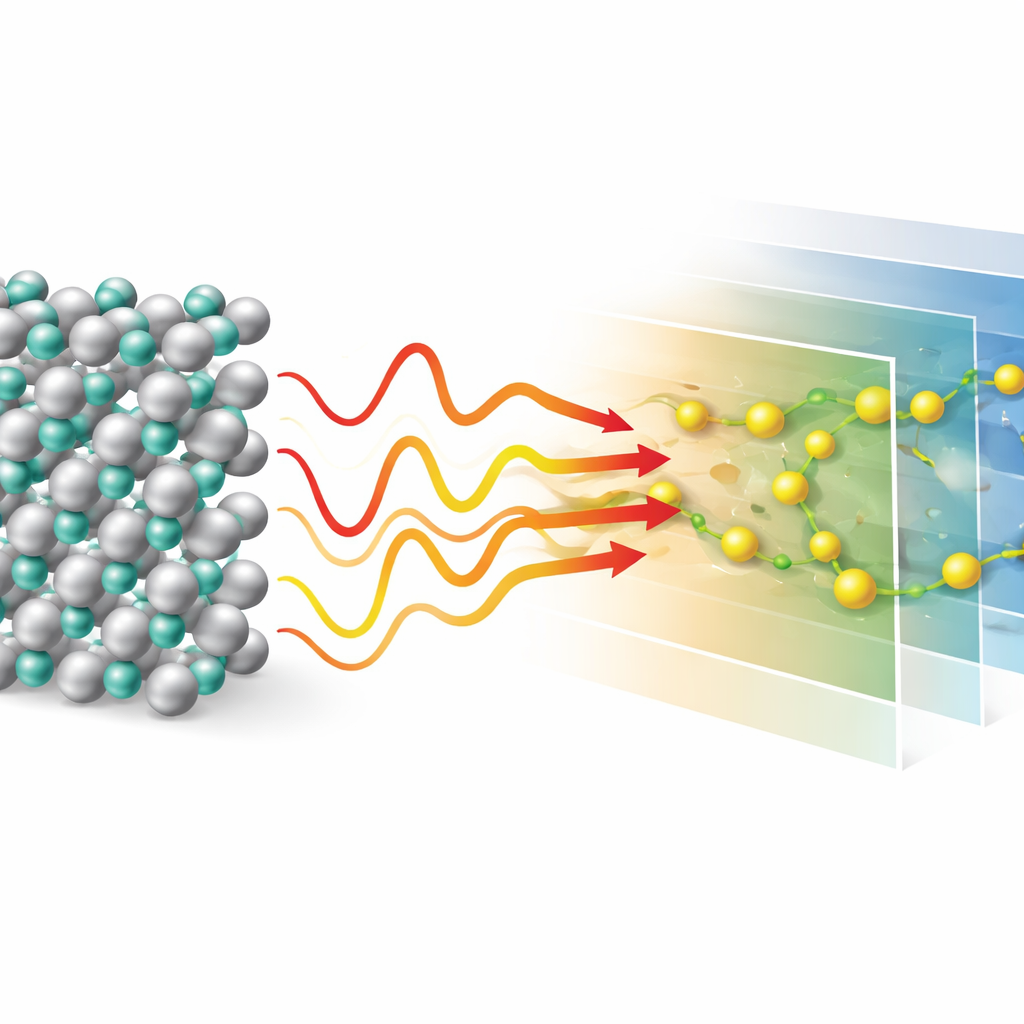
To check the internal order of the crystal more deeply, the team shone a laser on the material and analyzed the scattered light, a method known as Raman spectroscopy. The pattern and sharpness of the resulting peaks act like an acoustic fingerprint of how atoms vibrate inside the solid. The Ag₂Te crystals showed a small set of well‑defined peaks at the expected positions and, importantly, no extra signals that would betray contamination or an unwanted phase. The peaks were unusually narrow, which means the atoms vibrate in a highly uniform environment with few defects. This confirms that the growth method produces crystals that are not only chemically pure but also structurally pristine, an important requirement for both basic physics studies and demanding devices.
How charges move and store energy
The authors then pressed some of the material into pellets, added gold electrodes, and examined how it responds to alternating electric fields over a wide range of frequencies and temperatures. They observed that its ability to conduct electricity increases strongly with both temperature and signal frequency, while its capacity to store electric energy as polarization changes in a predictable way. The data fit a picture in which charge carriers hop between localized sites and build up at internal boundaries when the field changes too quickly, a behavior common in semiconductors used for sensors and capacitors. From these measurements they estimated a small energy gap between filled and empty electronic states, consistent with a material that can be tuned for both conduction and light detection.
From lab crystal to real-world devices
By putting all of these tests together, the study paints Ag₂Te as a robust multitasker. Its stability up to 400 °C and favorable electrical response suggest it could outperform current materials that convert temperature differences into electricity in medium‑temperature environments, such as industrial waste‑heat recovery. The reversible structural change near 150 °C hints that it could act as the active layer in fast, low‑energy memory devices that switch between two states when pulsed with heat or current. And its narrow electronic gap, combined with strong vibrational features, makes it a promising candidate for infrared detectors that operate at room temperature without bulky cooling systems. In simple terms, the researchers have not only grown an exceptionally “clean” silver‑telluride crystal, they have shown that its fundamental properties line up with several technologies poised to shape future energy and information systems.
Citation: Fangary, M.M., Taha, A.G., Reda, M.M. et al. Thermal, vibrational, and electrical properties of high-purity Ag₂Te for advanced applications. Sci Rep 16, 9340 (2026). https://doi.org/10.1038/s41598-026-39918-1
Keywords: silver telluride, thermoelectric materials, phase-change memory, infrared detectors, electrical conductivity