Clear Sky Science · en
Life cycle assessment of the production processes for high-value biomass derivatives HMF and FDCA
Turning Farm Waste into Everyday Materials
Every harvest leaves behind mountains of straw that are often burned or left to rot. This study asks a simple question with big consequences: instead of wasting that straw, can we turn it into building blocks for plastics and other products in a way that truly helps the climate? By tracing the full “life story” of two promising plant‑based chemicals, the authors show how smart choices in raw materials, factory design, and energy sources can make future consumer goods both cleaner and kinder to the environment. 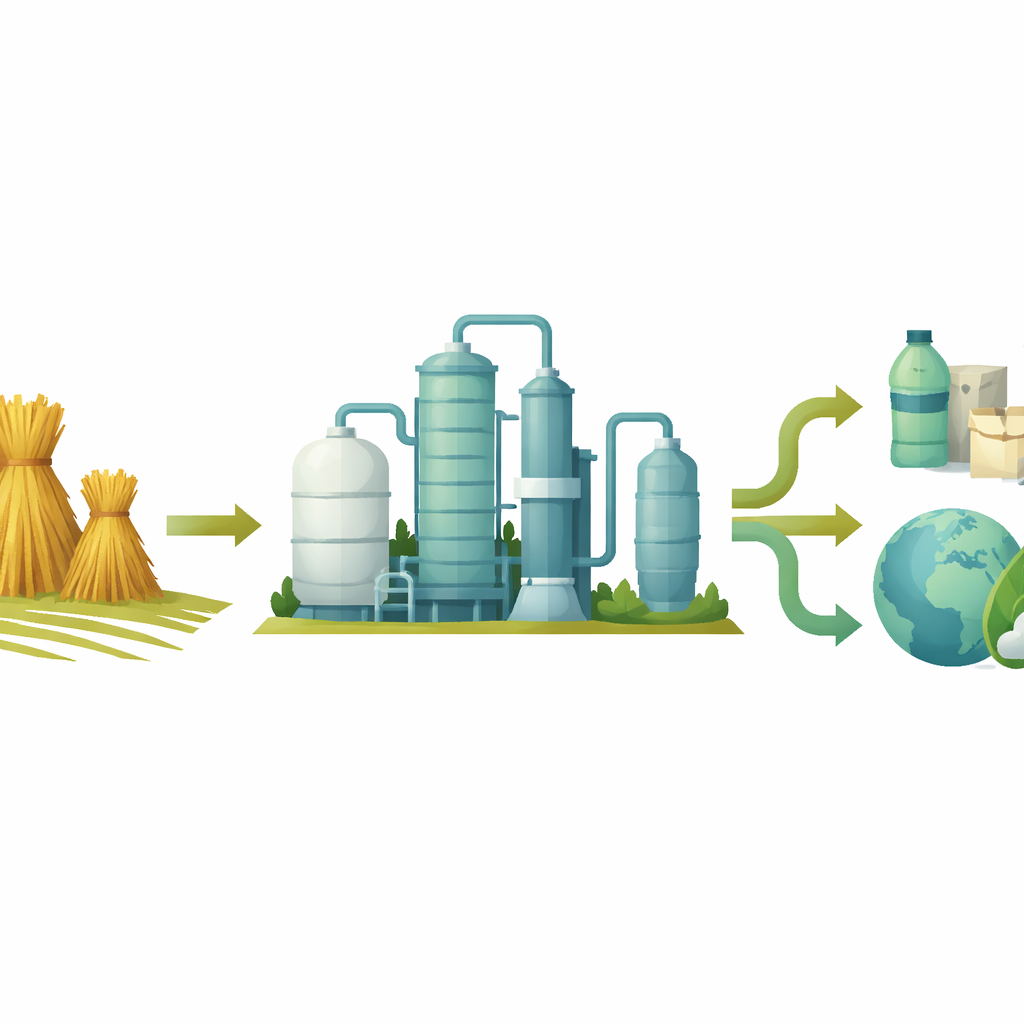
Why Straw Matters More Than Sugar
The first part of the work compares two ways of making a key plant‑based chemical called HMF. One route starts from fructose, a refined sugar; the other starts from corn straw, an agricultural leftover. Using a standard method called life cycle assessment, the researchers count all the inputs and emissions from the factory gate back through processing, including solvents, heat, electricity, and waste. They find that using straw clearly beats using fructose in every environmental category they examined. For the same amount of HMF, straw lowers climate‑warming emissions by about 88 kilograms of carbon‑dioxide equivalent and cuts substances that are toxic to living things in water and sediments by roughly one quarter. Because straw is a by‑product that does not need extra farmland, it also avoids the hidden climate costs of changing land use that can plague dedicated “energy crops.”
Inside the Plant: Where the Burden Really Comes From
Looking closer, the study shows that the most damaging steps are not always where one might expect. For both straw‑ and sugar‑based routes, the biggest burdens often arise during purification—separating HMF from a complex soup of other chemicals. In the fructose process, a solvent called DMA dominates the potential harm to human health, while in the straw process a common solvent, dichloromethane, is the main concern. Electricity use also looms large: under China’s current power mix, coal‑heavy grids drive most of the climate impact. When the authors model a switch to electricity generated entirely from renewable sources, the warming impact of straw‑based HMF drops by nearly three quarters. Replacing dichloromethane with a safer, bio‑derived solvent, γ‑valerolactone, cuts the human‑toxicity indicator by more than 60 percent. These findings show that cleaner chemistry and cleaner power can work together to transform the same basic process into a much greener one. 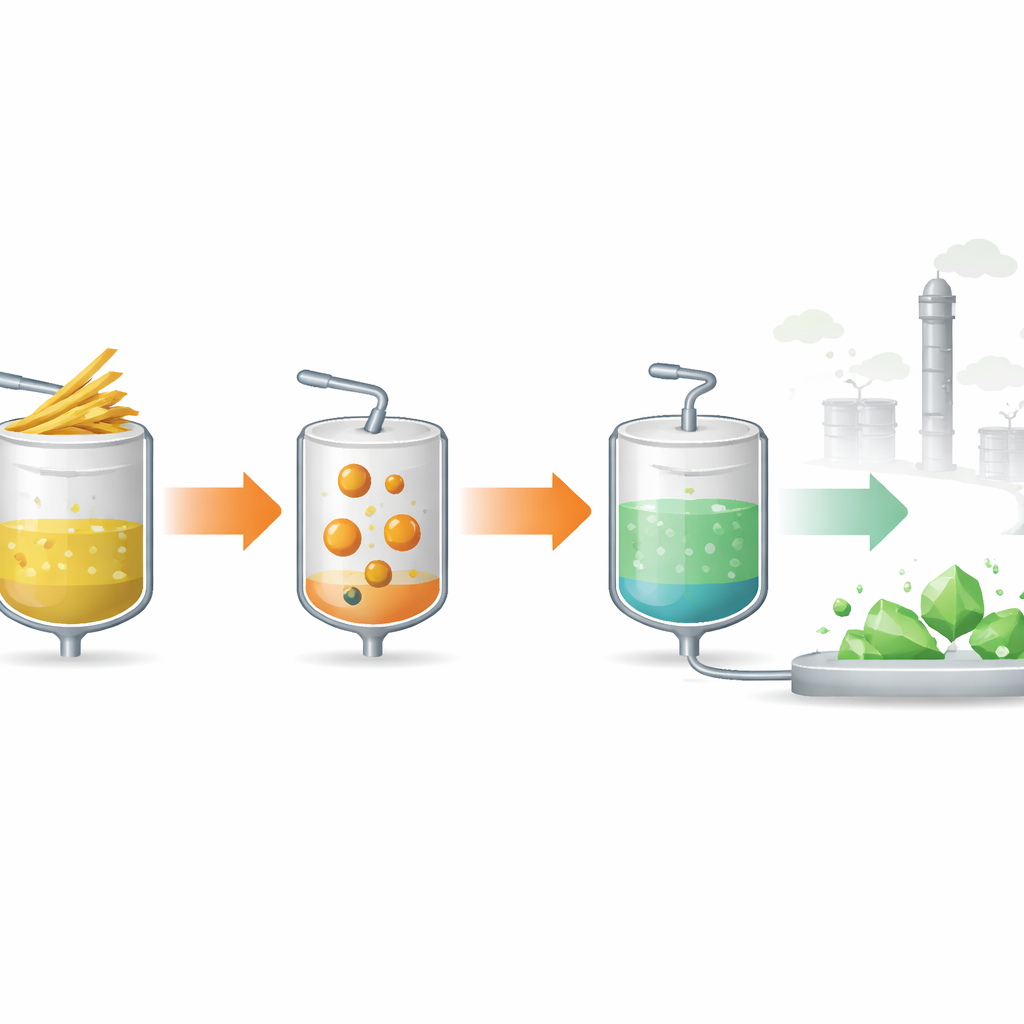
From Building Block to Bottle: Two Paths Compared
HMF is valuable partly because it can be converted into FDCA, a second chemical that can stand in for fossil‑based ingredients in plastic bottles, textiles, and packaging. The authors therefore extend their analysis beyond HMF to examine two industrial‑style ways of turning HMF into FDCA. In one, FDCA is purified by distillation, which involves boiling mixtures under reduced pressure; in the other, it is purified by allowing it to crystallize and filtering out the solid. Both routes use the same type of metal catalyst, but the energy and solvent needs differ sharply. The crystal‑based route comes out ahead across the board: compared with distillation, it cuts climate‑warming emissions and fossil energy use by about one fifth, and slashes acidification and human‑toxicity indicators by roughly half. The one area where the difference is modest is soil toxicity, which is driven mainly by the metal catalyst itself, suggesting that greener catalyst materials will be needed to tackle this last impact.
What This Means for Greener Products
Pulling the pieces together, the study paints a hopeful but nuanced picture. Turning crop straw into HMF, and then into FDCA using crystallization, is clearly better for the environment than relying on food‑grade sugars and energy‑intensive distillation. At the same time, the analysis reveals exactly where further gains can be made: shifting factory power to renewable sources, redesigning solvent systems around safer bio‑based options, and developing catalysts that do their job without long‑lasting harm to ecosystems. For non‑specialists, the takeaway is that “bio‑based” on the label is not automatically good enough; what matters is the whole chain from field to finished product. When that chain is carefully optimized, agricultural waste like straw can become a cornerstone of low‑carbon materials, helping move everyday plastics and packaging closer to true sustainability.
Citation: Gao, Y., Liu, Q., Wei, H. et al. Life cycle assessment of the production processes for high-value biomass derivatives HMF and FDCA. Sci Rep 16, 8530 (2026). https://doi.org/10.1038/s41598-026-39916-3
Keywords: biomass chemicals, agricultural straw, green plastics, life cycle assessment, renewable solvents