Clear Sky Science · en
Life strategies in an upwelling world: distribution patterns and niche partitioning of Calanidae copepods in the Benguela Current
Why tiny ocean drifters matter
Along the west coast of southern Africa, powerful winds push surface waters offshore, drawing cold, nutrient-rich water up from the deep. This process, called upwelling, fuels vast blooms of microscopic algae and supports some of the world’s most productive fisheries. At the heart of this ocean engine are copepods—tiny crustaceans that graze on algae and, in turn, feed sardines, anchovies, and other fish we eat. This study explores how closely related copepod species share space, food, and depth in the Benguela Current upwelling system, and what their survival strategies might mean for future fish catches in a changing climate.
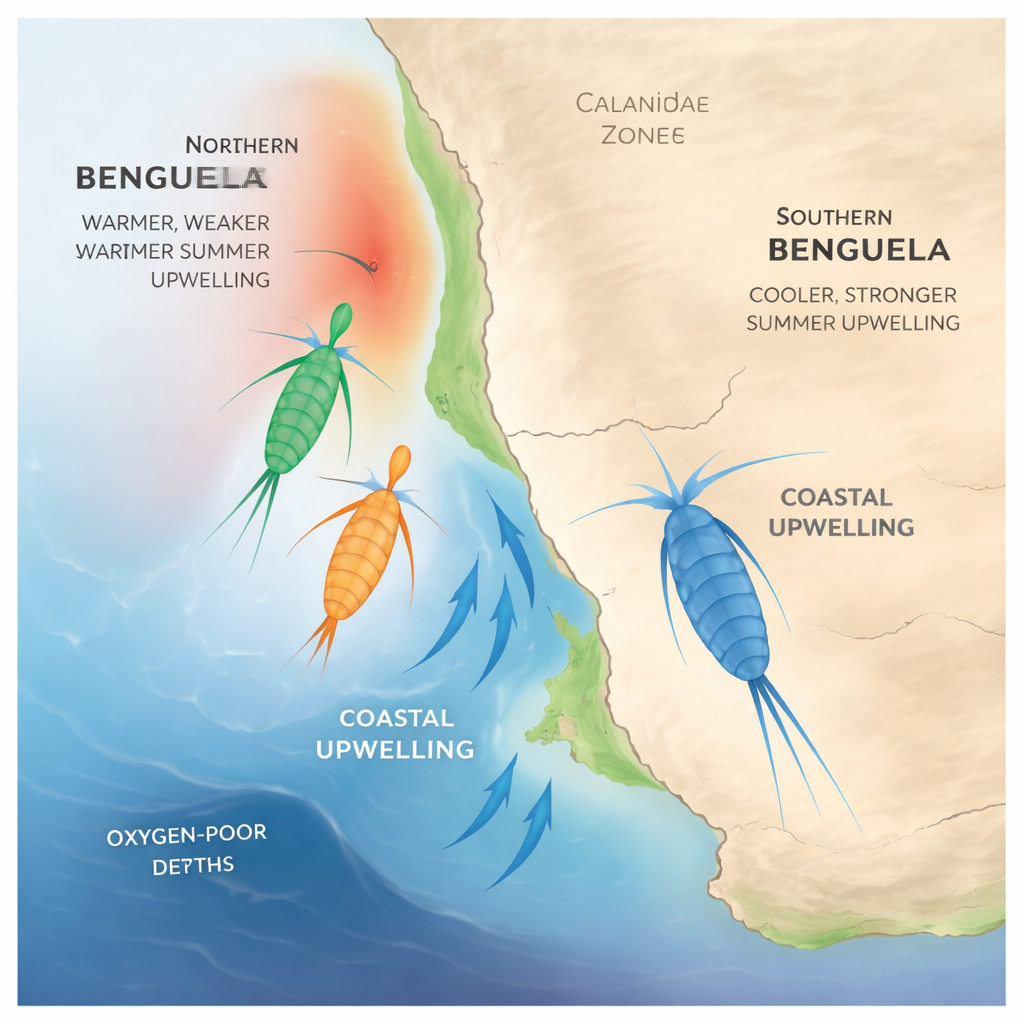
A tale of two coastal currents
The Benguela Current is split into two subsystems by a major upwelling center near Lüderitz, Namibia. To the north, waters are generally warmer at the surface, with a persistent layer of oxygen-poor water at mid-depths. To the south, summer winds drive strong, pulsed upwelling that cools the surface and stimulates intense plant growth near the coast. Despite similarly high primary production in both regions, their fish communities differ sharply. Northern stocks of sardines and anchovies collapsed decades ago and never fully recovered, giving way to horse mackerel and hardy gobies, while southern sardine and anchovy populations have rebounded. The authors suspected that the fine-scale behavior and distribution of copepods—the main middlemen between algae and fish—could help explain these contrasts.
Different niches for look-alike species
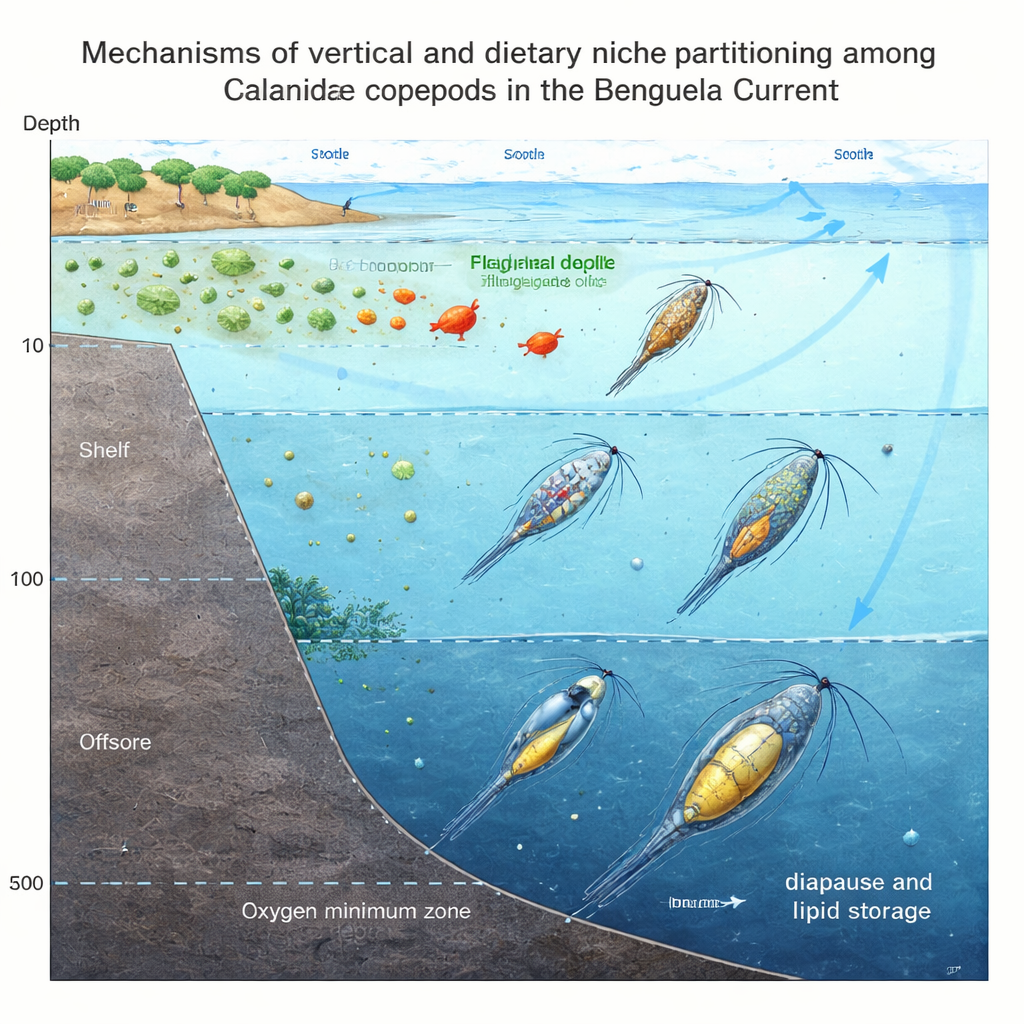
The team focused on six species in the Calanidae family, which are similar in body shape but differ in size. They grouped them into three size classes and then tracked how each species used horizontal space (coast versus offshore), vertical space (surface versus deep) and diet. Using a multi-net system to sample from the surface down to 1500 meters, plus measurements of temperature, oxygen, and chlorophyll, they mapped where each species and life stage occurred. Chemical fingerprints in the copepods’ tissues—stable nitrogen isotopes and fatty acids—revealed what they had been eating and how they stored energy. Even among species of similar size that presumably eat similar-sized prey, the study found that they carved out distinct niches along one or more of these dimensions.
Specialists of cold plumes and warm blue water
One large species, Calanoides natalis, dominated the cool, green coastal shelf, especially where upwelling was strongest and chlorophyll levels were high. Its tissues were rich in fatty acids that signal heavy feeding on diatoms, the silica-shelled algae that often bloom in upwelling plumes. Older juvenile stages of this copepod accumulated large stores of waxy fats and could be found both near the surface and hundreds of meters down, where many entered a dormant, low-metabolism state to ride out lean periods. In contrast, another large species, Calanus agulhensis, was most common in warmer, more offshore waters of the southern Benguela and surprisingly showed up at great depths in the north, likely carried there by aging rings of Indian Ocean water that drift into the region. Although it stores substantial wax esters at one life stage, it fed less strongly on diatoms and appears adapted to lower, steadier food levels than its shelf-dwelling cousin.
Sharing the open ocean and the dark depths
Medium-sized species such as Nannocalanus minor and Mesocalanus tenuicornis favored warmer, offshore waters and rarely dominated the turbulent coastal shelf. They overlapped in horizontal range but subtly separated by depth and, likely, diet: M. tenuicornis tended to occupy slightly deeper waters and has mouthparts suited to somewhat different prey. The largest species, Neocalanus gracilis and Neocalanus tonsus, were present only in low numbers but showed distinct depth habits; for example, N. tonsus was found exclusively in deep, often oxygen-poor layers, probably in a dormant phase fueled by internal fat stores. Across all these species, early life stages generally stayed near the surface where food is abundant, while older stages of some species retreated to depth, especially in zones where low oxygen can shelter them from predators that cannot tolerate such conditions.
What this means for future fish and fisheries
To a lay reader, the key message is that these seemingly interchangeable “plankton bugs” are in fact finely tuned specialists. By partitioning space, depth, and diet, closely related copepods can coexist and collectively provide a steady food supply for fish, even in a highly changeable environment. The study suggests that if climate change intensifies coastal upwelling in some areas, species like Calanoides natalis that thrive in cold, diatom-rich plumes may gain an advantage—potentially boosting the food available for anchovies and similar fish. But because each copepod species responds differently to temperature, oxygen, and food, shifts in upwelling or oxygen-poor zones could also reshuffle who the “winners” and “losers” are, with ripple effects on fisheries. Understanding these hidden life strategies is therefore crucial for predicting how climate change will affect the productivity of one of the world’s great marine ecosystems.
Citation: Bode-Dalby, M., Rittinghaus, H., Lamont, T. et al. Life strategies in an upwelling world: distribution patterns and niche partitioning of Calanidae copepods in the Benguela Current. Sci Rep 16, 7469 (2026). https://doi.org/10.1038/s41598-026-39910-9
Keywords: upwelling ecosystems, marine zooplankton, Benguela Current, copepod niches, climate change and fisheries