Clear Sky Science · en
The efficacy of rimegepant for the acute treatment of vestibular migraine
Why dizzy spells linked to migraine matter
Many people know migraine as a pounding headache, but for some, the most frightening part is the spinning room, unsteady footing, and waves of nausea that can come with it. This condition, called vestibular migraine, can make everyday activities like walking down a hallway or driving a car feel unsafe. The study in this paper explores whether a modern migraine pill, rimegepant, can quickly calm these dizzy attacks and do so safely, offering hope for patients who currently have few fast-acting options.

A closer look at dizzy migraine attacks
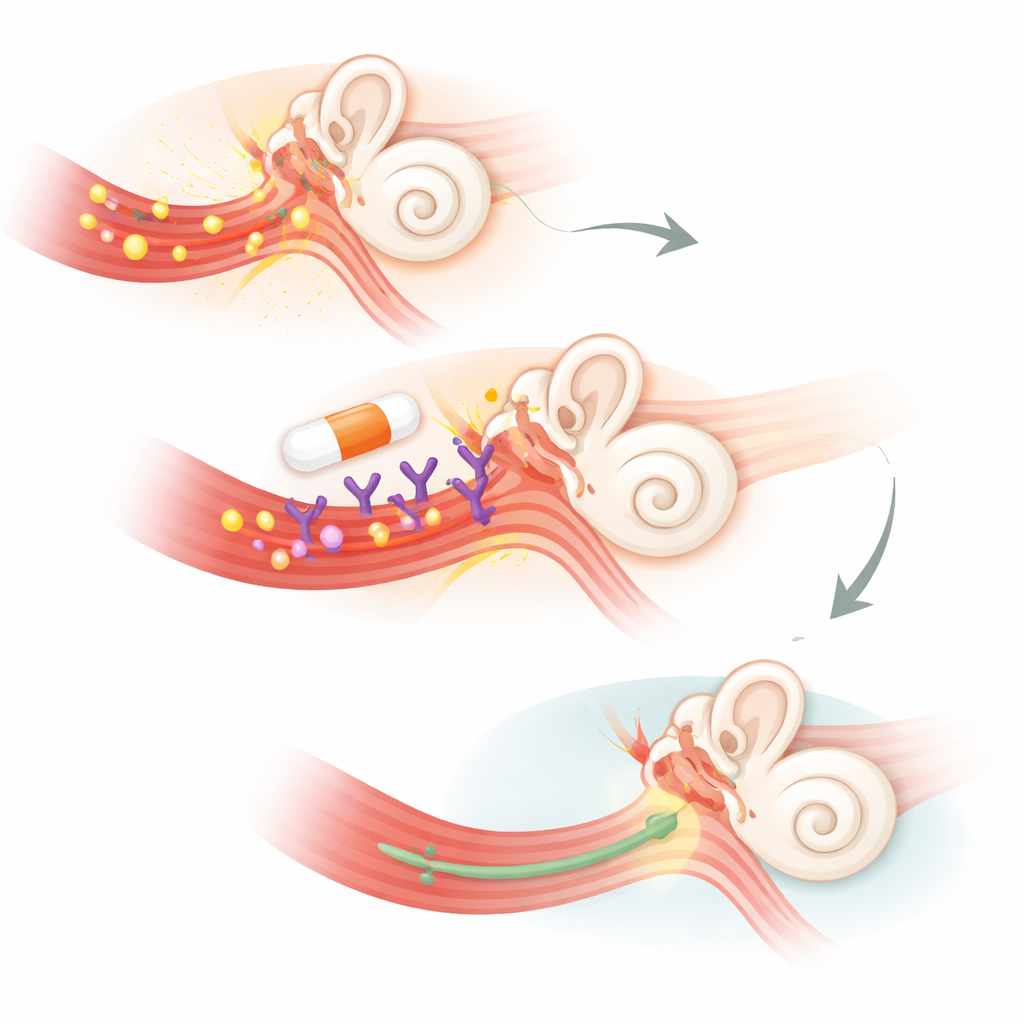
Vestibular migraine is a brain and inner-ear disorder marked by repeated bouts of vertigo, imbalance, nausea, and sensitivity to light and sound. These attacks can last from minutes to days and often occur in people who also have more typical migraine headaches. Scientists suspect that a messenger molecule in the nervous system, called CGRP, helps drive both pain and balance problems by widening blood vessels and stirring up inflammation. Because rimegepant blocks CGRP’s action and is already approved to treat regular migraine attacks, the authors asked whether it might also work when dizziness is front and center.
How the study was carried out
The researchers followed 18 adults treated at a hospital in Shanghai who had either definite or probable vestibular migraine. All were over 18, had been having moderate to severe attacks for at least several months, and were on stable long-term preventive medications. During an acute attack, each participant took a single 75 mg dose of rimegepant. They then rated five key symptoms—vertigo, unsteadiness or general dizziness, nausea or vomiting, sensitivity to light or sound, and headache—on a simple four-point scale from absent to severe. These ratings, along with an overall disturbance score on a 0–10 line, were recorded just before taking the pill and again over the next 48 hours.
What changed after taking the pill
Symptom scores began to drop within 30 minutes of taking rimegepant and kept improving over time. By two hours, all symptoms except headache had fallen significantly compared with the starting point. After 24 hours, the average score for every symptom had fallen to zero, except for a tiny amount of lingering unsteadiness, which disappeared by 48 hours. When the researchers looked at how many people moved from moderate or severe symptoms down to mild or none, nearly all had improved by two hours, and none still had moderate or severe symptoms by 24 hours. Freedom from symptoms—having no vertigo, no nausea, and so on—increased steadily, and by 24 hours everyone was free of all symptoms except a small fraction who still felt a bit unsteady.
How these results compare and what is still unknown
Because vestibular migraine attacks sometimes ease on their own within a day or two, the team compared their findings to results from a recent placebo-controlled trial that tested a different acute migraine drug, rizatriptan, for vestibular migraine. In that earlier work, just over half of placebo-treated attacks showed clear improvement in vertigo at one hour. In the present study, the proportion of patients whose symptoms improved after rimegepant was equal to or higher across all five symptom types, suggesting a genuine drug effect. Importantly, none of the 18 participants reported side effects such as allergic reactions or problems with liver or kidney function, which supports the idea that rimegepant is well tolerated in this group. Still, the authors stress that their study was small, conducted at a single center, and did not include a comparison or sham treatment group.
What this could mean for people with dizzy migraines
The findings suggest that a single 75 mg dose of rimegepant may quickly ease the spinning, nausea, and light or sound sensitivity that plague people during vestibular migraine attacks, all without obvious safety concerns in this small sample. For now, this work should be viewed as an encouraging first step rather than proof: larger, carefully controlled trials are needed to confirm whether rimegepant truly outperforms placebo and to see which patients benefit the most. If future studies back up these results, rimegepant could become a valuable rapid-relief option for people whose migraines don’t just hurt their heads but also throw their balance off course.
Citation: Chu, H., Pan, J. & Huang, C. The efficacy of rimegepant for the acute treatment of vestibular migraine. Sci Rep 16, 9247 (2026). https://doi.org/10.1038/s41598-026-39902-9
Keywords: vestibular migraine, rimegepant, dizziness, CGRP blocker, acute migraine treatment