Clear Sky Science · en
Layer-resolved berry curvature and Rashba spin–orbit control of quantum transport in magnetic tunnel junctions
Why Layers Matter in Magnetic Memory
Modern digital devices increasingly rely on magnetic tunnel junctions, the tiny sandwiches of materials that lie at the heart of some computer memories and magnetic sensors. This paper digs beneath the surface—literally—asking what happens not just at the outer faces of these junctions, but layer by layer inside the ultra-thin insulating barrier. By tracking how quantum effects change from the interface to the center, the authors show how engineers might more precisely steer electron behavior and design faster, more efficient spin-based electronics.
A Tiny Sandwich for Storing Information
A magnetic tunnel junction consists of two magnetic metals separated by a nanometer-thin insulating layer. Even though the insulator should block charge, quantum mechanics allows electrons to “tunnel” through it. The electrical resistance of this structure depends on how the magnetizations of the two metals line up, a property exploited in magnetic random access memory and read heads for hard drives. For years, research has focused on choosing good materials and improving interfaces. This work instead asks: how does the quantum landscape change as you move from the metal–insulator boundary into the interior of the insulator, and can that internal structure be used as a control knob?

Spins, Twists, and Hidden Geometry
The authors focus on two intertwined ideas. First is Rashba spin–orbit coupling, an effect that links an electron’s spin to its motion when structural asymmetry and electric fields are present, especially at interfaces. Second is Berry curvature, a measure of how the quantum wavefunction of an electron “twists” in momentum space, much like how a path on a curved surface accumulates extra turning. Berry curvature is closely tied to unusual transport effects, such as sideways deflection of electrons and spin-dependent currents. Using a detailed quantum model, the researchers apply Rashba coupling only at the two interfaces where the magnetic metals touch the insulator, then calculate how the Berry curvature behaves separately in each atomic layer of the barrier.
Layer-by-Layer Quantum Response
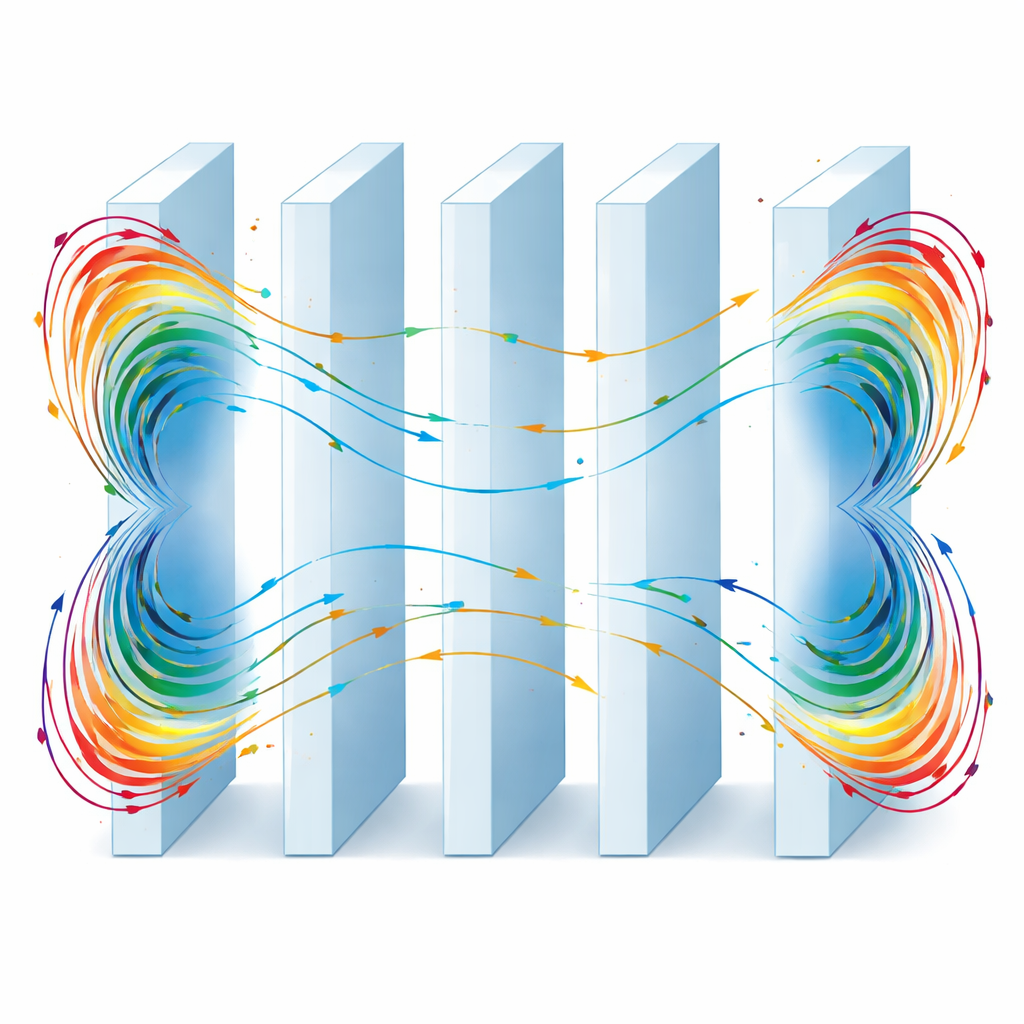
The simulations reveal that the interface layer, directly in contact with a magnetic metal, is where the action is strongest. As the height of the insulating barrier is varied, the average Berry curvature in this layer oscillates strongly, signaling intense quantum interference driven by confinement of electrons in the thin barrier. When the strength of Rashba coupling at the interface is increased, the Berry curvature in that layer systematically diminishes, showing a competition: confinement tends to enhance geometric twisting, while stronger spin–orbit coupling reshapes the energy bands and suppresses those twists. The next layer in from the interface still shows oscillations and sensitivity to spin–orbit strength, but both effects are weaker. By the time one reaches the central layer, the oscillations are faint and the response to Rashba coupling is minimal, indicating that the interface-driven quantum structure decays rapidly with depth.
Consequences for Electron Flow and Device Design
Because tunneling in these junctions depends on which momentum channels are available and how spins are oriented in each channel, the layer-resolved Berry curvature is not just a mathematical curiosity. It directly affects which paths electrons can take, how long spin information is preserved, and how strongly spin-polarized currents can be manipulated. The study suggests that interfaces act as powerful filters and mixers for spin-dependent transport, while the interior of the barrier behaves more like a quiet bulk medium. This depth-dependent pattern implies that adjusting interface fields, strain, or composition—rather than over-engineering the entire barrier thickness—will yield the greatest leverage over key device metrics like tunneling magnetoresistance and spin torques.
What This Means for Future Spintronics
In plain terms, the paper concludes that the “edges” of the insulating barrier in a magnetic tunnel junction do most of the quantum heavy lifting. By selectively turning up or down the Rashba effect only at these boundary layers, engineers can tune the hidden geometric properties of electron motion, and thereby influence how spins flow through the device, without disturbing the more stable inner region. This layered view of quantum behavior offers a roadmap for next-generation spin-based technologies: focus on smart interface engineering to harness or suppress geometric phase effects, and use the barrier interior as a stable backbone that carries, rather than shapes, the delicate quantum signals.
Citation: Ghobadi, N., Daqiq, R. & Moradi, S.A.H. Layer-resolved berry curvature and Rashba spin–orbit control of quantum transport in magnetic tunnel junctions. Sci Rep 16, 9066 (2026). https://doi.org/10.1038/s41598-026-39901-w
Keywords: magnetic tunnel junctions, spintronics, Rashba spin orbit coupling, Berry curvature, quantum transport