Clear Sky Science · en
Collective route memories emerge through differential forgetting of navigational information in homing pigeons
Why Two Birds May Remember Better Than One
When flocks of animals find their way home, we often credit a kind of “group wisdom.” But what if part of that wisdom lies not in making decisions together in the moment, but in how groups remember past journeys over time? This study uses homing pigeons to explore whether pairs of birds can hang on to a shared memory of a route better than a single bird can—and what that might tell us about how animal groups, including human groups, stay on track in a changing world.
Following the Same Road Home
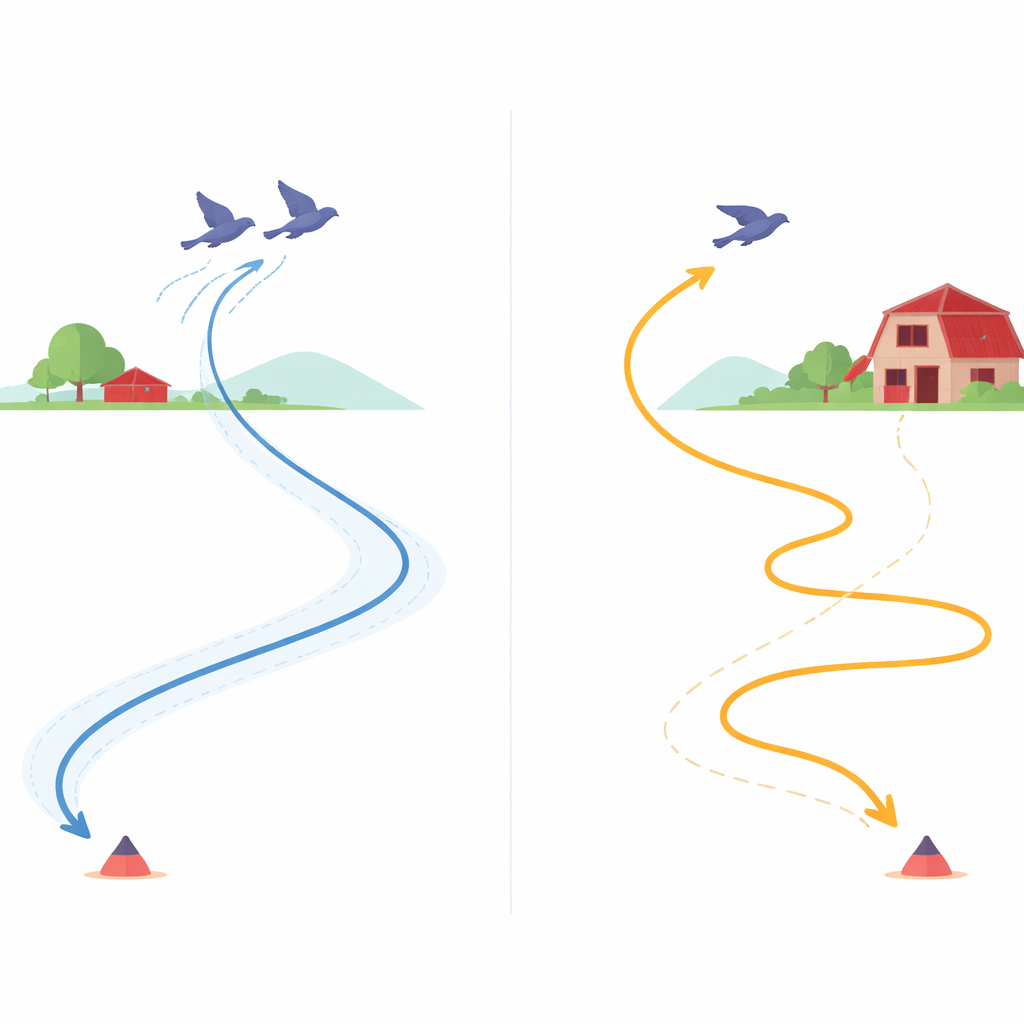
Homing pigeons are famous for finding their way back to their loft from unfamiliar locations. When they repeat the same trip, they gradually settle on preferred routes, like commuters favoring a familiar shortcut. In this experiment, researchers released pigeons in stable pairs from two sites several kilometers from home. Over many flights, the same pairs flew again and again along each route, allowing them to learn a shared path back to the loft. Tiny GPS devices recorded their positions every second, turning each homeward trip into a detailed map line that could later be compared.
Testing Memory After Time Passes
The team then asked a simple question with a twist: after time has passed, do two birds together remember their joint route better than a single bird on its own? To probe this, they used two types of schedules. In a “forgetting” treatment, birds stopped flying one of the routes for eight weeks before being tested again. In an “extra training” treatment at the other site, the same pairs got more practice flights and then had a shorter five-week break. At the final test, some birds flew home in their usual pairs, while others were split and flew solo. The researchers measured how closely each new flight matched the earlier “baseline” routes from training, using distance-based comparisons between the new track and the stored GPS lines.
Shared Memories From Uneven Forgetting
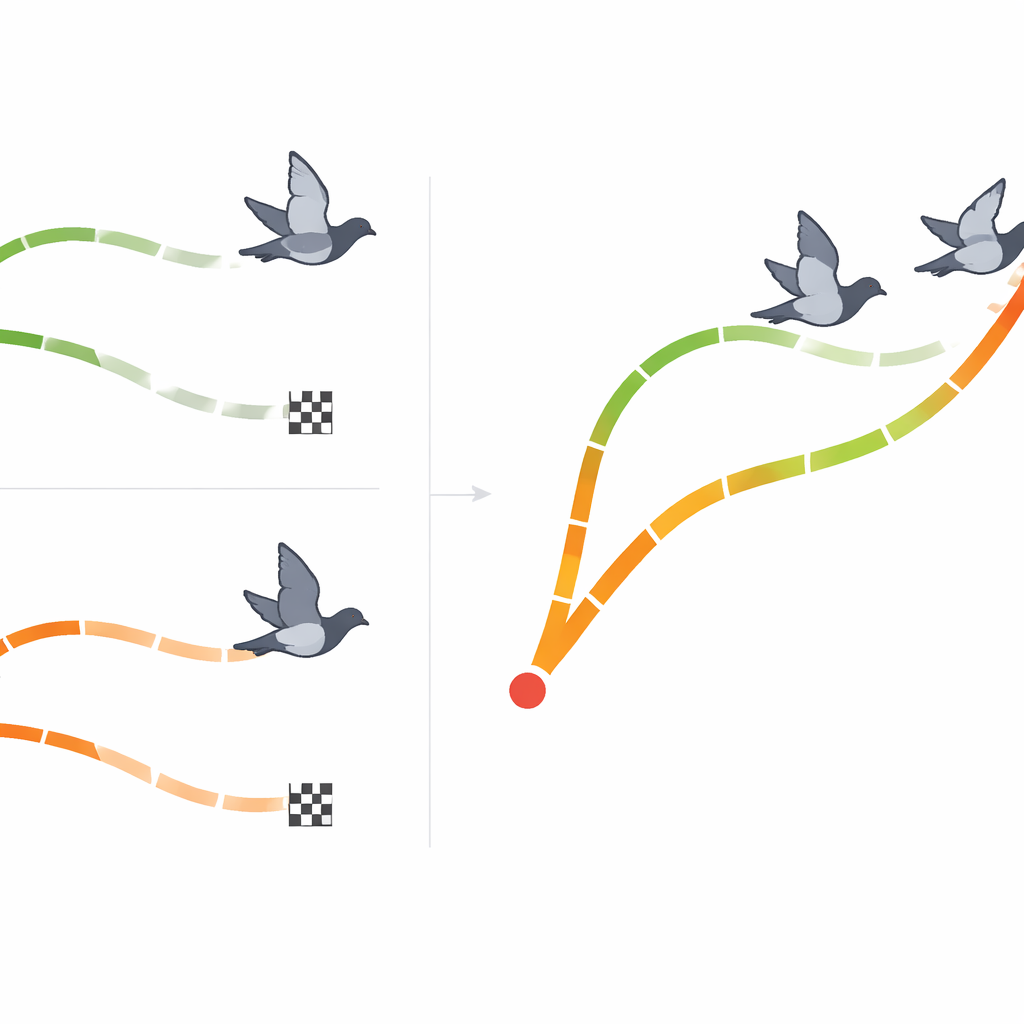
In the long-break, forgetting treatment, pairs outperformed solo birds when memory was tested. After eight weeks, two birds flying together stayed closer to their previously learned route than individuals flying alone, even though at the end of training there had been no such difference. This suggests that the group’s advantage did not come from one consistently superior “leader” bird, but from the way separate memories aged differently in each individual. Each pigeon seemed to forget different parts of the route, so when they flew together later, their combined, partly overlapping recollections produced a closer match to the original path than either bird could achieve alone—a kind of distributed memory spread across the pair.
When Extra Practice Erases the Group Edge
The story changed in the extra training treatment. There, after additional joint flights and a shorter delay, pairs no longer showed better route memory than solo birds. In fact, the best solo members sometimes did as well as, or better than, the pair. This pattern points to forgetting as the key ingredient that allowed a special group memory to emerge in the other treatment. When birds had more recent practice and less time to forget, there was less room for different pieces of the route to be lost by different individuals—and therefore less opportunity for combining complementary fragments into a stronger shared memory.
Memory Gains Without Better Performance
Surprisingly, the improved route memory in pairs did not lead to faster or more efficient trips home. Across both treatments, overall homing efficiency—how directly birds flew from release point to loft—barely changed between training and the final tests. In the forgetting treatment, even after eight weeks, birds still flew nearly as efficiently as before, leaving little scope to see a clear “wisdom of pairs” in how quickly they returned. The authors suggest that a longer period without practice might be needed before memory loss is strong enough to hurt performance and make any group advantage in efficiency stand out.
What This Means Beyond Pigeons
The results show that animal groups can develop a kind of collective memory not because they communicate in complex ways, but because individuals forget differently. Over time, this uneven fading of memories can turn a pair into a shared storehouse of information that is more complete than any one member’s mind. While this did not yet translate into smarter navigation in terms of speed or directness, the work highlights a new pathway by which group life could boost problem-solving in nature. In longer or more challenging tasks, such distributed memories may help flocks, herds, or even human teams keep hold of hard-won knowledge that no individual can fully retain alone.
Citation: Morford, J., Lewin, P.J., Mann, R.P. et al. Collective route memories emerge through differential forgetting of navigational information in homing pigeons. Sci Rep 16, 8894 (2026). https://doi.org/10.1038/s41598-026-39898-2
Keywords: collective memory, homing pigeons, animal navigation, group decision-making, collective intelligence