Clear Sky Science · en
Role of friction on the formation of confined granular structures
Grains That Behave Like Solids, Liquids, and Something In Between
Sand in an hourglass, grains in a cereal box, and dust on the Moon all have something in common: they are made of tiny solid particles that sometimes flow like a liquid and sometimes jam into a solid mass. This study explores how a simple detail—the slipperiness of the particles’ surfaces—can decide whether a crowded swarm of grains settles into an orderly crystal, a disordered glass, or keeps flowing. Understanding this behavior is not only fascinating physics; it also matters for technologies like chemical reactors, waste treatment, and even future off-world mining.
A Narrow Tube Full of Floating Beads
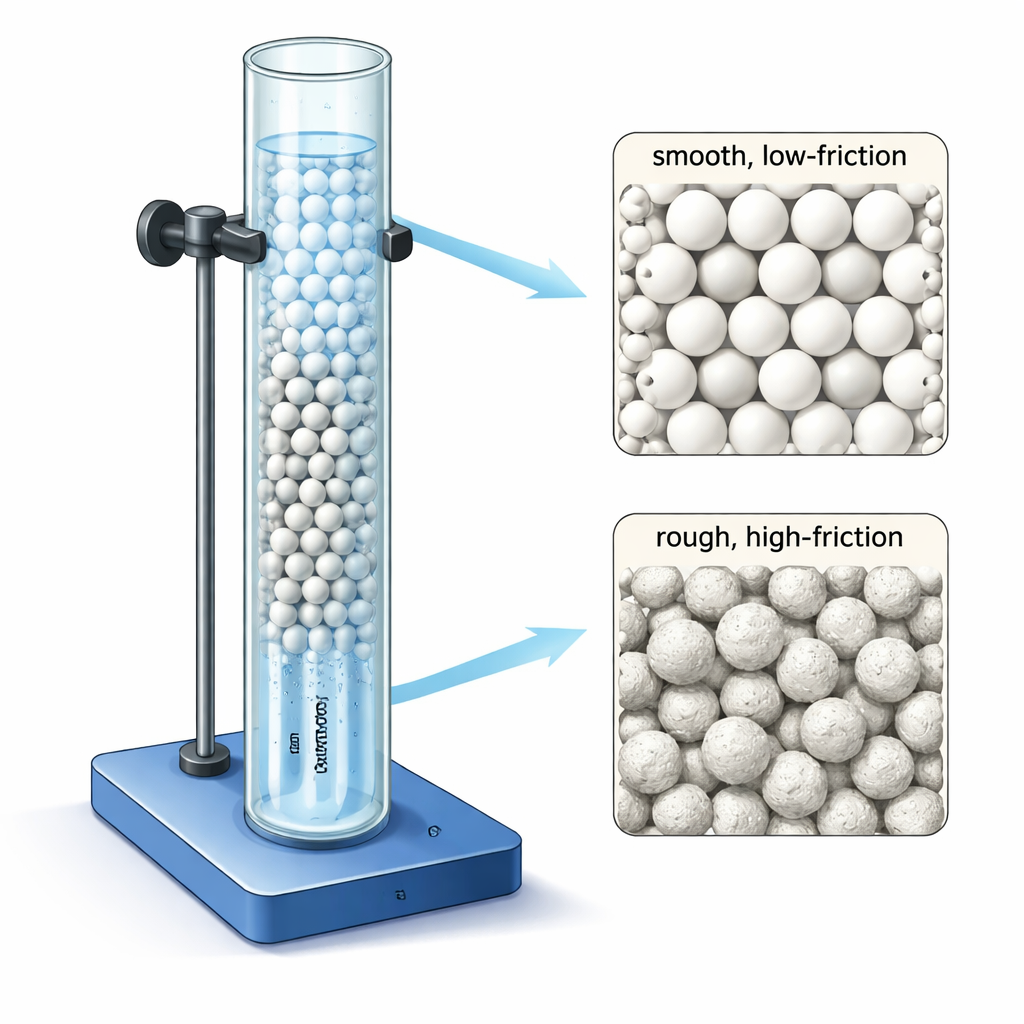
The researchers built a carefully controlled experiment using a transparent vertical tube filled with water and small plastic spheres. Water was pumped upward so that the rising flow could lift and keep the grains suspended, forming what engineers call a “fluidized bed.” Because the tube was only about four to five grain diameters wide, the particles were strongly confined, a situation known to produce unusual patterns such as plugs (dense clumps) and empty regions. This narrow geometry is also relevant to miniaturized reactors used for processes like biomass conversion or carbon capture, where the flow of particles must be reliable and predictable.
Slippery Versus Sticky Grains
To isolate the role of friction, the team compared two types of polymer beads: smoother, more slippery PTFE (similar to Teflon) and slightly rougher, higher-friction ABS. They measured how easily each material slid when a wet sphere was dragged across a matching plate, finding friction values that differed by about a factor of three. PTFE spheres had the lowest friction, while ABS spheres resisted sliding more. They also quantified surface roughness with a profilometer, confirming that PTFE was smoother overall. These seemingly modest differences in friction and texture turned out to have a major impact on how the grains organized inside the moving water.
From Flowing Bed to Frozen Shell
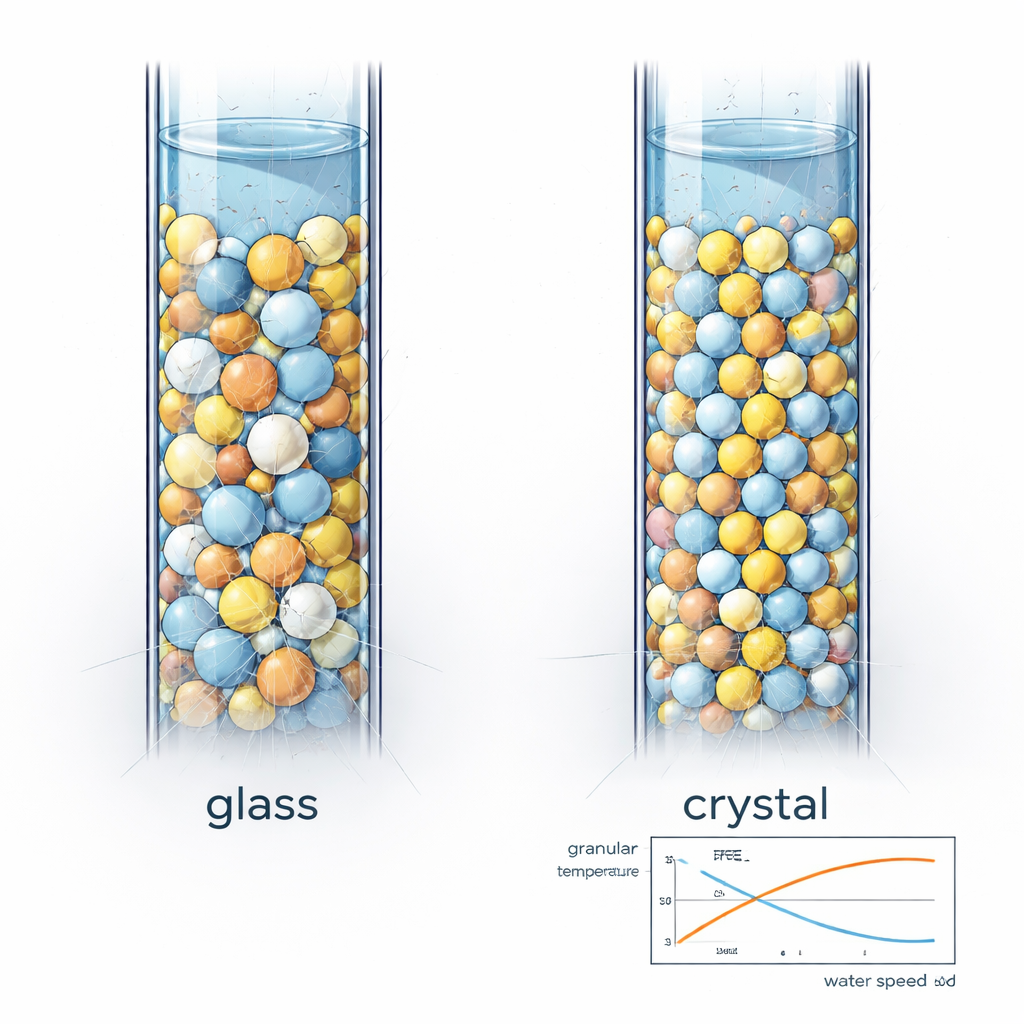
By varying the water speed and the number of particles, the researchers mapped out the different behaviors of the bed. At low but sufficient flow speeds, the grains were fluidized and moved around, sometimes forming traveling plugs of high concentration. As the flow conditions changed, the system could suddenly “defluidize”: grain motions slowed and eventually stopped, creating a static structure while the water still flowed around it. Depending on friction and driving conditions, this frozen state resembled either a crystal—highly ordered layers of particles along the tube wall—or a glass, where particles were locked in place but arranged irregularly. The team introduced a measure called “granular temperature,” which tracks how strong the particles’ random velocity fluctuations are, and used it to distinguish flowing, partially flowing (metastable), and fully jammed states.
Seeing Order and Disorder in the Grain Patterns
To quantify how orderly the jammed structures were, the researchers analyzed images of the particle positions using a geometric tool called Voronoi tessellation. In essence, this divides space into cells around each grain and allows measurement of angles between neighboring particles. For low-friction PTFE beads, the distribution of these angles clustered tightly around 60 degrees, the hallmark of hexagonal packing seen in close-packed crystals. For higher-friction ABS beads, the angle distribution split into two peaks, one near 60 degrees and another near 90 degrees, indicating a mix of hexagonal and more square-like arrangements typical of a disordered glass. The PTFE systems also showed longer, more aligned chains of contacting grains, suggesting a more robust, well-organized structure.
Why This Matters for Everyday and Extreme Environments
Overall, the study shows that making particles more slippery encourages them to settle into neat, crystal-like layers, while rougher, stickier particles are more likely to freeze into messy, glass-like patterns. The way the granular temperature drops—how quickly random motion dies out—also influences whether the final state is ordered or amorphous, echoing how cooling rates affect the formation of crystals and glasses in metals or window glass. These insights help bridge our understanding between everyday granular flows and traditional solid-state physics, and they could guide the design of industrial fluidized beds and future processes that rely on precise control of tiny grains in confined spaces.
Citation: Oliveira, V.P.S., Borges, D.S., Franklin, E.M. et al. Role of friction on the formation of confined granular structures. Sci Rep 16, 7507 (2026). https://doi.org/10.1038/s41598-026-39896-4
Keywords: granular materials, fluidized beds, particle friction, crystallization, jamming