Clear Sky Science · en
Long-term ecological effectiveness of the Three-North shelterbelt program assessed by changes in ecosystem services
Why planting trees across northern China matters
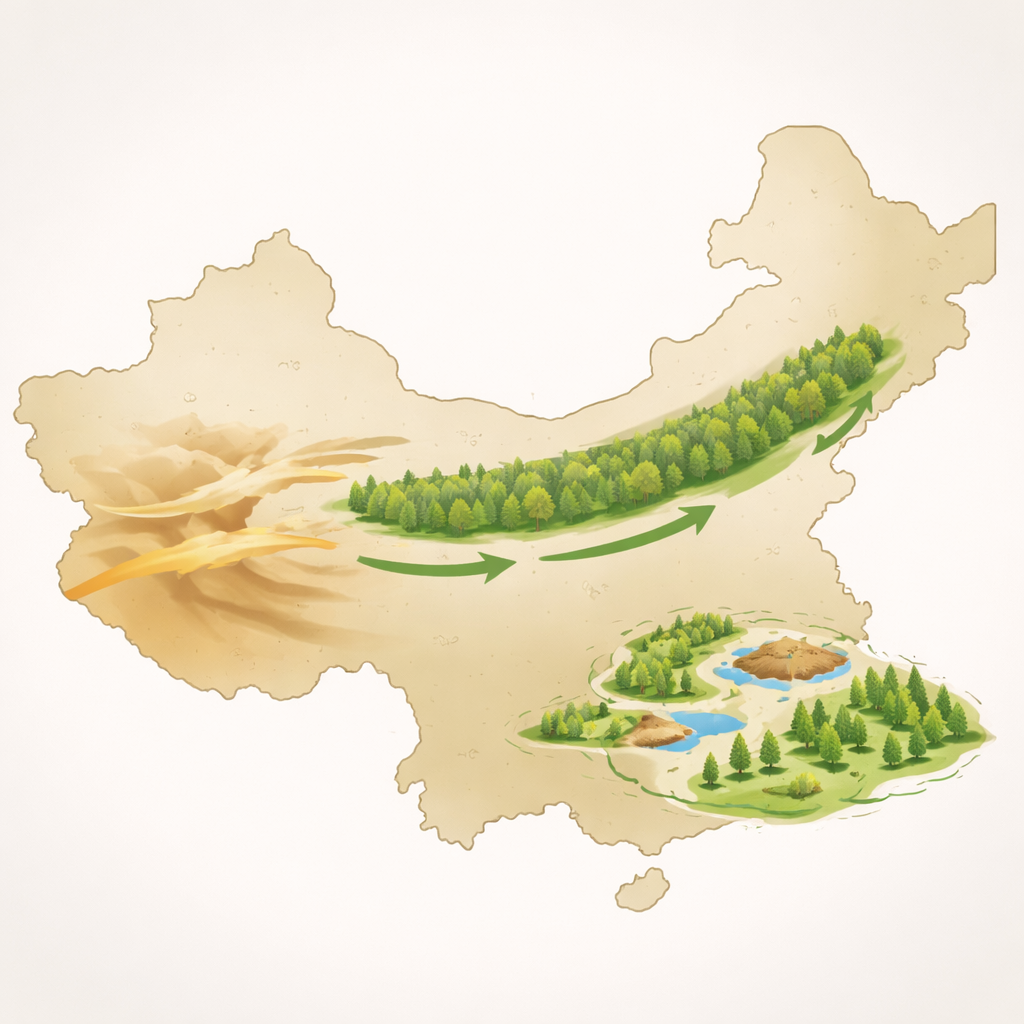
Across northern China, vast deserts and dry plains have long sent dust storms sweeping into cities, stripped soil from farms, and strained already scarce water supplies. For more than four decades, China has tried to counter these pressures with the Three-North Shelterbelt Program—a massive effort to plant forests and restore grasslands from the northeast to the far northwest. This study asks a simple but crucial question: after nearly 40 years, is this gigantic green wall really helping nature work better, and if so, where and how?
Looking at nature through the lens of benefits
Instead of focusing on just one sign of recovery—such as how green the land looks—the researchers examined four key “services” that healthy ecosystems provide to people: storing and slowly releasing water, supporting a rich variety of life, holding soil in place, and blocking wind-driven sand and dust. They pulled together satellite images, climate records, soil data, and maps of land use for five moments in time between 1985 and 2024. By applying well-established models to these data, they could estimate how much water forests and grasslands helped keep in the landscape, how strongly they supported living communities, how many tons of soil they stopped from washing away, and how much sand they kept from being blown into the air.
A patchwork of gains across a dry landscape
The big picture that emerges is one of overall improvement, but with strong regional contrasts. On average, each of the four ecosystem services increased over the last four decades, and a combined index that summarizes them all rose as well. Wetter, hillier, and more forested parts of the Three-North region—such as mountain ranges in the south and northeast—now provide clearly stronger ecosystem services than they did in the 1980s. In contrast, the driest central and northwestern areas still lag behind, limited by scarce rainfall, poor soils, and ongoing land pressures. The study finds a clear gradient from higher services in the southeast to lower values in the northwest, reflecting how climate and terrain shape what restoration can realistically achieve.
How forests and grasslands do the heavy lifting
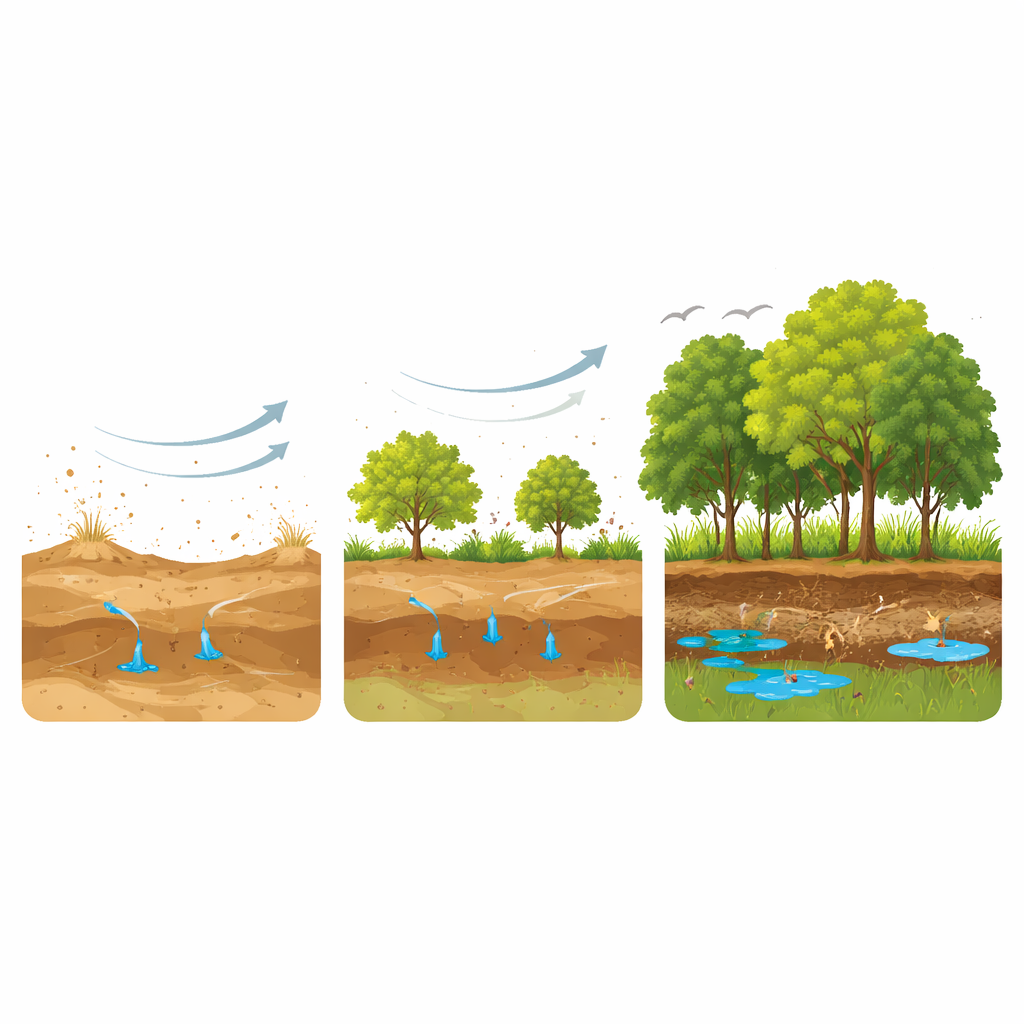
Different kinds of land contribute in different ways. Forests and grasslands stand out as workhorses, offering the strongest overall package of services: they store water, support more diverse life, reduce soil loss, and help stop wind erosion. Croplands tend to score highest for maintaining biodiversity compared with their other functions, but their ability to hold soil is relatively weaker. Lakes, rivers, and wetlands are especially important for water storage and wildlife, while built-up and unused lands deliver relatively little, aside from some local wind protection. Over time, soil retention nearly doubled, with hot spots forming in the Loess Plateau and other restoration belts. Sand control also improved markedly, especially in sandy lands where mobile dunes shrank and the area of strong wind protection expanded, although this trend weakened somewhat after 2015 as drought and climate extremes intensified.
Climate, policy, and people acting together
The study makes clear that no single program explains these trends. The Three-North Shelterbelt, other major restoration efforts such as the Grain-for-Green program, shifts in farming and grazing practices, and a changing climate have all worked together—sometimes reinforcing, sometimes undermining one another. Periods of rapid soil and sand control tended to coincide with large-scale tree planting and conversion of cropland on steep slopes back to vegetation. More recently, rising aridity and more frequent extreme weather have made it harder for ecosystems to keep improving, especially in already fragile drylands. By tying the numbers back to real management actions and climate shifts, the authors highlight both the successes and the vulnerabilities of large-scale restoration in harsh environments.
What this means for future green walls
For non-specialists, the main takeaway is that northern China’s vast tree and grass belts are, on the whole, helping nature function better—storing more water, holding more soil, sheltering more life, and cutting down dust and sand. Yet these gains are uneven and not guaranteed to last. Forests and grasslands in wetter and hillier zones now provide critical ecological support and need strong protection. Moderately productive areas call for careful, sustainable farming and grazing, while the driest regions will need tailored, water-wise approaches that favor native species and efficient land use. By viewing the Three-North Shelterbelt through the benefits people actually receive, this study offers a roadmap for refining restoration efforts not only in China, but in drylands around the world facing similar challenges.
Citation: Guan, X., Wang, S., Xu, M. et al. Long-term ecological effectiveness of the Three-North shelterbelt program assessed by changes in ecosystem services. Sci Rep 16, 8330 (2026). https://doi.org/10.1038/s41598-026-39895-5
Keywords: Three-North Shelterbelt, ecosystem services, ecological restoration, desertification control, arid regions