Clear Sky Science · en
Design of a portable machine for picking chamomile flowers
Why a Flower-Picking Gadget Matters
Chamomile is more than a calming tea; it is a high‑value medicinal and cosmetic ingredient, and its tiny flower heads must usually be plucked by hand. That work is slow, tiring, and expensive, limiting how much farmers can realistically grow. This study presents a new portable machine that lets a single person harvest chamomile flowers far more quickly, while keeping the delicate blooms intact. For anyone interested in how clever engineering can ease farm labor and lower the cost of herbal products, this device offers a concrete glimpse of the future of small‑scale agriculture.
From Hand Picking to Smart Picking
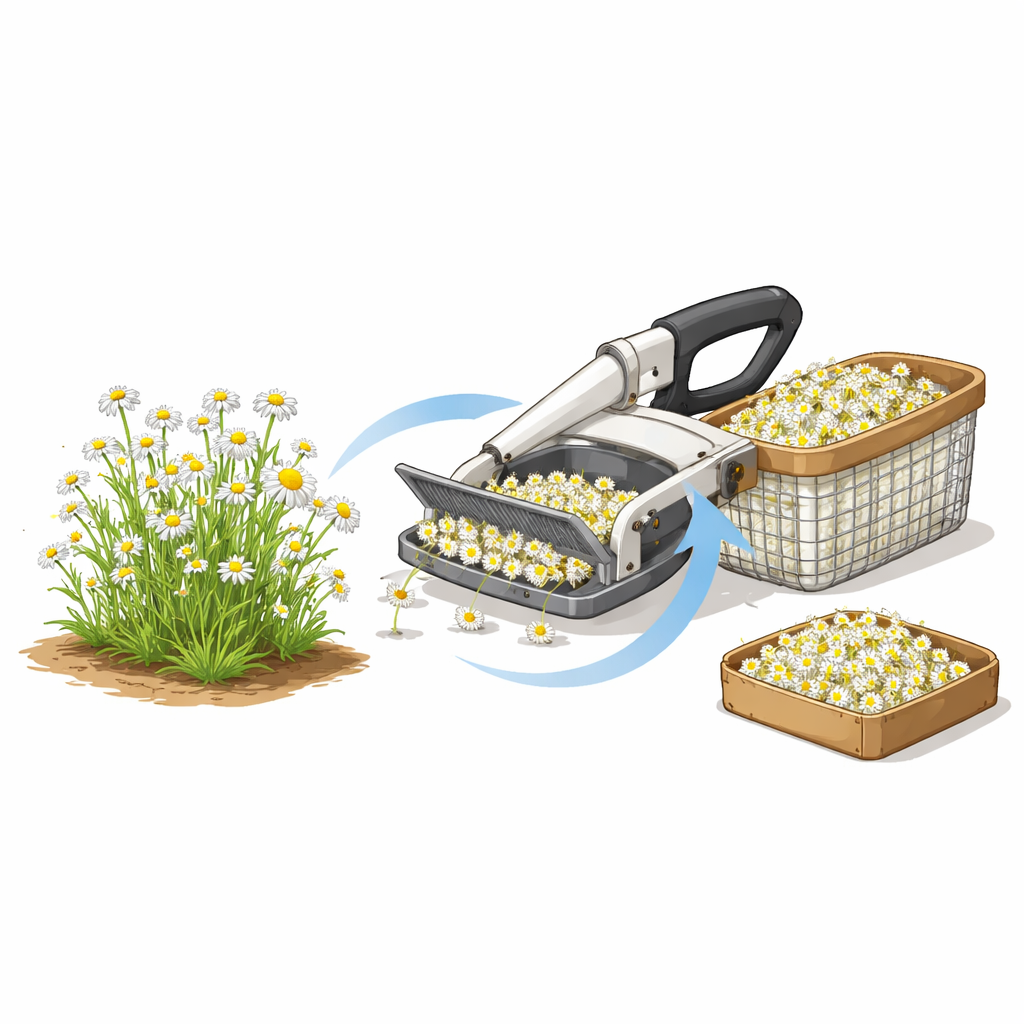
German chamomile is grown worldwide for use in teas, pharmaceuticals, essential oils, and cosmetics. The active compounds are concentrated in the flower heads, which appear in several flushes over the season. Traditionally, workers bend over the plants and pinch off flowers, gathering only 3–5 kilograms per hour and needing 30–40 people to harvest a quarter‑hectare field. Some countries use large harvesting machines, but these are often expensive, complex, and not well suited to small farms or to very delicate crops. The authors set out to bridge this gap by creating a compact, battery‑powered harvester that one person can carry and push through narrow rows, combining the care of hand picking with the speed of mechanization.
How the New Harvester Is Built
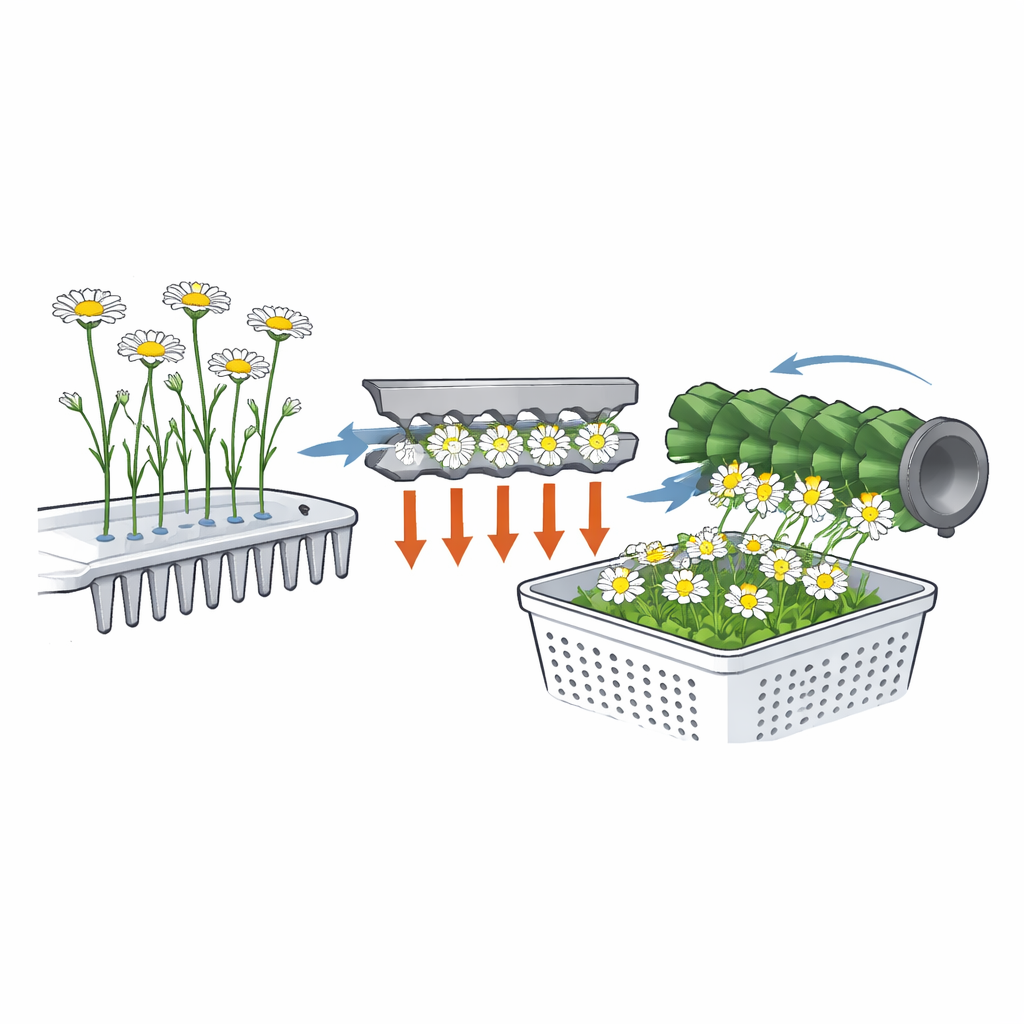
The portable machine centers on a long metal comb that slides between the stems, straightening and holding them so the flower heads rest along the top edge. Just beneath this edge, a pair of thin blades move back and forth like scissors, cutting the stems cleanly. Above them, a rotating brush made of flexible rubber fingers gently sweeps the cut flower heads into a fabric basket. The entire system is mounted on a lightweight steel frame and powered by two small electric motors fed by lithium‑ion batteries, one motor driving the cutting blades and the other turning the brush. Earlier measurements of chamomile stem thickness, strength, and airflow behavior guided every dimension, from the spacing between comb teeth to the angle of the blade edge, so the machine could cut efficiently without crushing the flowers.
Tuning the Machine for Best Performance
To move beyond a clever prototype and into reliable farm use, the researchers systematically tested four adjustable settings in a real chamomile field: the length of the comb teeth, the gap between them, the speed of the cutting blades, and the rotation speed of the brush. For each combination, they timed how long a worker took to pass through a plot, weighed the harvested flowers, and repeated the test three times. Statistical analysis showed that all four settings had a strong effect on how much the machine could collect per hour, and that the geometry of the comb—its length and gap width—mattered the most. In practical terms, the right shape and spacing of the comb teeth determined whether stems flowed smoothly into the cutting zone or slipped through uncut or caused jams.
Finding the Sweet Spot
The tests revealed clear sweet spots in how the machine should be run. A comb with 100‑millimeter‑long teeth collected more flowers than a shorter one, but longer teeth tended to tangle stems and slow movement. A gap of 5 millimeters between teeth was ideal: narrower gaps resisted the plant flow, while wider ones let too many stems pass through untouched. Faster blade motion always helped up to the highest tested speed, because brief contact between stem and blade led to cleaner cuts and fewer misses. The brush did best at a moderate 200 revolutions per minute—too slow and it left flowers behind, too fast and it flung uncut blooms away from the comb. Under the best combination of these settings, the machine reached a productivity of about 31.7 kilograms of flowers per hour, many times what a person can pick by hand.
What This Means for Growers
In simple terms, the study shows that a thoughtfully designed, battery‑powered handheld machine can replace a whole team of manual pickers while keeping chamomile flowers in good condition. By pinpointing the most effective comb size, gap width, blade speed, and brush speed, the authors provide a ready‑to‑use recipe for building and operating similar devices on small and medium farms. Although they emphasize that more testing under different field and seasonal conditions is still needed, the work demonstrates that smart, lightweight tools can make labor‑intensive herbal crops more profitable and widely available, without relying on massive industrial harvesters.
Citation: El-Moulaa, M.A.M.A., Zaalouk, A.K. & Mahmoud, W.A. Design of a portable machine for picking chamomile flowers. Sci Rep 16, 8726 (2026). https://doi.org/10.1038/s41598-026-39880-y
Keywords: chamomile harvesting, portable farm machinery, mechanized flower picking, small-scale agriculture, herbal crop engineering