Clear Sky Science · en
High-gain CRLH vivaldi antenna for enhanced channel performance at Ku-band communication systems
Why better antennas matter to everyday connections
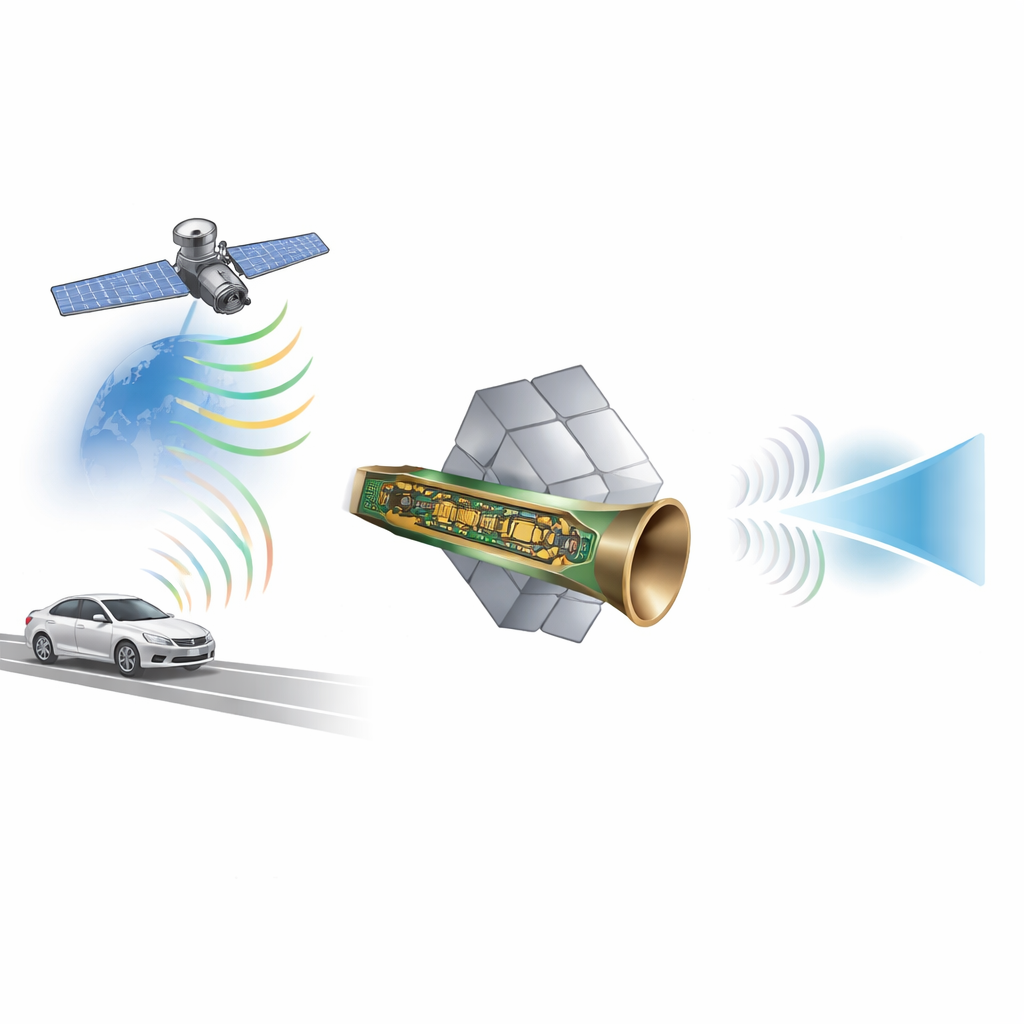
Whether it is a car talking to nearby traffic lights or a satellite beaming television and data, all of these links depend on antennas. As our demand for fast, reliable wireless communication grows, we need antennas that can send focused signals over long distances without wasting energy in unwanted directions. This paper presents a new antenna design that does just that at Ku-band frequencies, an important slice of the spectrum used for satellites, radar, and emerging Vehicle‑to‑Everything (V2X) services.
Building a smarter signal “funnel”
The heart of the work is a refined version of a Vivaldi antenna, a popular shape that looks like a flaring slot and is already known for high gain, wide bandwidth, and stable radiation. The authors mount this tapered structure on a low‑loss Rogers RT5880 circuit board, carefully shaping the metal wings and feed network so that the antenna can operate across a broad Ku‑band range. Instead of relying solely on the classic flare to launch waves into space, they treat the entire front end as a signal “funnel,” guiding energy from a transmission line into a well‑behaved, outward‑pointing beam.
Patterned paths that tame the waves
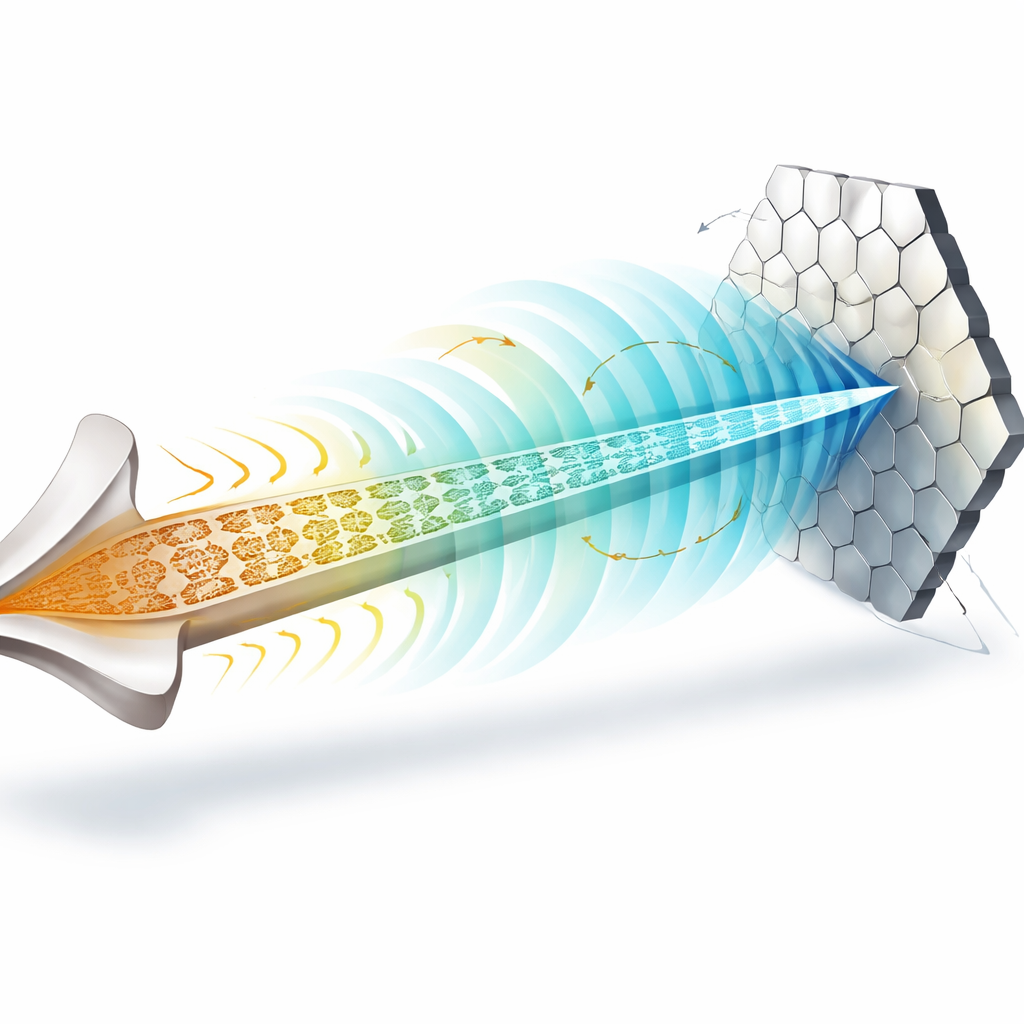
To squeeze more performance out of the same size, the team embeds along the antenna’s length a row of 14 tiny repeating patterns known as a composite right/left‑hand (CRLH) array. Each unit cell combines two kinds of fractal shapes—Hilbert curves along the sides and Minkowski loops in the center. These intricate copper traces force the radio waves to follow a longer, carefully controlled path, slowing them down and reshaping their phase. In effect, the patterned strip behaves like a man‑made lens with a graded index, bending and focusing the waves so that they add up in the forward direction while suppressing stray radiation to the sides. An artificial‑intelligence‑based circuit model is used to extract the tiny effective resistors, capacitors, and inductors hidden in these patterns, matching simulated behavior with measurements across the 12–18 GHz band.
A 3D reflector that keeps power on target
Even with the fractal array, some power would normally leak backward or sideways, creating side lobes and back lobes that can interfere with other systems and waste energy. To combat this, the researchers add a compact three‑dimensional hexagonal reflector behind the antenna. Unlike a flat plate, this folded honeycomb‑like shape creates a more gradual phase response, helping redirect wayward waves toward the main beam. By adjusting the spacing between the antenna and this reflector, they tune a resonant cavity that broadens bandwidth and sharpens directivity. The final combination of Vivaldi flare, CRLH strip, and 3D reflector concentrates most of the energy in a narrow, end‑fire beam with a much higher front‑to‑back ratio than a standard design.
From lab modeling to real‑world performance
The authors validate their ideas through a blend of full‑wave electromagnetic simulations, circuit analysis, and measurements on a fabricated prototype. The optimized antenna achieves a peak gain of 14.5 dBi at 15.4 GHz with a total usable bandwidth of 2.8 GHz, split into two sub‑bands (14.8–16 and 16.4–18 GHz). Side lobes and back lobes are significantly reduced to about −10.6 dB and −2.6 dB, and the main beam becomes narrow and well defined. To connect these physical improvements to communication quality, the team simulates a digital link with the antenna, showing that the refined beam reduces the bit error rate by more than 90% and increases channel capacity by over 11% at a given signal‑to‑noise ratio, compared with a similar antenna without the reflector.
What this means for future wireless links
Put simply, this work shows how combining smart geometry, engineered materials, and AI‑assisted modeling can turn a familiar antenna type into a far more precise and efficient transmitter. By carving fractal patterns into the metal and shaping a compact 3D reflector, the researchers guide radio waves much like optical engineers steer light with lenses and mirrors. The resulting compact Ku‑band antenna offers higher gain, cleaner beams, and better data throughput, making it an attractive building block for next‑generation satellite links, automotive V2X systems, and radar sensors that must fit into tight spaces while delivering robust, high‑speed connections.
Citation: Ali, M.M., Segura, E.M. & Elwi, T.A. High-gain CRLH vivaldi antenna for enhanced channel performance at Ku-band communication systems. Sci Rep 16, 8651 (2026). https://doi.org/10.1038/s41598-026-39876-8
Keywords: Vivaldi antenna, Ku-band, metamaterial, vehicle-to-everything, high-gain antenna