Clear Sky Science · en
Estimation of contact area among carbon black nanoparticles in composites by tunneling properties, interphase depth and contact number
Why tiny touches between particles matter
From flexible phone cases that sense pressure to car tires that monitor their own wear, many emerging technologies rely on plastics that can conduct electricity. A popular way to make everyday polymers conductive is to mix in carbon black, a fine, soot-like powder. But exactly how these countless nanoparticles touch each other inside the plastic – and how much area they share at each contact – has been almost impossible to measure. This paper develops a practical way to estimate that invisible "contact area" and shows how tuning it can dramatically boost electrical performance in real products. 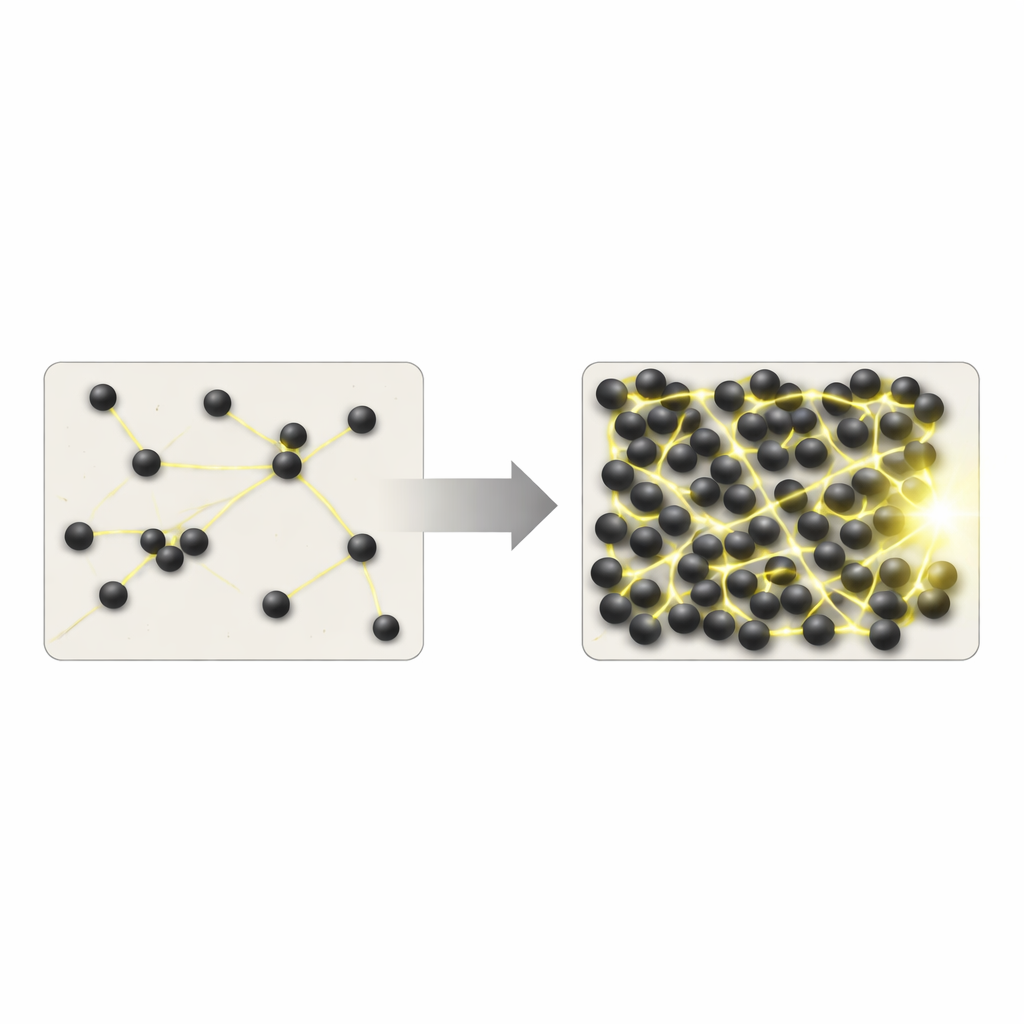
From scattered grains to conducting pathways
When carbon black is blended into a polymer, the particles at first are scattered and isolated, so the material behaves like an insulator. As more particles are added and begin to cluster, they form a continuous network that lets electrons travel across the sample; this sudden change is known as the percolation threshold. The authors emphasize that current models often focus only on how much carbon black is present at this threshold. They typically ignore two crucial features: a thin modified shell of polymer surrounding each particle (called an interphase) and the quantum "tunneling" of electrons across ultra-thin gaps of polymer between nearby particles. Both effects strongly influence how easily charges can move.
Building new formulas for electrical behavior
The researchers construct two mathematical models to predict how well a carbon-black-filled plastic will conduct electricity. In the first, they treat the main barrier to electron flow as the resistance of tiny tunnels of polymer separating adjacent particles. This resistance depends on how far electrons must tunnel, how wide the tunnel is, the resistivity of the polymer in the gap, and – most importantly – the contact area between facing particle surfaces. The second model adapts an older framework used for fiber-filled composites, but extends it to spheres and explicitly builds in the effects of interphase thickness, the number of contacts each particle makes, the size of the particles, and how strongly the polymer and carbon black surfaces interact. By comparing both models to published measurements for several different polymer–carbon black systems, they show that the formulas match real data over a wide range of carbon black loadings.
Turning conductivity models into a contact-area map
Because both models describe the same measured conductivity, the authors combine them and solve for the unknown: the effective contact area between particles. This yields a compact equation that links contact area to measurable material properties: particle radius, amount of carbon black, interphase depth, tunneling distance and diameter, surface energies of polymer and filler, the onset of percolation, and how many neighbors each particle typically touches. Using this expression, they generate three-dimensional maps showing how contact area responds when any pair of factors is varied. A thicker interphase and a higher number of contacts both enlarge the network of connected particles, dramatically increasing contact area, whereas an extremely thin interphase or very few contacts collapse it toward zero. 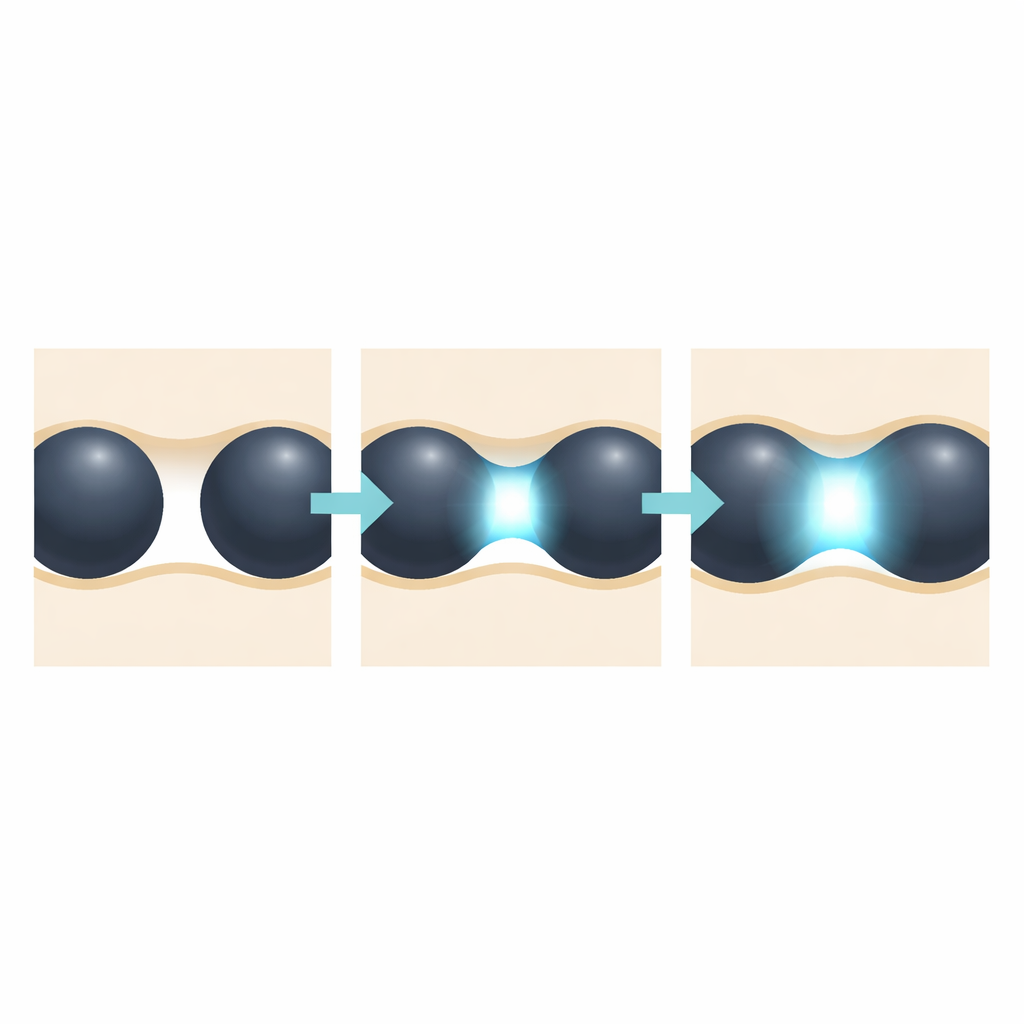
Design rules for better conductive plastics
The contour plots reveal clear design guidelines. Wide but short tunnels between particles – meaning large facing diameters but very small gaps – greatly expand contact area, while very narrow contacts or long gaps fail to create usable pathways. Lower percolation thresholds and stronger interfacial tension between polymer and carbon black both favor dense, connected clusters, again raising contact area. Smaller particles at higher concentrations create more connection points than a few large ones, and a larger overall fraction of the sample occupied by the network strongly boosts contact area. By contrast, the inherent resistivity of the polymer inside the tunnel affects how easily electrons pass but does not change the amount of contact itself.
What this means for real-world materials
In plain terms, the study shows that how carbon black particles meet inside a plastic – not just how many are present – controls whether the material becomes a good electrical pathway or remains a poor conductor. The authors provide a practical equation that lets engineers estimate this hidden contact area from quantities they can measure or choose during design, such as particle size, surface chemistry, and filler loading. With it, manufacturers can systematically tune formulations to maximize contact area, lower tunneling resistance, and achieve targeted conductivity for sensors, antistatic coatings, and other advanced polymer components without endless trial-and-error.
Citation: Zare, Y., Gharib, N., Choi, JH. et al. Estimation of contact area among carbon black nanoparticles in composites by tunneling properties, interphase depth and contact number. Sci Rep 16, 9118 (2026). https://doi.org/10.1038/s41598-026-39872-y
Keywords: conductive polymer composites, carbon black nanoparticles, electrical percolation, tunneling conduction, nanocomposite design