Clear Sky Science · en
CFD and site analysis for optimizing indoor air quality in sustainable social housing via windcatcher integration
Cooler Homes Without Plugging In
As cities grow hotter and more crowded, many families rely on air conditioners just to make their homes livable. But this cooling comes with a cost: higher energy bills and more greenhouse gas emissions. This study explores how a simple rooftop structure, inspired by traditional Middle Eastern buildings and called a windcatcher, can keep low-income apartments in Egypt cooler and fresher—using almost no energy at all.
Old Ideas for New City Life
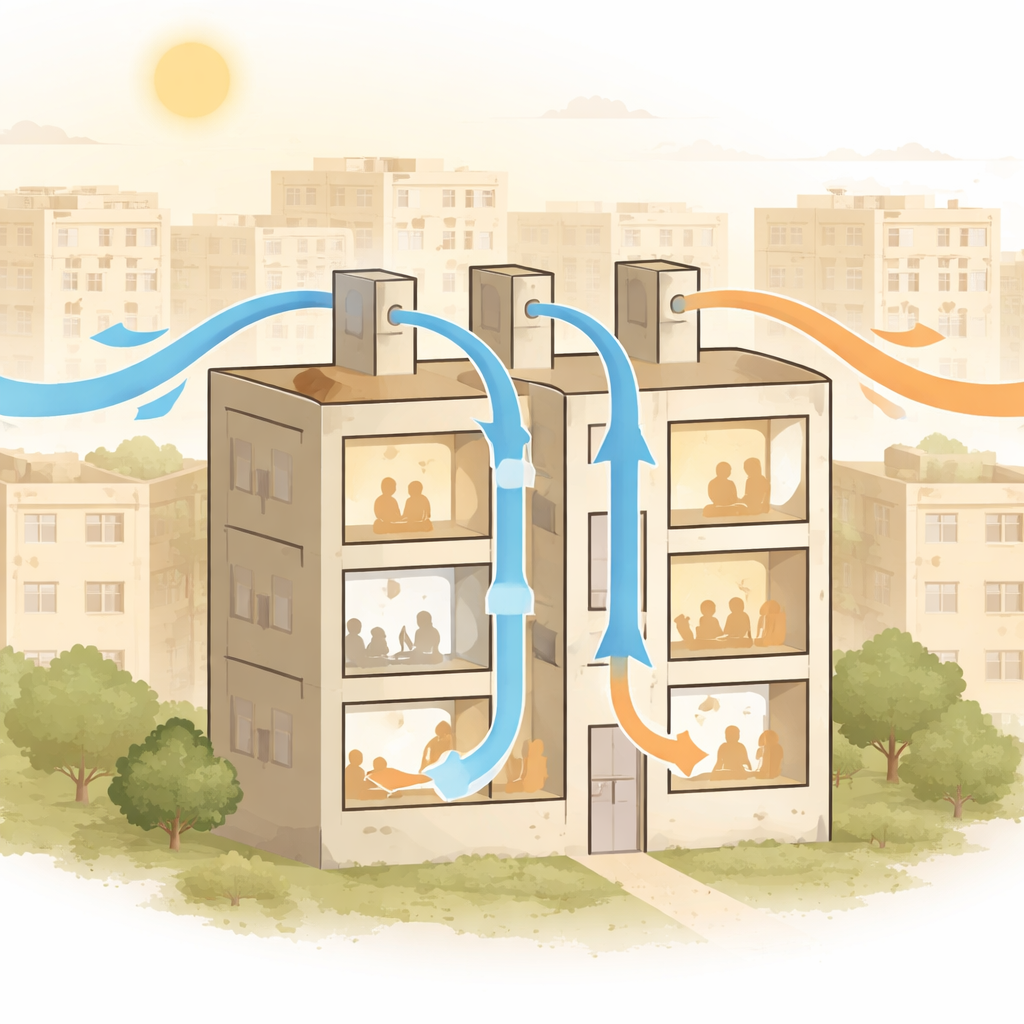
Windcatchers are tall rooftop shafts that scoop outdoor breezes and guide them down into rooms below. They have been used for centuries in hot, dry regions to cool homes naturally. At the same time, modern Egypt is rapidly expanding its social housing program to provide affordable apartments for people with low and middle incomes. These buildings are often simple concrete blocks that heat up quickly and depend heavily on air conditioners and fans. The authors asked whether adding windcatchers to these standard blocks could improve indoor air quality and comfort, while also cutting energy use and helping the country meet its climate and public-health goals.
Testing Airflow in Real Apartments
The research team selected a typical Egyptian social housing building with several identical floors and no built-in windcatchers. They measured actual air speeds in the rooms using handheld instruments, then built detailed 3D computer models of two representative apartments: one facing northwest and one facing southwest. Using computational fluid dynamics—advanced airflow simulations commonly used in engineering—they tested how air would move through each apartment under local wind conditions. Crucially, they first checked that the computer results matched their on-site measurements, finding differences of less than about 6.5 percent, which gave confidence that the simulations could reliably predict how new designs would perform.
Where the Towers Go Matters Most
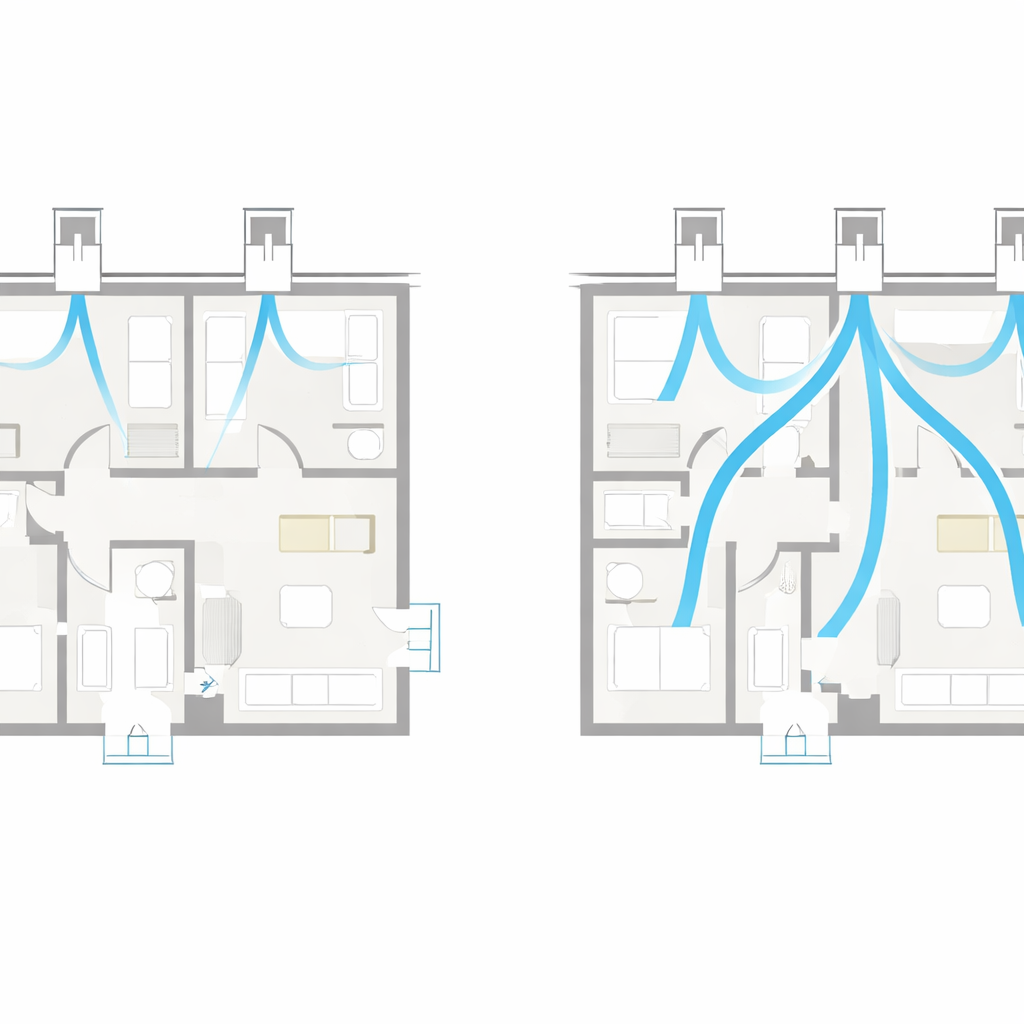
For each apartment, the team tried multiple layouts, changing both the number and positions of rooftop windcatchers. In the northwest-facing unit, three cases were tested: no windcatcher, one placed at a balcony, and one placed above a rear bedroom. Here, a single windcatcher carefully placed over the third bedroom worked best, increasing the overall natural ventilation rate by about 7 percent compared with having no windcatcher. This setup allowed fresh air to enter at the back and flow through to existing openings near the front, strengthening cross-ventilation without disrupting the main pressure differences that drive the breeze indoors.
Helping the Hardest-to-Cool Homes
The southwest-facing apartment started out in a worse position: its orientation produced much weaker natural airflow, so rooms were more stagnant. The researchers explored seven different combinations, from a single windcatcher in one room up to three windcatchers serving the living room and bedrooms. Adding just one tower already helped, but the biggest change came from distributing three windcatchers across the living room and key bedroom areas. In that configuration, the average ventilation rate improved by about 45.7 percent compared with the original design. Interestingly, a well-chosen pair of windcatchers—serving the living room and a rear bedroom—performed nearly as well as the three-tower setup, showing that smart placement can be almost as powerful as adding more devices.
Healthier, Cheaper, and More Sustainable Homes
To a non-specialist, the takeaway is straightforward: by thoughtfully placing a few simple rooftop shafts, these standard apartment blocks can become cooler, fresher, and healthier to live in, while using far less electricity for air conditioning. The study shows that windcatchers are most effective when they create clear paths for air to enter high-pressure sides of the building, sweep through main living spaces—especially the family living room—and exit at low-pressure points. The authors recommend weaving windcatchers into social housing designs from the start and even embedding them in building codes. Scaled up across thousands of units, this passive cooling approach could cut national energy use, reduce pollution and heat-related illness, and reconnect modern construction with a long-standing architectural tradition adapted to hot climates.
Citation: Abdelhady, M.I., Habba, M.I.A., Alsaber, M.A. et al. CFD and site analysis for optimizing indoor air quality in sustainable social housing via windcatcher integration. Sci Rep 16, 9684 (2026). https://doi.org/10.1038/s41598-026-39870-0
Keywords: windcatcher ventilation, passive cooling, indoor air quality, social housing, sustainable buildings