Clear Sky Science · en
Model predictive control with adaptive Kalman filter for premixed turbocharged natural gas engine
Keeping the Lights Steady When Demand Jumps
Modern cities and factories increasingly rely on natural gas engines to generate electricity, especially in local or backup power plants. But when people suddenly switch machines or appliances on or off, these engines feel that change as a sudden "yank" on the shaft. If the control system cannot react quickly and smoothly, the generator’s speed – and therefore the power grid’s frequency and voltage – will wobble. This paper explores a smarter way to keep a natural-gas generator running smoothly under such surprise load changes, improving both power quality and exhaust cleanliness.
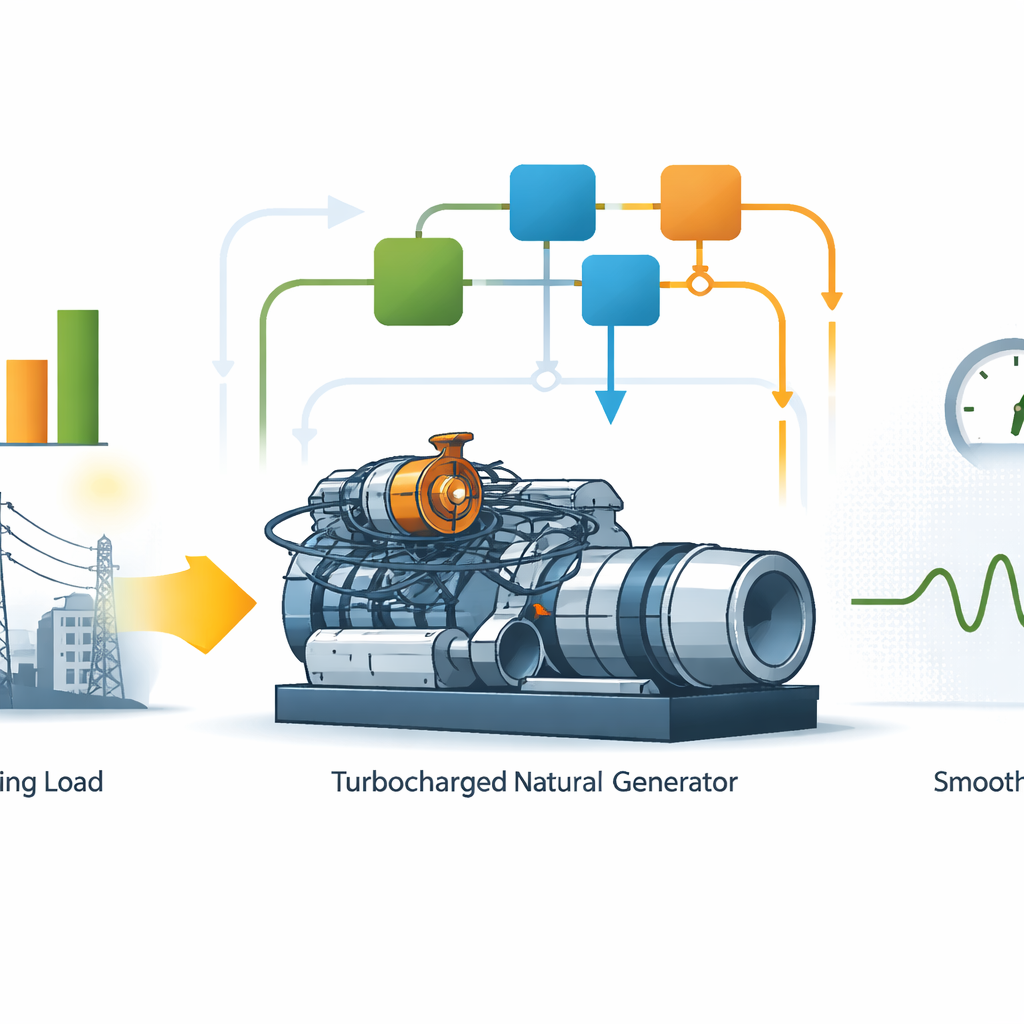
Why Natural Gas Generators Are Hard to Control
Large natural gas engines used in power plants often mix fuel and air before the turbocharger, a configuration that is cheaper and gives a more even mixture across many cylinders. However, because a single fuel and a single air control affect both engine speed and mixture quality at the same time, the system behaves like a tightly intertwined knot: changing one setting pulls on several outcomes at once. On top of that, gases must travel through long pipes and the turbocharger before reaching the cylinders, introducing delays that make the engine slow to show the full effect of any adjustment. All of this makes it difficult to hold both engine speed and air–fuel balance within tight limits when the electrical load on the generator suddenly changes.
A Predictive "Autopilot" for the Engine
To handle these complications, the authors build on a technique known as model predictive control, which can be thought of as an autopilot that uses a mathematical model of the engine to look a short time into the future. At every step, the controller computes how the two main throttles – one for the fuel–air mixture, one for the fuel – should move so that the engine speed and mixture stay on target while obeying limits on how fast the throttles can move. The paper reformulates this controller so that it works with changes in speed and mixture, instead of their absolute values. This trick helps the system automatically remove steady offsets caused by imperfect modeling, without adding extra complexity that could make implementation on a real engine controller difficult.
Listening Smarter: An Adaptive Noise-Aware Estimator
Knowing exactly how much torque the generator’s load is demanding at each moment is key to reacting quickly, but that quantity cannot be measured directly. Instead, the authors design a compact estimator based on a Kalman filter, a mathematical tool that fuses noisy measurements into a best-guess estimate. Rather than tracking all engine details, they reduce the problem to just engine speed and unknown load torque, yielding a simple second-order model that can run very fast. They then add a clever adaptation mechanism: when the filter detects that the engine speed is changing in a way that reveals a new load, it temporarily becomes more “agile,” giving more weight to rapid changes. Once things settle, it dials back its sensitivity to avoid being fooled by small random fluctuations in sensor readings.
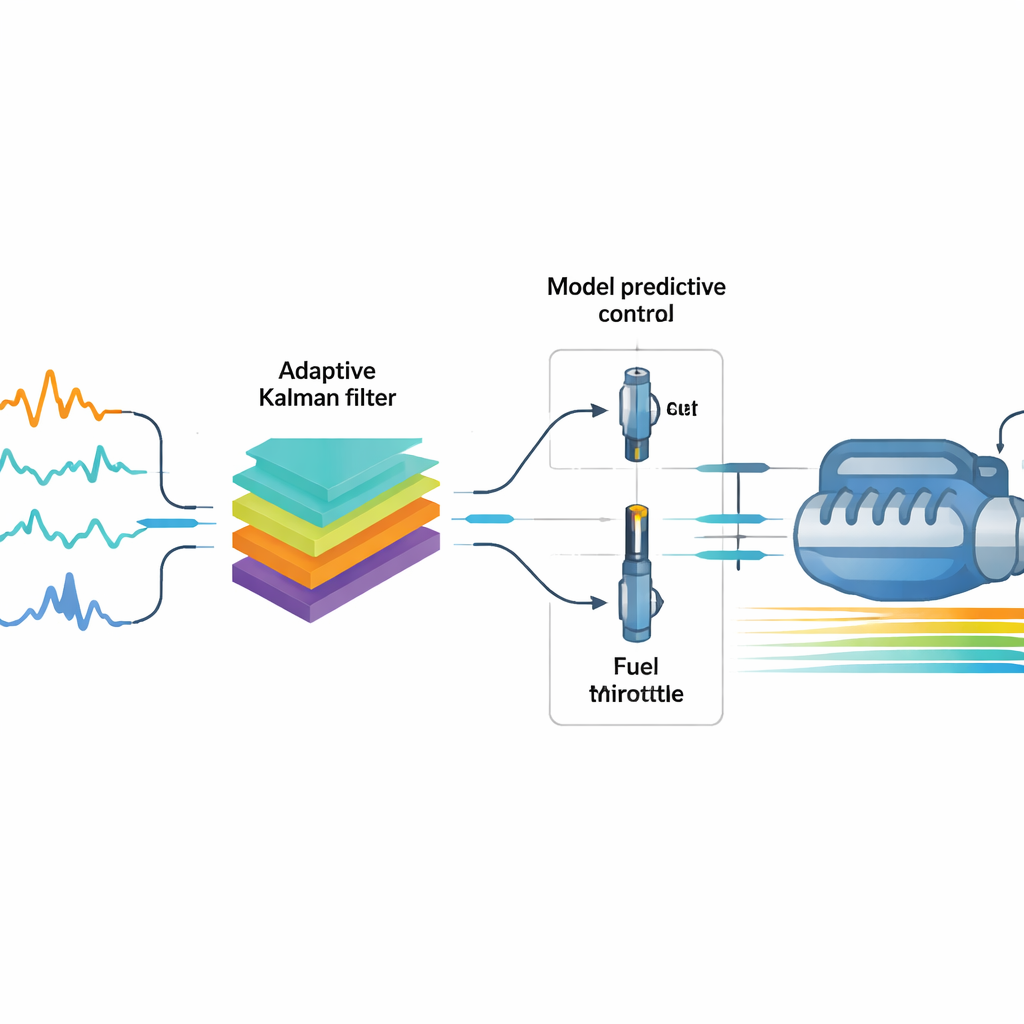
Adjusting Control Strength as the Load Shifts
The estimated load torque does more than simply inform the controller that “something changed.” It is used to update the engine’s local operating point and to compute a small adjustment matrix that reshapes how the predictive controller’s output acts on the real engine. Instead of storing a full set of different controllers for every possible load, the method keeps a single base controller designed for a nominal point – for example, 1500 revolutions per minute at a standard mixture and no load. When the load shifts, the engine’s behavior changes, but the adjustment matrix compensates for this shift so that the base controller still works well. At the same time, the steady throttle positions are “pre-shifted” according to the new load estimate, so the predictive part only has to fine-tune around the right starting point.
What the Experiments Show on a Real Engine
The team tests their approach on a full-scale natural-gas generator rated at 155 kilowatts. They compare three internal estimators – a slow but quiet filter, a fast but noisy one, and their adaptive version – and then compare three complete control strategies: a traditional pair of tuned PI controllers, a predictive controller without adaptation, and the new adaptive predictive scheme. The adaptive filter is able to detect and track step changes in load torque within a few tenths of a second, yet keeps its estimate nearly noise-free when the system is steady. When hooked into the predictive controller and gain-scheduling scheme, this leads to much smaller speed swings and quicker recovery after load steps, while also keeping the air–fuel ratio close to its ideal value.
Why This Matters for Reliable and Cleaner Power
In simple terms, the article shows how a generator can “feel” sudden changes in electrical demand more quickly and respond more intelligently, thanks to a compact and adaptive estimation method paired with a predictive controller that can adjust its behavior on the fly. The proposed setup reduces how far and how long engine speed and mixture stray from their targets when the load changes, which helps keep the delivered power within required frequency limits and the exhaust within emission standards. Because most of the heavy calculations are done in advance and the online algorithms are lightweight, the method is practical for the embedded computers found in real power-generation engines, offering a clear path toward more reliable and environmentally friendly natural-gas power units.
Citation: Xiong, W., Gong, Q., Huang, S. et al. Model predictive control with adaptive Kalman filter for premixed turbocharged natural gas engine. Sci Rep 16, 9102 (2026). https://doi.org/10.1038/s41598-026-39850-4
Keywords: natural gas engine control, model predictive control, adaptive Kalman filter, generator load disturbance, air fuel ratio stability