Clear Sky Science · en
Low-power optical tweezers using large-diameter Gaussian and vortex beams for giant bubble trapping and rotation in fluorescent dye media
Light That Gently Grabs Giant Bubbles
Imagine being able to grab and spin a bubble in a glass of colored water without touching it at all—only using a faint beam of light. This study shows how physicists can trap and rotate unusually large bubbles in a glowing dye solution using very low-power lasers. The work points toward energy‑efficient ways to steer bubbles and tiny objects in liquids, which could one day help in micro‑scale chemistry, medical diagnostics, and lab‑on‑a‑chip devices.
From Optical Tweezers to Bubble Control
For decades, "optical tweezers" have used tightly focused laser beams to hold and move microscopic objects, from plastic beads to living cells. Traditional setups, however, normally work with small spots of light only a few micrometers across and often require higher powers, making them less ideal for sensitive samples or large structures. Bubbles are especially tricky: they contain gas, bend light differently from water, and tend to be pushed away by simple light forces. Yet bubbles are valuable tools because they link light, heat, and fluid motion, and can act like tiny pumps or handles inside microfluidic devices.
Making Big Bubbles With Gentle Light
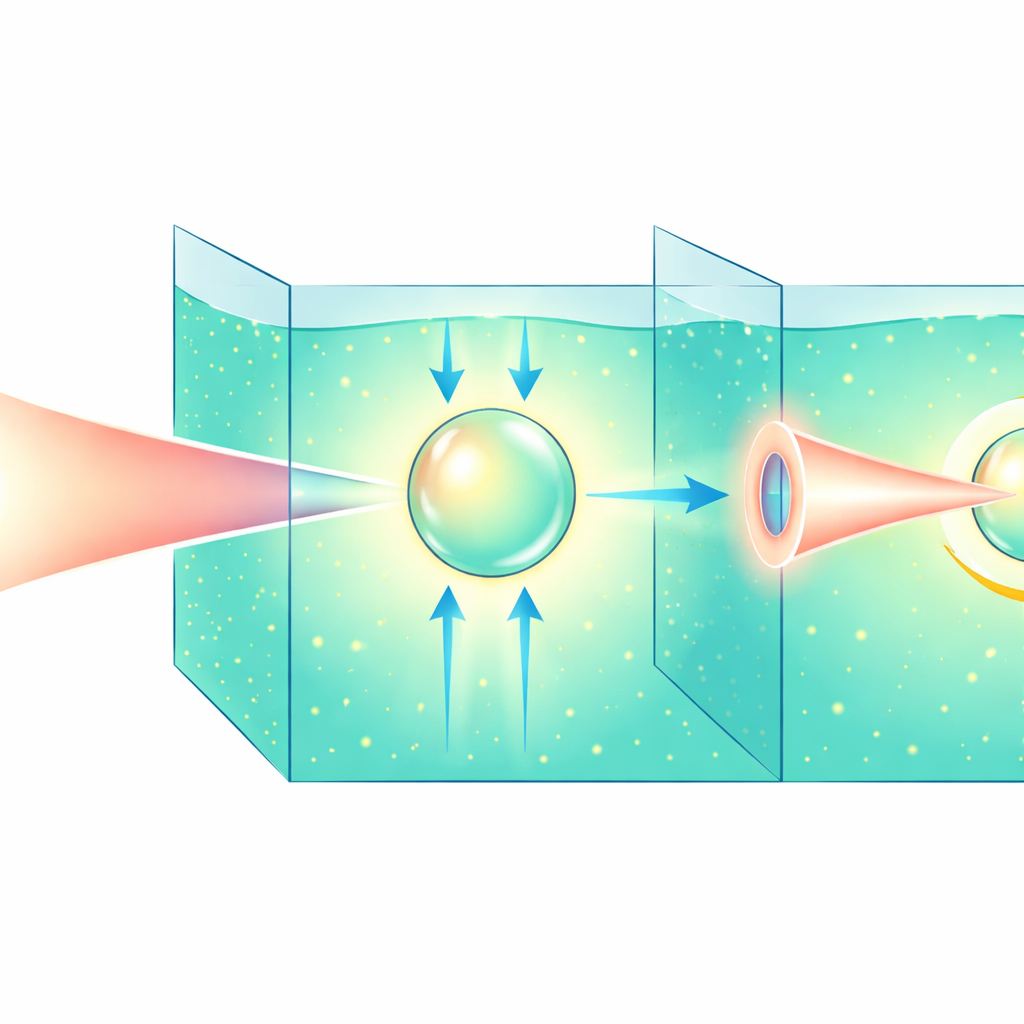
The researchers filled a thin sample cell with distilled water containing a fluorescent dye that strongly absorbs near‑infrared light. When a 785‑nanometer laser beam illuminated the dye, the dye molecules heated the surrounding liquid. This local heating caused water to boil or become superheated, forming vapor bubbles that glowed with the dye’s fluorescence. Unlike most optical tweezers, the team deliberately used very wide beams—hundreds of micrometers across—so that the bubbles could grow to sizes comparable to the beam itself, reaching more than one‑tenth of a millimeter in diameter while still being controlled by only a few milliwatts of power.
How Heat Turns Light Into a Bubble Trap
At first glance, light should push these bubbles out of the beam rather than hold them in place, because gas has a lower refractive index than water. The key lies in heat‑driven surface forces instead of simple pushing by photons. As the dye absorbs light, it sets up a temperature gradient around the bubble: hotter near the beam center, cooler farther away. Surface tension on the bubble depends on temperature, so these gradients create so‑called Marangoni flows—tiny currents along the bubble surface and in the surrounding liquid. These flows pull the bubble toward the hottest region, effectively pinning it to the laser focus. Measurements show that this thermally driven force clearly wins over the usual optical force that would otherwise expel the bubble.
Shaping Light to Move and Spin Bubbles
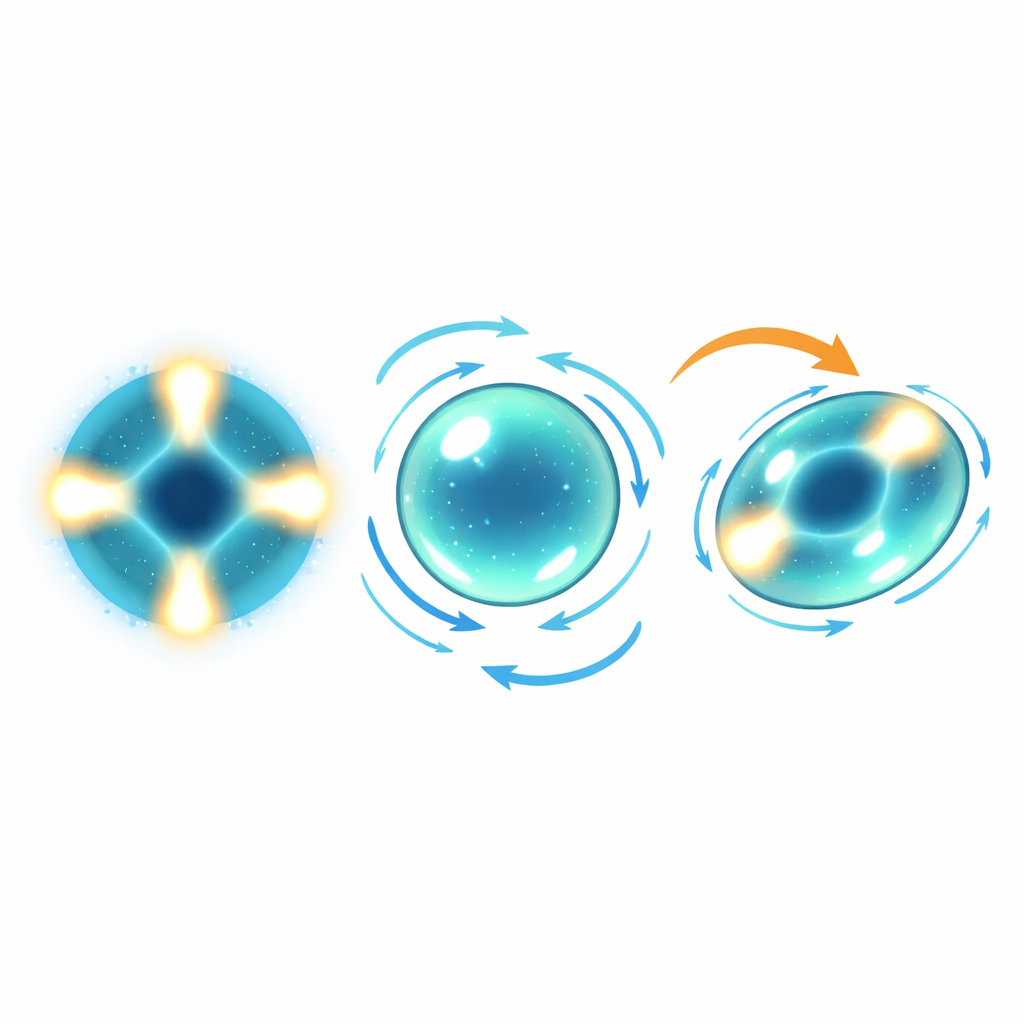
The team compared two kinds of beams. A normal Gaussian beam focuses light into a bright spot, while a vortex beam forms a doughnut‑shaped ring and carries orbital angular momentum, often described as a twist in the wavefront of light. Even with the large beam diameters, both types could trap and drag bubbles sideways across the field of view. Remarkably, the vortex beam did so with even lower power than the Gaussian beam, thanks to its ring‑like intensity pattern that sharpens temperature differences at the bubble edge. By carefully calibrating the motion of a translation stage, the researchers demonstrated that bubbles remained stably trapped as the surrounding reference point moved, confirming robust control over bubbles as large as about 120 micrometers.
Using Polarization as a Bubble Steering Wheel
To go beyond simple trapping, the experimenters added a second polarizer to reshape the vortex beam. This produced a cross‑shaped pattern of bright and dark regions inside the doughnut of light. When they rotated the polarizer, the bright cross rotated as well. Because the heating followed this pattern, the temperature around the bubble became uneven in angle, generating surface flows that exerted a torque. As a result, the trapped bubble rotated in sync with the turning light pattern, and its spin speed depended directly on how fast the polarizer was turned. The team showed both clockwise and counterclockwise rotation of bubbles roughly 176 micrometers across, with attached dye particles acting as visible markers.
Why This Matters for Future Tiny Machines
By showing that large bubbles can be trapped, translated, and even spun using low‑power, wide laser beams, this work expands what optical tweezers can do while using less energy and simpler optics. Instead of relying on intense, tightly focused spots, researchers can now think in terms of gentle, extended light fields that sculpt temperature and flow. Such control over bubble motion could become a valuable ingredient in microfluidic circuits, bubble‑driven microrobots, and controlled chemical reactions that depend on cavitation. In simple terms, the study turns soft, glowing bubbles into precise, light‑driven tools inside tiny liquid worlds.
Citation: Buathong, S., Phetdeang, C., Srisuphaphon, S. et al. Low-power optical tweezers using large-diameter Gaussian and vortex beams for giant bubble trapping and rotation in fluorescent dye media. Sci Rep 16, 8781 (2026). https://doi.org/10.1038/s41598-026-39847-z
Keywords: optical tweezers, microbubbles, optothermal manipulation, vortex beams, microfluidics