Clear Sky Science · en
Integrative transcriptomic and machine learning framework reveals candidate genes and potential mechanisms of aflatoxin B1 exposure in breast cancer
Why a food mold matters for breast health
Aflatoxin B1 is a toxin made by certain molds that can grow on common foods like corn and peanuts, especially in warm, humid regions. It is well known for damaging the liver, but scientists are increasingly worried that it may also influence breast cancer. This study asks a simple yet crucial question: if women regularly eat low levels of this toxin, could it subtly change their breast tissue in ways that raise cancer risk—and can we detect those changes early using modern genetic and data-science tools?
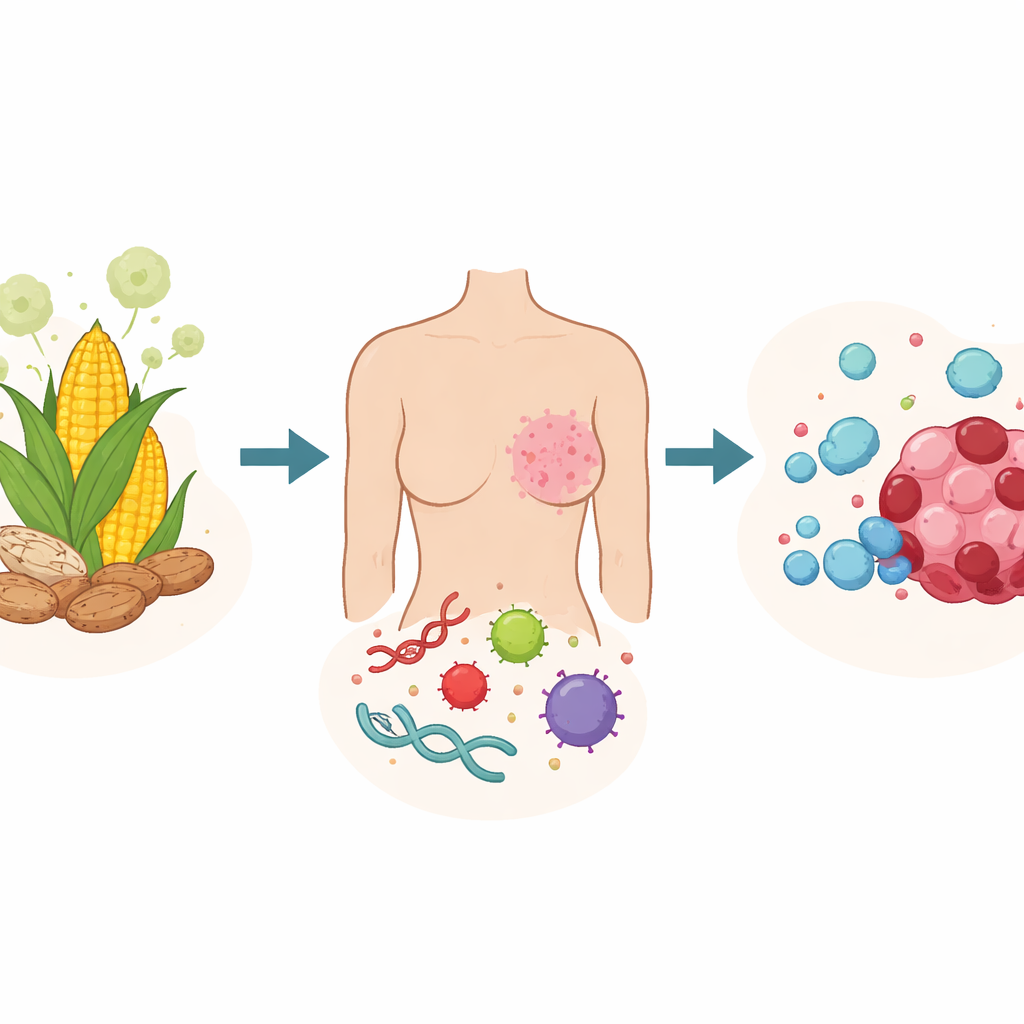
Connecting a hidden toxin to breast tumors
The researchers began by assembling a large collection of existing genetic data from breast tumors and healthy breast tissue. They combined several public datasets and carefully corrected for technical differences so that all samples could be compared fairly. In parallel, they used chemical databases to predict which proteins in the human body aflatoxin B1 is most likely to interact with. By overlapping the toxin’s predicted targets with genes that behave differently in breast cancer, they narrowed thousands of possibilities down to a small list of genes that sit at the crossroads between aflatoxin exposure and tumor biology.
Finding a seven-gene warning panel
To turn this biological insight into something clinically useful, the team applied a wide range of machine learning methods. These algorithms sifted through the intersection genes to see which combination best separates breast cancer samples from non-cancerous breast tissue. After testing 127 model variations, they arrived at a streamlined panel of seven genes. Together, these genes allowed their best model to distinguish cancer from non-cancer with extremely high accuracy. Some of the genes, such as EGFR and MET, are well-known players in cancer growth, while others—like PPARG, MME, NQO2, and NR3C2—are more closely tied to hormone balance, detoxification, and inflammation.
How the immune system and tissue layout are involved
Beyond simple on–off switches, the study explores how these genes shape the local immune environment of breast tissue. Using computational tools that estimate which immune cells are present in bulk tissue samples, the authors found that certain supportive immune cells, particularly a type of activated macrophage, tend to be more abundant in tumors. Some of the seven genes, notably MME and NR3C2, were consistently linked to lower levels of these inflammatory cells, hinting that when these protective genes are dialed down, the tumor’s immune surroundings may become more permissive to cancer growth. Single-cell and spatial RNA technologies then added a microscopic map, showing where and in which cell types each gene is turned on within actual tumor sections.
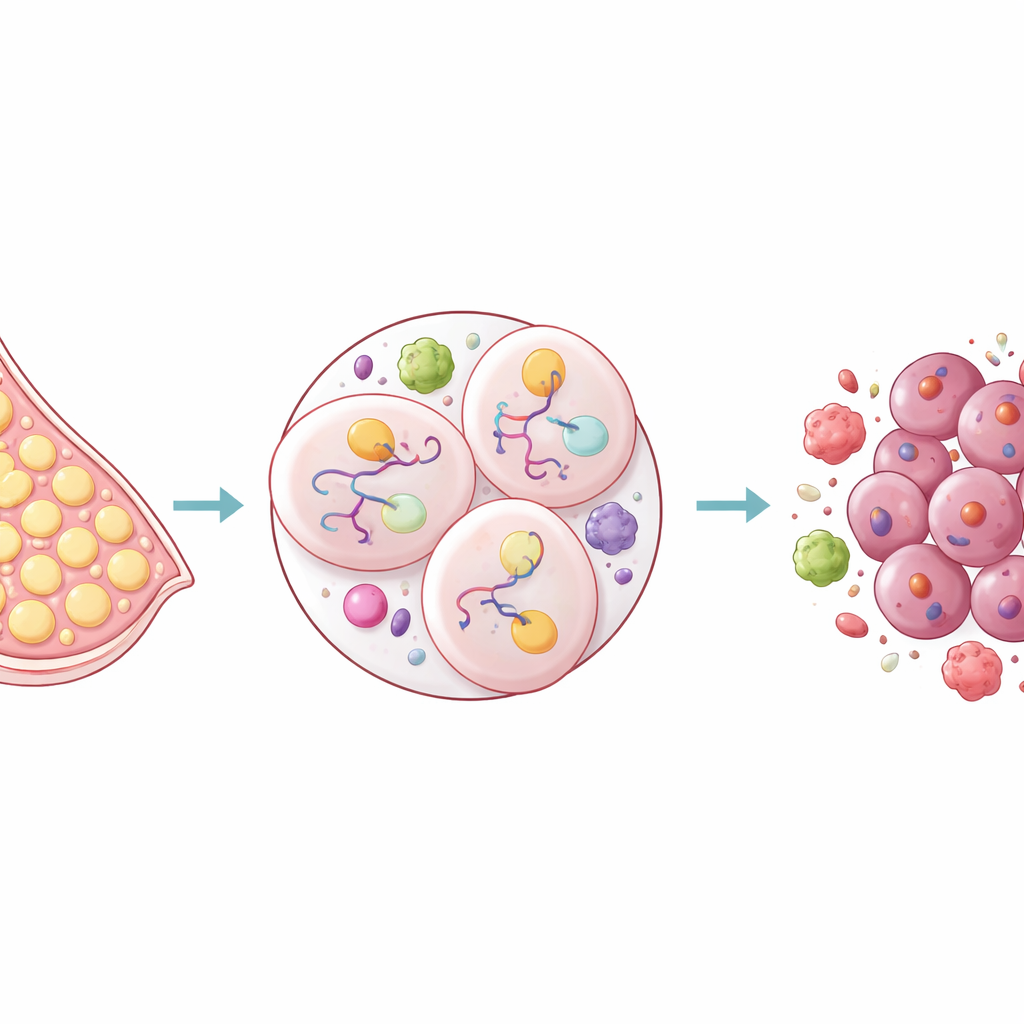
Zooming in on cells one by one
By examining thousands of individual cells from different breast cancer subtypes—such as hormone-sensitive, HER2-positive, and triple-negative tumors—the researchers could track how gene activity changes along a rough “timeline” of tumor progression. Several of the protective genes were most active in earlier cellular states and faded as cells moved toward more aggressive profiles. One gene, MIF, showed the opposite pattern, becoming more prominent in macrophages and tumor cells in regions dense with immune activity, consistent with a role in driving inflammation and immune evasion. These patterns were mirrored in spatial maps of tumor slices, where high expression of certain genes clustered in tumor-rich or immune-rich zones, highlighting an intricate dialogue between cancer cells, immune cells, and their surroundings.
What this means for patients and food safety
In plain terms, this work suggests that aflatoxin B1 may nudge breast tissue toward cancer by disturbing a small but influential group of genes that control growth signals, detoxification, and the local immune climate. The same seven genes that mark this disturbance also form a powerful diagnostic signature that, after further testing in larger and more diverse groups of patients, could help doctors detect breast cancer earlier and better understand individual risk. While the study does not prove that everyday aflatoxin exposure directly causes breast cancer, it strengthens the case for stricter control of food contamination and offers a new genetic toolkit for probing how environmental pollutants quietly shape cancer risk.
Citation: Wang, W., Liu, M. & Li, X. Integrative transcriptomic and machine learning framework reveals candidate genes and potential mechanisms of aflatoxin B1 exposure in breast cancer. Sci Rep 16, 8818 (2026). https://doi.org/10.1038/s41598-026-39844-2
Keywords: aflatoxin B1, breast cancer, environmental carcinogens, multi-omics, cancer biomarkers