Clear Sky Science · en
Climate-driven Avicennia germinans expansion reduces marsh edge erosion in coastal Louisiana (USA)
Why coastal roots matter to all of us
Along the low, flat coast of Louisiana, land is disappearing into the sea at an alarming pace. Much of this loss happens where marshes meet open water, as waves slowly bite into the soft shoreline. This study asks a deceptively simple question with big implications for coastal communities: as warmer winters allow tropical black mangroves to move north and replace native marsh grasses, will these new shrubs help hold the shoreline together—or make things worse?
Two plant neighbors on a sinking coast
In southern Louisiana, the shoreline is a patchwork of traditional salt marsh dominated by a grass called Spartina and expanding stands of black mangrove shrubs (Avicennia). The region is already under pressure from sinking land, rising seas, and storms. Here, waves can chew several meters of marsh away each year, and this “edge erosion” accounts for roughly half of all marsh loss. Because mangroves have woody stems and thick root systems, scientists suspected that they might change how fast the shoreline crumbles, but no one had carefully measured this for the frequent, everyday wave conditions that do most of the damage.
Measuring how fast the edge retreats
To find out, the researchers combined nearly two decades of high-resolution satellite images with detailed field work near Port Fourchon, Louisiana. They compared sites dominated by grass, sites where mangroves and grass shared space, and sites densely covered by mangroves, under both sheltered and wave-exposed conditions. By tracking how far the marsh edge moved landward over time, and by estimating the amount of wave energy striking each shoreline, they could calculate not just how quickly the edge retreated, but also how easily the soil gave way when struck by waves. 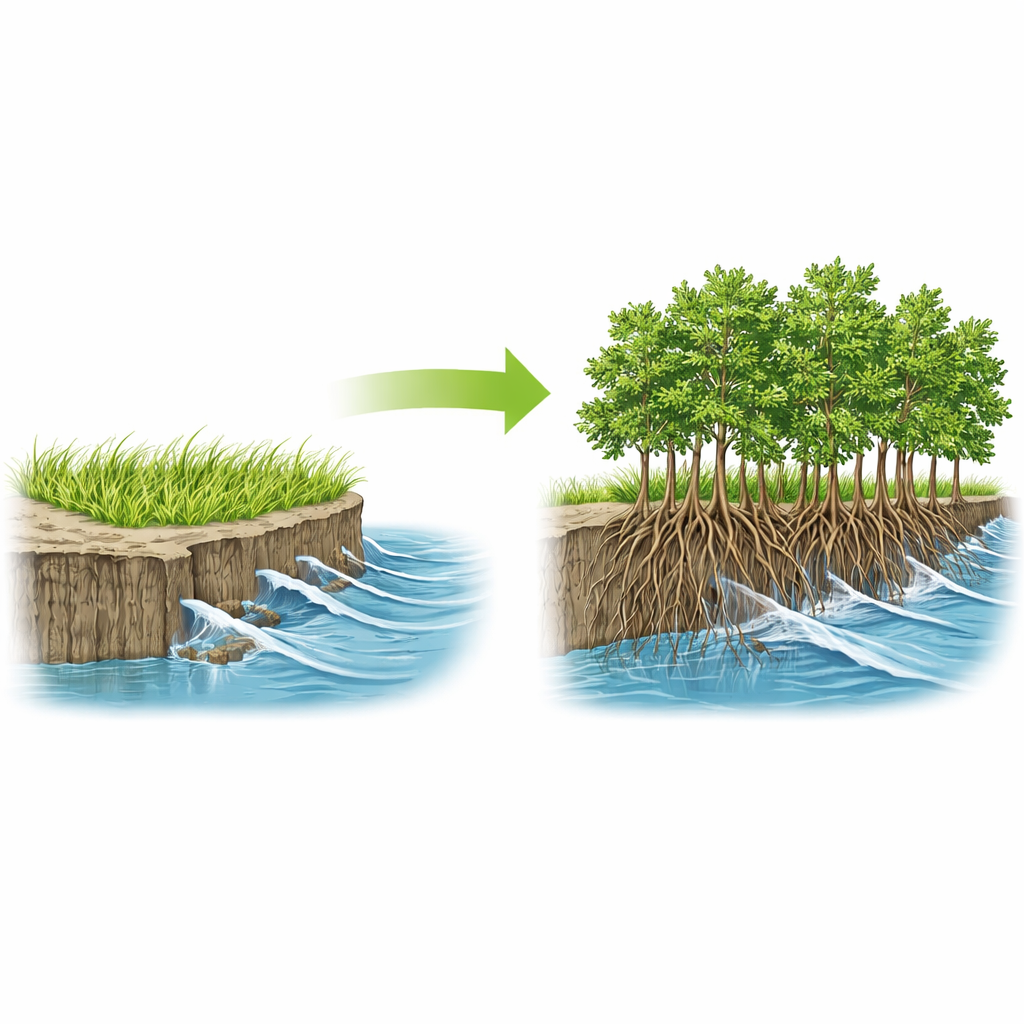
Hidden strength in deep roots
Below the surface, the differences were striking. In mangrove-dominated patches, the soil along the marsh edge had roughly twice the live root material as grass-dominated areas, and those roots extended much deeper—well beyond the 25-centimeter depth where waves typically undercut the bank. Tests showed that soils in dense mangrove stands were stronger and more resistant to being pulled apart, especially at these deeper layers. Individual mangrove roots themselves were tougher than grass roots at depth, likely because they are woodier and less hollow. Bulk density of the soil was also higher in mangrove zones, but the tight link between root mass and soil strength suggested that the living root network was doing most of the work in binding the shoreline together.
When more mangroves really help
The payoff at the surface was clear. Where mangroves formed dense stands, annual edge erosion was 40–60 percent lower than in nearby grass-only marshes facing similar wave energy. In contrast, areas with only a sparse sprinkling of mangroves eroded at about the same rate as pure grass marshes. That means scattered shrubs are not enough; mangroves must be well established—covering more than half the area and having had years to grow their deep root systems—before they significantly slow the waves’ bite on the edge. The benefits also extended inland: in dense mangrove stands, soil strength in the marsh interior looked similar to that at the edge, so as the shoreline retreats, the land that becomes the new edge is already better prepared to resist erosion. 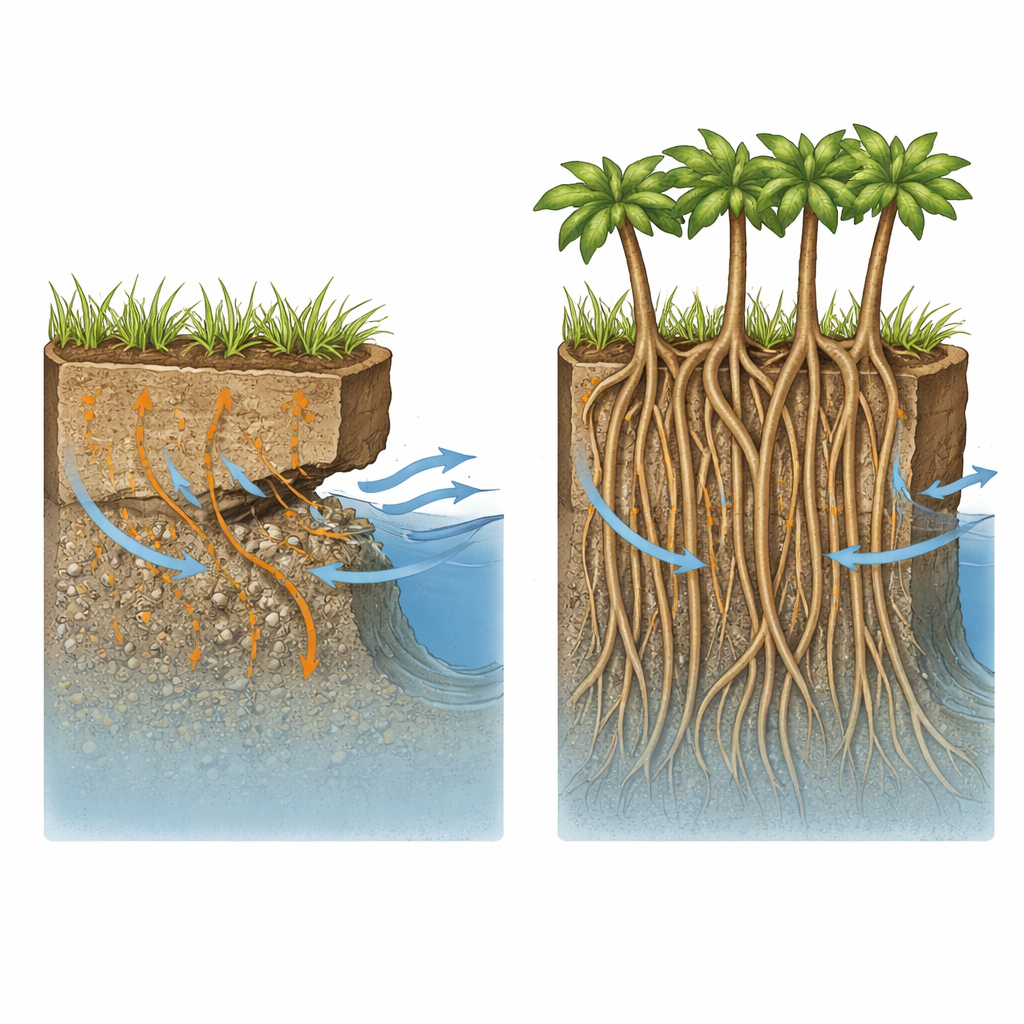
Planning with future shorelines in mind
Because hard winter freezes that kill mangroves are becoming less frequent, models suggest that black mangroves could largely replace grass marshes along parts of the U.S. Gulf Coast. This study indicates that such a shift will not stop coastal land loss altogether, but it could meaningfully slow it. For Louisiana alone, the authors estimate that climate-driven mangrove expansion might prevent several square kilometers of wetland loss per year, especially if mangroves take hold farther north. They also note that managers can harness this effect by planting mangroves inland from today’s edge, giving them 5–10 years—or even a few decades—to mature and grow deep roots before that line of plants eventually faces open water.
A slower crumble, not a complete fix
For non-specialists worried about vanishing coasts, the message is nuanced but hopeful. Black mangroves are not a magic shield against rising seas or stronger storms, and they cannot replace the need for sediment supply, thoughtful development, and large-scale restoration. However, when they form dense, mature stands, their deep, tough roots can knit marsh soils together and cut everyday wave-driven erosion nearly in half. In a landscape where every meter of shoreline matters, this added “root armor” from an expanding tropical neighbor could buy valuable time for Louisiana’s embattled wetlands and the people who depend on them.
Citation: Rabalais, M., Elmer, E., Quirk, T.E. et al. Climate-driven Avicennia germinans expansion reduces marsh edge erosion in coastal Louisiana (USA). Sci Rep 16, 9521 (2026). https://doi.org/10.1038/s41598-026-39843-3
Keywords: coastal erosion, mangroves, salt marshes, climate change, wetland restoration