Clear Sky Science · en
Federated microservices architecture with blockchain for privacy-preserving and scalable healthcare analytics
Why your health data needs smarter protection
Every visit to a clinic, every blood test, and every reading from a smartwatch adds to a growing mountain of health data. That information could help doctors spot diseases earlier and tailor treatments, but it is scattered across hospitals and devices and guarded by strict privacy rules. This paper explores a new way to tap into that data’s power without letting it leak, by combining three modern ideas from computing into one practical blueprint for hospitals.
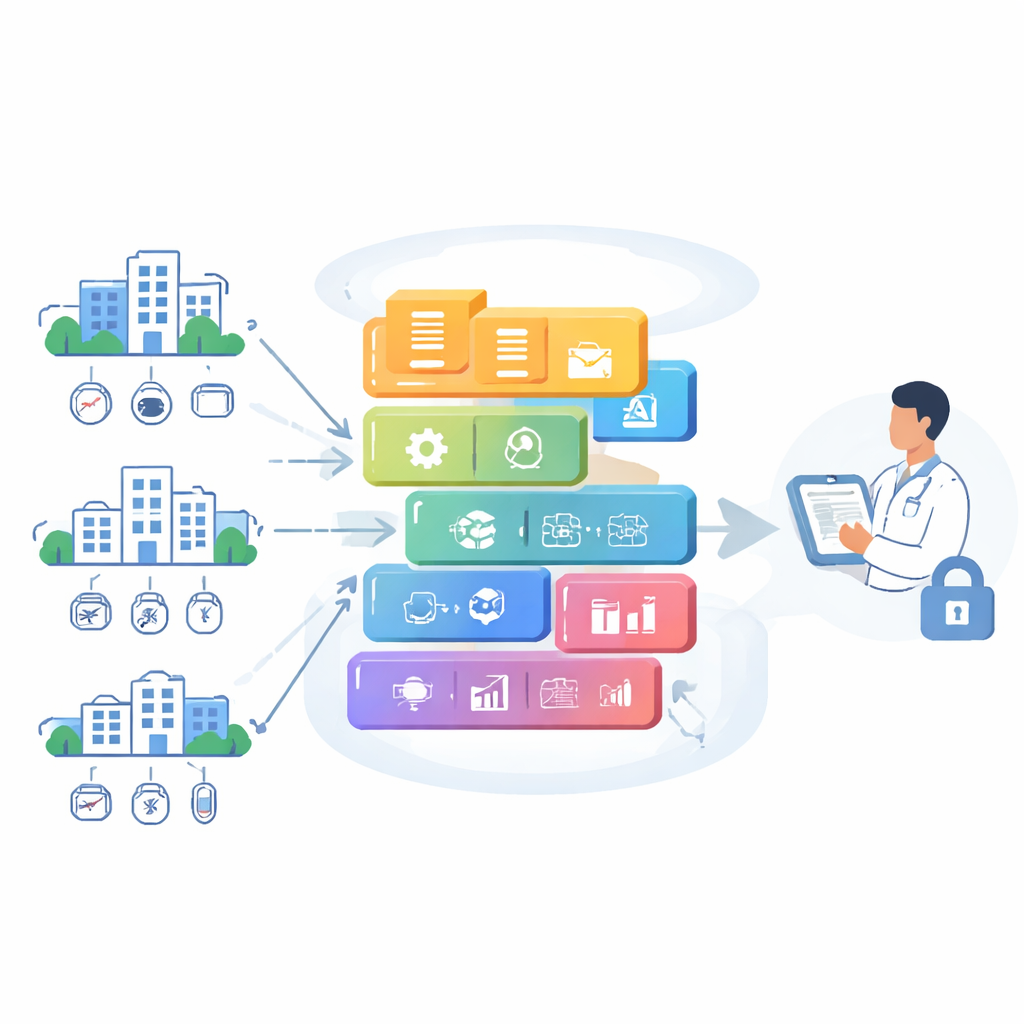
Breaking the hospital computer into smaller building blocks
Most hospitals still rely on large, all-in-one software systems that handle everything from storing records to running prediction tools. These “one big box” designs are hard to scale, slow to update, and risky if something breaks or is hacked. The authors instead slice the system into many small, focused services that each do a single job, such as cleaning incoming data, running a prediction model, or serving a web dashboard. These services run in containers and are managed by an orchestration platform that can start, stop, or duplicate them on demand. This lets the system grow smoothly as more patients and clinics join, and it isolates problems so that a failure in one part does not bring down the whole network.
Training shared prediction models without sharing raw data
A major challenge in medicine is that each hospital holds only a partial view of the population, and simply pooling everyone’s records into one giant database breaks many privacy rules. The paper uses federated learning to work around this. In this setup, the predictive model travels to each hospital, learns from local records, and sends back only math-based updates rather than names, lab values, or notes. A central coordinator blends these updates into a stronger global model and sends it back out again for the next round. Extra safeguards, such as adding carefully tuned noise and encrypting the updates, make it very hard for an attacker to reverse-engineer individual patient details from these messages.
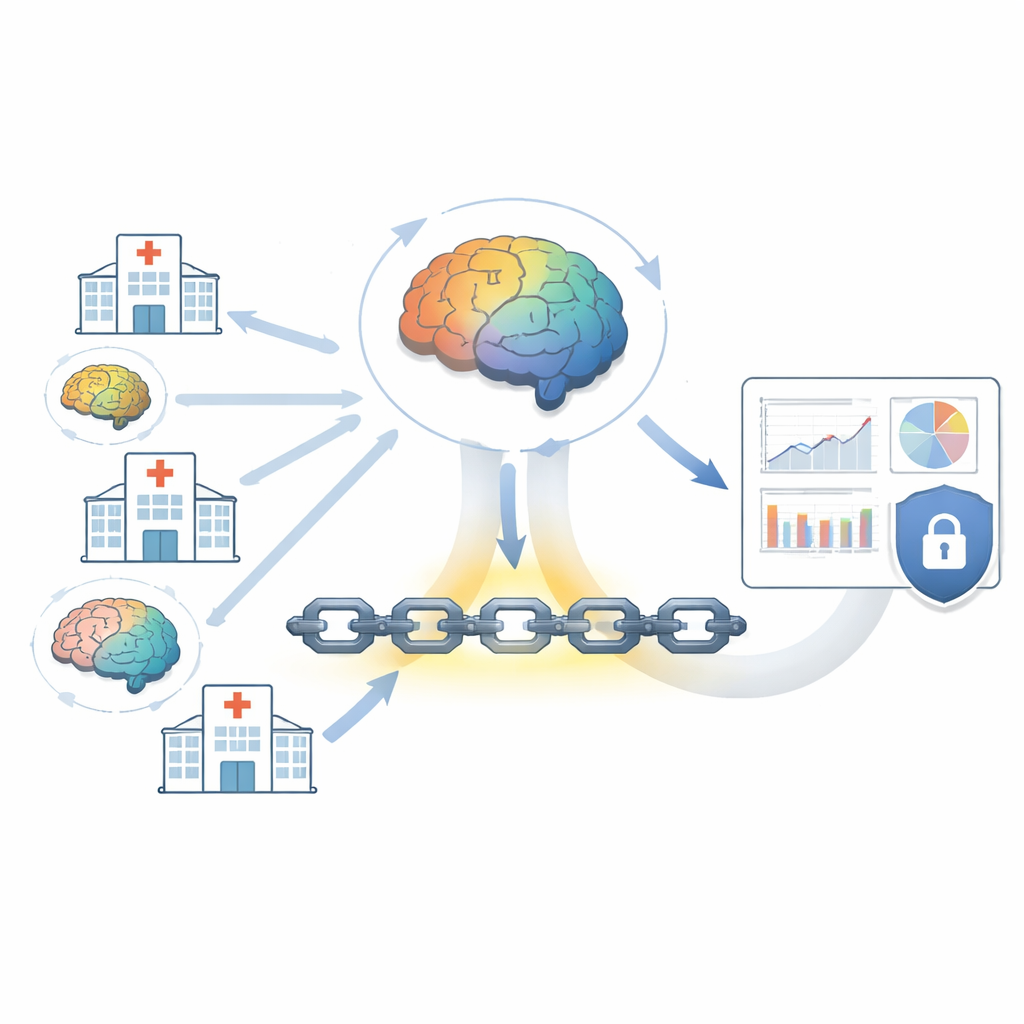
Locking the trail of actions on a tamper-proof ledger
Modern privacy laws not only care about who sees data but also about proving what happened when. To address this, the framework records important events—like when a model is updated or when a prediction is made—on a permissioned blockchain. This is a shared digital ledger that only approved parties can write to, and once an entry is added it cannot be silently changed. Smart control rules on this ledger check that incoming model updates are valid and that access rules are followed. If someone tries to slip in a fake update or replay an old one, the mismatch is detected and blocked, providing a strong audit trail for regulators and hospital compliance teams.
Putting the system to the test with real and simulated patients
To see whether this design is more than just theory, the authors built a full working system and tested it on two kinds of data. One was a large set of computer-generated patient records meant to mimic real hospital traffic; the other was a real-world collection of records from people treated for diabetes across more than a hundred U.S. hospitals. Their goal was to predict who would develop Type 2 diabetes within six months. The combined setup reached about 95 percent accuracy, outperforming both a traditional centralized model trained on pooled data and separate models trained in isolation at each hospital. At the same time, the microservices layout cut response times nearly in half and made the system recover from failures about ten times faster than an older, monolithic design.
What this could mean for future care
Taken together, the results suggest that hospitals do not have to choose between powerful analytics and strong privacy. By splitting software into modular pieces, letting models learn where the data live, and recording every important step on a tamper-resistant ledger, the proposed approach delivers faster predictions, better accuracy, fewer system outages, and no successful data breaches in simulated attacks. For patients, that could translate into earlier warnings for conditions like diabetes without their personal records ever leaving their home institutions. For health systems, it offers a roadmap toward smarter, more trustworthy digital tools that can grow across regions and countries while still respecting strict privacy and safety rules.
Citation: Harshith, M., Ansari, Z.A., Fatima, S. et al. Federated microservices architecture with blockchain for privacy-preserving and scalable healthcare analytics. Sci Rep 16, 9023 (2026). https://doi.org/10.1038/s41598-026-39837-1
Keywords: healthcare analytics, federated learning, microservices, blockchain, patient privacy